
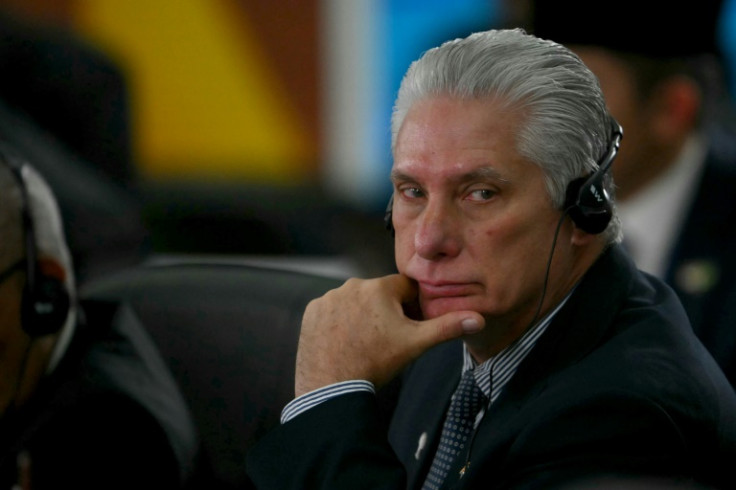
Cuban President Miguel Diaz-Canel said Havana is not holding talks with the U.S. except on some migratory issues, an apparent response to a comment from President Donald Trump's about the two countries having conversations.
In a social media publication, Diaz-Canel said the country has always "been willing to hold serious and responsible talks with the different U.S. governments, including the current one, on the basis of sovereign equality, mutual respect, principles of International Law, reciprocal benefit and without meddling in internal affairs."
No existen conversaciones con el gobierno de EE.UU, salvo contactos técnicos en el ámbito migratorio.
— Miguel Díaz-Canel Bermúdez (@DiazCanelB) January 12, 2026
1/6
"As history has shown, for relations between the U.S. and Cuba to move forward, they must be based on International Law rather than hostility, threats and economic coercion," he added.
The comments appear to be a response to a remark by Trump, who said during the weekend that the U.S. was "talking to Cuba."
Trump also said during the weekend that Venezuela would stop sending oil to the country after the capture of authoritarian President Nicolas Maduro and urged Havana to reach a deal with his administration.
Diaz-Canel also responded on social media, saying that "those who hysterically drain against our nation do so sick with rage due to the people's sovereign decision to choose their political model."
"Those who blame the Revolution for the severe economic issues we are dealing with should shut up in shame. Because they know and recognize they are a result of draconian measures of extreme asphyxiation that U.S. exerts going back six decades and threatens to increase now," he added.
Quienes culpan a la Revolución de las severas carencias económicas que padecemos, deberían callar por vergüenza. Porque saben y lo reconocen, que son fruto de las draconianas medidas de asfixia extrema que EE.UU nos aplica hace seis décadas y amenaza con superar ahora.
— Miguel Díaz-Canel Bermúdez (@DiazCanelB) January 11, 2026
"Cuba is a free, independent and sovereign nation. No one tells us what to do. Cuba doesn't attack, it's attacked by the U.S. going back 66 years and it doesn't make threats, it gets ready, willing to defend the Homeland until the last drop of blood."
The comments also come in the context of the worst economic crisis the island is going through almost 70 years since the communist revolution, according to a recent report.
"I, who was born there, I, who lives there, and I'll tell you: It's never been as bad as it is now, because many factors have come together," economist Omar Everleny Perez told The New York Times.
According to a recent poll, over three in four Cubans intend to flee the country. The survey was conducted by the Social Rights Observatory during the summer and reported by the Wall Street Journal as part of a broader piece about the country's crumbling economy.
The same poll showed that seven in ten respondents go at least without a meal a day and nearly 90% live in extreme poverty. Moreover, for over 70% of Cubans their main concerns are the lack of food and constant blackouts.
Some 2.7 million people have already left Cuba since 2020, a quarter of the population. Hundreds of thousands have gone to the U.S., Havana-based demographer Juan Carlos Albizu-Campos told the outlet.


© 2025 Latin Times. All rights reserved. Do not reproduce without permission.


