
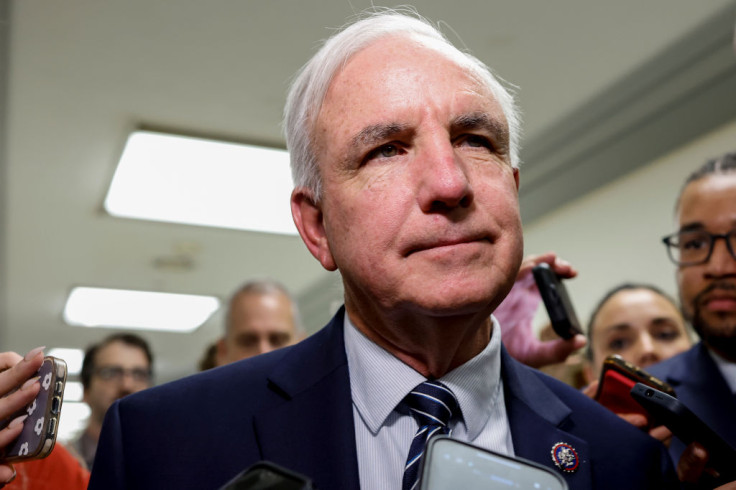
Republican Rep. Carlos Gimenez reiterated his support for land strikes in Venezuela to oust authoritarian President Nicolas Maduro.
Speaking to Bloomberg, he said that even though he knows that "the American people may not support something like that," he supports "strikes against the infrastructure that Nicolas Maduro has established in Venezuela, like I support strikes against Al-Qaeda or strikes against ISIS infrastructure in the Middle East."
Trump again discussed the possibility on Friday. Asked if he would seek authorization from Congress for any land attacks on cartels in the country, he said: "I wouldn't mind telling them. I don't have to tell them, it's been proven. But I wouldn't mind at all, I just hope they wouldn't leak it. They're politicians."
Q: Would you seek authorization for any land attacks on cartels in Venezuela?
— Aaron Rupar (@atrupar) December 18, 2025
TRUMP: I don't have to tell them. It's been proven. pic.twitter.com/lF8PwryiNq
Maduro, in turn, on Thursday called on the Colombian army to join forces with his country's counterparts.
In a televised address, Maduro said the "best guarantee we have for peace and stability in this world is unity." Therefore, he said, he was calling on the "Colombian people, its social movements, political forces, its military, to for a perfect union with Venezuela so no one dares to touch our sovereignty."
The call is similar to one made in November by Colombian President Gustavo Petro, who is also going through tensions with the Trump administration.
Concretely, he floated the idea of uniting several South American nations to revive Gran Colombia, the 19th-century republic that once encompassed modern-day Colombia, Venezuela, Ecuador and Panama, claiming that he United States' military campaign in the Caribbean and eastern Pacific is undermining regional sovereignty.
Despite Petro's repeated references to Gran Colombia, Interior Minister Armando Benedetti later told the Miami Herald that the president's comments were "symbolic."
Moreover, relations between Petro and Maduro are seemingly rocky at the moment, considering that the former called the latter a dictator for the first time this week.
In a social media post, Petro said Maduro is a dictator for concentrating power in Venezuela. Despite that characterization, the Colombian president defended Maduro by saying he is not a drug trafficker, arguing there is no evidence in Colombia linking him to organized crime, as the Trump administration claims.
"Maduro is a dictator for concentrating power," Petro wrote on X. "There is no evidence in Colombia that he is a narco. That is a narrative from the U.S."

© 2025 Latin Times. All rights reserved. Do not reproduce without permission.


