
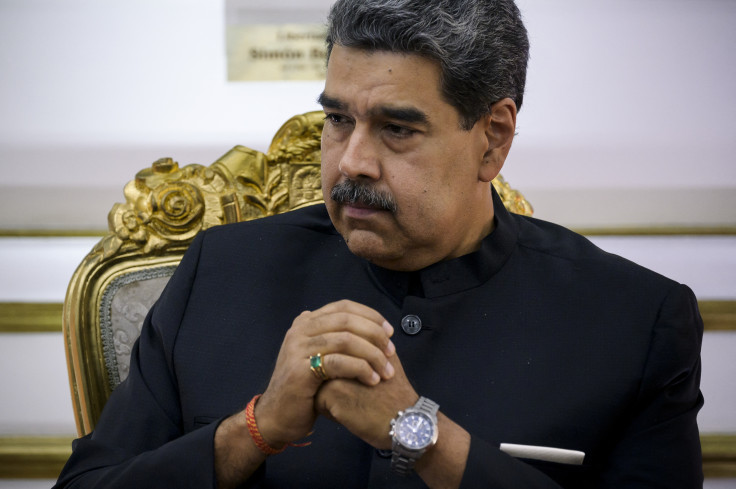
Venezuela's captured authoritarian President Nicolas Maduro could be eligible for the death penalty if convicted of narco-terrorism charges in the U.S., the New York Post noted.
The outlet detailed that Maduro and his wife, Cilia Flores, are facing four charges, and that under federal law, a defendant found guilty of violating the Controlled Substances Act "as part of a continuing criminal enterprise" could be sentenced to death.
However, it noted, death sentences for drug-related offenses are extremely uncommon. "Most capital offenses involve a homicide," the Post added, citing the Library of Congress.
NBC News also claimed on Monday that while Monday's hearing could be quick, the legal process could be much longer and they could stay at the Metropolitan Detention Center in Brooklyn for at least a year.
Another report said that some Trump officials decided to support the operation to capture Maduro after seeing public displays of defiance, which included dancing to a remix of him calling for no wars, according to a new report.
Some officials understood that Maduro was mocking the Trump administration and trying to call what he saw as a bluff, The New York Times reported, citing two people familiar with the matter.
One of the latest such episodes took place this week when Maduro refrained from addressing a U.S. strike on alleged cartel infrastructure, instead dancing to the remix.
During a recent appearance in Maracay, Aragua, Maduro resorted to his usual calls in English: "Victory forever, forever, forever. Not crazy war. Yes peace forever," Maduro said before the applauding crowd.
Then he proceeded to dance along with people next to him to a remix of a speech including those phrases. "I can't speak because the DJ plays the music. That music is for nightclubs. It's the number one song of the Venezuelan season. They haven't been able to take it down from the Billboard list," Maduro claimed.
Trump, in turn, decided to approve the capture after Maduro's repeated rejections of deals to leave power in exchange for amnesty, according to another report.
The Wall Street Journal noted that Secretary of State Marco Rubio was pushing for a harsher approach for months, but Trump held off, seeking to strike a deal first. "We're doing it my way," he told Rubio, according to the outlet.
However, Trump approved of the operation in late December after the repeated rejections and Rubio managing to convince the president that Maduro wouldn't relinquish power on his own.
Maduro was captured after Trump gave the green light to "Operation Absolute Resolve." Elite troops had trained for months to execute the operation, even using a replica of the presidential compound based on gathered intelligence.


© 2025 Latin Times. All rights reserved. Do not reproduce without permission.


