
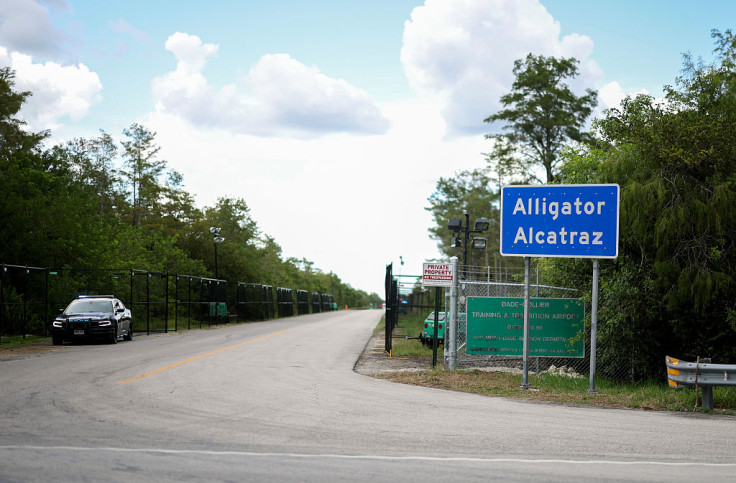
Ever since opening its doors in the summer, Alligator Alcatraz has faced resistance from the public, human rights organizations, migrant advocates and environmental groups.
Multiple reports of human rights violations and alleged abuses against migrants dominated headlines shortly after its opening, prompting a federal judge to order its closure in August, despite the federal government having signed more than $245 million in contracts to build and operate the facility.
But despite the judge's order calling for its closure, the facility has remained operational. That is why a group of activists continues to camp outside the gates of Alligator Alcatraz, aiming to raise awareness about alleged irregularities at the site and to support families of migrants who arrive at the center seeking information about the whereabouts of their loved ones.

As reported by the Miami Herald, a group of roughly half a dozen activists and protesters continues to camp outside the immigration detention center. Although a judge ordered the site to close, an appeals court ruling has allowed it to remain open, and attention on the facility has gradually faded, which protesters say is why they continue to demonstrate outside its gates.
"Everybody thinks it was shut down," Debbie Clark Wehking told the Miami Herald. "I hope that we can generate some more awareness."
Wehking, a 75-year-old retiree who now works at the Episcopal Church Center at the University of Miami, said that months into the protests, continued presence still matters, as it could put pressure on state and federal officials and ultimately force a shutdown.
Earlier this month, a new investigation by NBC6 revealed multiple irregularities inside Alligator Alcatraz since its opening on July 3.
Advertised by officials such as Florida Gov. Ron DeSantis and President Donald Trump as a site meant to house dangerous criminals with deportation orders, an NBC6 analysis found that only about one in four of the more than 6,700 people held at Alligator Alcatraz had a criminal conviction.
The majority of those detained also lacked a final order of removal. According to the data, only 31% of the more than 1,200 men held at Alligator Alcatraz in July had a final order of removal, a trend that continued through Oct. 15, the last date included in data ICE released to the University of California, Berkeley's Deportation Data Project, which obtained the records through a lawsuit against ICE.
Beyond raising awareness, protesters camping outside Alligator Alcatraz have also become a source of information for families who arrive at the detention center looking for their loved ones.
"They're not alone standing here on the side of the road. And I think that's the powerful thing we're doing," Nora Espinal, one of the protesters, told the Miami Herald. "We're making a community for them."

As noted by the outlet, the protesters are a diverse group that includes retirees, social media influencers and a teenager.
Randy Nazir, a 17-year-old high school student at Olympic Heights High School in Palm Beach County, said he became involved because he personally relates to the struggles of migrants.
Nazir's family moved from Guyana to the United States in 2006, which is why, with the help of his mother, he founded the organization Migrants Hope to connect families with legal services and resources.
"Being the son of an immigrant myself, I could envision my mom, my brother or my sister being taken into Alligator Alcatraz, and it just broke my heart for all the kids who are being left behind," he told the Miami Herald.
The Department of Homeland Security and the Florida Division of Emergency Management did not respond to the Herald's inquiry about whether the protesters have affected operations at the facility.
Although they cannot enter the facility or speak directly with those being held at Alligator Alcatraz, protesters say they want immigrants to know they are not alone.
"I'm hoping that some of what we're doing by trying to shine a light on what's happening will make a difference now," said Andrea Scherben, who has been raising awareness outside the facility since July. "But if it doesn't, it will at least create accountability in the future, and keep businesses from saying, 'I wasn't involved.'


© 2025 Latin Times. All rights reserved. Do not reproduce without permission.


