
The sharp expansion of U.S. military activity in the Caribbean since August has prompted analysts to assess how Venezuela could respond if Washington moves beyond pressure and toward direct military action against Nicolás Maduro's regime.
The deployment includes the arrival of the USS Gerald R. Ford, F-35 fighter jets operating out of Puerto Rico, expanded naval patrols, roughly 15,000 U.S. personnel in the region, and a declared blockade of Venezuelan oil tankers carrying sanctioned crude. While the Trump administration initially described the buildup as a counter-narcotics operation, analysts note that its scale exceeds what is typically required for drug interdiction.
Recent actions — including the seizure of a tanker carrying Venezuelan oil and public statements by President Donald Trump — have reinforced concerns that the military posture is designed to coerce the Maduro government rather than solely disrupt trafficking networks.
Assessments of Venezuela's ability to respond suggest that its armed forces would struggle in a conventional conflict, as specialized defense site War on the Rocks explains. Years of economic collapse, sanctions, and emigration have degraded readiness across the military. Venezuela fields roughly 123,000 active personnel, supported by reservists and a large Bolivarian militia, but many of its most advanced weapons systems suffer from maintenance problems and limited operational availability.
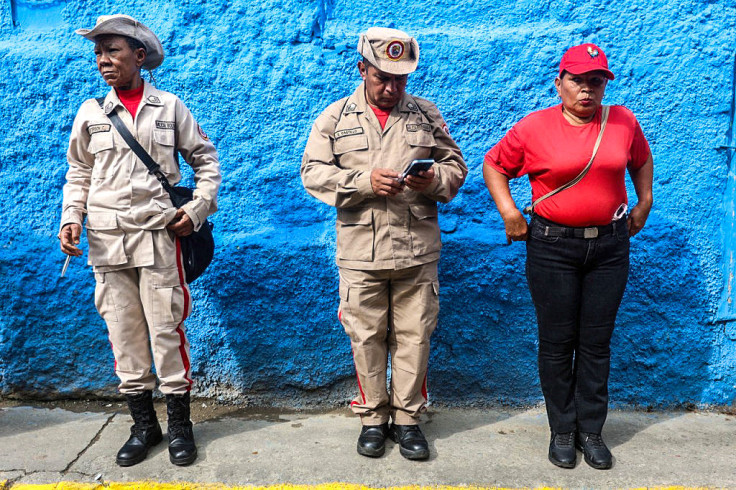
Despite those weaknesses, War on the Rocks says Venezuela retains enough asymmetric capacity to complicate any U.S. operation. The government has built a layered internal-control structure that includes territorial defense zones, militias embedded in civilian areas, intelligence networks, and pro-government armed groups.
While these forces are poorly suited for conventional combat, they could support guerrilla tactics, urban resistance, and prolonged internal unrest.
-
Trump Sends Cryptic Message To Maduro As He Escalates Pressure On Venezuela: 'He Knows Exactly What I Want'

-
Rand Paul Slams Trump Over Venezuela Campaign: 'I'm Not For Sending Kids I Know In The Military To Die For Oil'

-
Russia Cautions U.S. About Making a 'Fatal Mistake' In Military Campaign Against Venezuela


Air defenses, including S-300 and Buk systems, are unevenly maintained but could pose risks during the opening phase of an air campaign, particularly around major population centers. Venezuelan Su-30 fighter jets, though limited in number and readiness, could attempt high-risk attacks against naval targets, analysts say, though such missions would likely face overwhelming U.S. defenses.
If air defenses were neutralized, the Venezuelan military would likely shift toward dispersal, concealment, and internal repression while relying on militias and paramilitary groups to raise the political and economic costs of intervention.
Reuters reported earlier this month that Venezuelan planning includes preparations for "prolonged resistance," involving small units positioned across hundreds of locations to carry out sabotage and disruption. Another strategy, called "anarchization" and not acknowledged by officials, would revolve around creating disorder in Caracas and making the country impossible to govern.
© 2025 Latin Times. All rights reserved. Do not reproduce without permission.


