
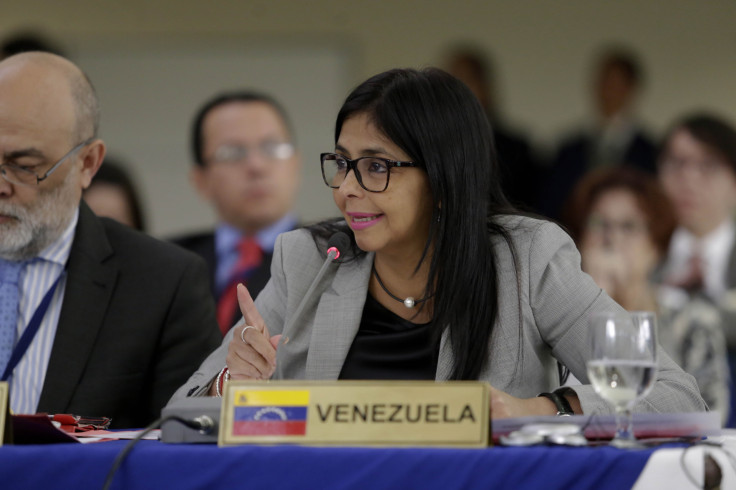
Venezuela's interim leader Delcy Rodríguez was labeled a "priority target" by the U.S. Drug Enforcement Administration years before rising to the top of the country's power structure, according to records reviewed by The Associated Press and interviews with current and former U.S. law enforcement officials.
The designation, applied in 2022, is reserved for individuals believed to have a "significant impact" on the drug trade. DEA records show the agency began compiling intelligence on Rodríguez as early as 2018, documenting alleged links to drug trafficking, gold smuggling and money laundering networks, including connections to Venezuelan government-linked business figures.
-
Venezuela Opposition Figures Reel as Trump Backs Delcy Rodríguez Over Machado: 'I Could Not Believe What I Was Hearing'
-
U.S. Intelligence Describes Venezuela's Interim Leader As 'a Socialist but the Most Capitalistic One I've Seen'

-
Venezuela's Opposition Leader Machado Warns that Country's New Interim Leader Is 'Even More Ruthless' Than Maduro


The U.S. government has never publicly accused Rodríguez of criminal wrongdoing, and she is not among the Venezuelan officials formally charged in U.S. drug trafficking cases tied to former president Nicolás Maduro. DEA officials declined to comment to The AP, and Venezuela's communications ministry did not respond to requests for comment.
Rodríguez's name has appeared in nearly a dozen DEA investigations across multiple field offices, according to the AP. Several cases remain open, though the records do not explain why she was elevated to priority target status. "There's a difference between being talked about and having evidence that supports an indictment," said Kurt Lunkenheimer, a former U.S. federal prosecutor.
The disclosure comes amid a sharp contrast between U.S. scrutiny and Rodríguez's public posture. As vice president and later acting president, she has repeatedly rejected U.S. claims that Venezuela is a hub for cocaine trafficking. In September, she said Venezuelan authorities have seized more narcotics since DEA agents were expelled from the country in 2005, citing government data that shows more than 1,000 metric tons confiscated since then.
Rodríguez also pointed to the DEA's own National Drug Threat Assessments from 2024 and 2025, which she says do not identify Venezuela as a major source of cocaine bound for the United States. In August, responding to accusations from DEA Administrator Terry Cole, she called the claims "false" and said U.S. policy seeks to justify pressure on Venezuela and gain access to its energy resources.
Rodríguez went further, asserting that "the real cartel is in the North" and accusing Washington of using drug trafficking allegations as a political tool. She has said Venezuela will defend its sovereignty and territorial integrity.
U.S. analysts note that Rodríguez's rise illustrates how political power and criminal investigations often intersect in Venezuela. "Being a leader in a highly corrupted regime makes it logical that she would attract scrutiny," said David Smilde, a professor at Tulane University. "That scrutiny can also become leverage."
© 2025 Latin Times. All rights reserved. Do not reproduce without permission.


