
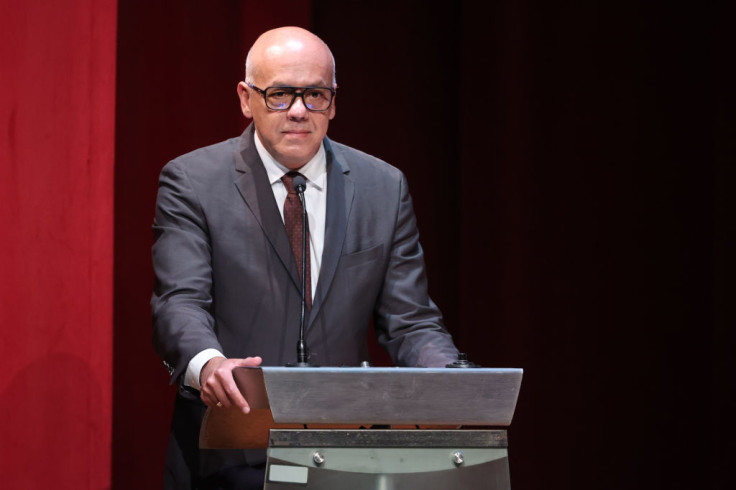
Venezuela's National Assembly president, Jorge Rodríguez, announced that the government has begun releasing a "significant number" of political prisoners, describing the move as a decision taken jointly by the executive and other state institutions.
Speaking ahead of the legislature's first ordinary session of the year, Rodríguez, who's the brother of the country's current interim leader Delcy Rodríguez, said the releases were already underway and involved both Venezuelan and foreign detainees. "It has been decided to grant freedom to a significant number of Venezuelan and foreign individuals," he said, adding that "these release processes are occurring at this very moment."
He framed the decision as "a gesture with a broad intention to seek peace" and an effort to allow the country to "continue its peaceful life in pursuit of prosperity."
#URGENTE | Jorge Rodríguez informa que se ha “decidido la puesta en libertad de un número importante” de presos políticos venezolanos y extranjeros.
— Orlando Avendaño (@OrlvndoA) January 8, 2026
Dice que está ocurriendo desde este momento. pic.twitter.com/4CuTZMRNIN
Rodríguez went on to publicly thank former Spanish prime minister José Luis Rodríguez Zapatero, Brazilian President Luiz Inácio Lula da Silva, and Qatar for their roles in facilitating dialogue. He denied that the government was negotiating with what he described as "extremist sectors," saying contacts had been limited to organizations that recognize Venezuela's constitution.
ÚLTIMA HORA | Jorge Rodríguez sobre proceso de excarcelaciones en Venezuela: "Es un número importante de personas venezolanos y extranjeras".
— AlbertoRodNews (@AlbertoRodNews) January 8, 2026
"Agradecemos a Zapatero, Lula Da Silva, al gobierno de Catar y las instituciones que atendieron el llamado" https://t.co/7DxJxGVtbb pic.twitter.com/Esx93u36XH
The announcement follows heightened international scrutiny of Venezuela's detention system after U.S. President Donald Trump said this week that authorities in Caracas were shutting down a detention facility he described as a "torture chamber in the middle of the city."
While Trump did not name the site, his remarks appeared to refer to El Helicoide, a facility long identified by human rights groups and the United Nations as a center for political detention and abuse. Trump said the closure was being carried out under the authority of interim President Delcy Rodríguez, who assumed office after the capture of Nicolás Maduro.
Opposition leader and Nobel Peace Prize laureate María Corina Machado has argued that the release of political prisoners must be the first step in any genuine transition. In an interview with Venezuelan news site La Patilla on Wednesday, Machado said more than 800 political detainees remain in custody and warned that repression is the main pillar sustaining the current power structure.
"This phase begins with the release of political prisoners, the end of repression, and the dismantling of the structure that persecutes and terrorizes," she said.

© 2025 Latin Times. All rights reserved. Do not reproduce without permission.


