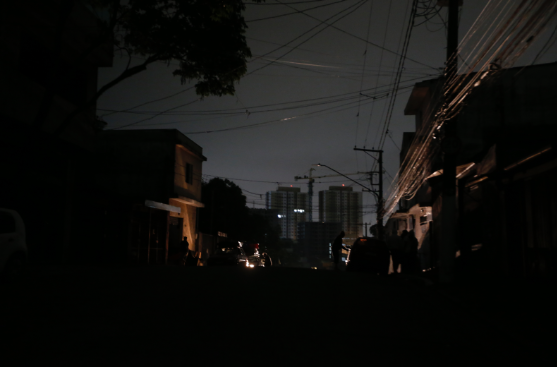
Cristina Malcov, 67, took everything out of her freezer before leaving her apartment in Brazil's largest city last Friday. She had been over 48 hours without electricity and was using flashlights to guide herself through her home at night.
Her neighborhood, Mirandópolis, in São Paulo, saw a power outage on Wednesday after an extratropical cyclone passed through southern Brazil, affecting the region. As of Wednesday, most businesses in the neighborhood remain closed, and Cristina is staying with her son in Interlagos, over 20 kilometers away.
Cristina was one of over 1 million people in São Paulo who were without power for days due to the cyclone. The power returned to her apartment on Saturday.
Local reports state that more than 400 flights were cancelled or rescheduled in the last few days, along with falling trees and lack of access to potable water.
"Besides the emotional strain and stress, I have a heart condition, and this instability and lack of predictability causes enormous anxiety," Malcov told Latin Times over text message.
Once free of climate extremes, Brazil faces a new weather reality
According to São Paulo's Civil Defense body, which helps with disaster preparedness, the pressure difference within the cyclone caused wind gusts to reach nearly 100 km/h (62 mph) in the region.
Extreme weather events are happening with a higher frequency in Brazil, and the country's Southeast region seldom sees cyclones of this magnitude.
"Historically, we perhaps experienced these events much more rarely, with longer time periods," Tercio Ambrizzi, a Full Professor in the Department of Atmospheric Sciences at the University of São Paulo, told Latin Times. "Today, due to atmospheric warming, and the atmosphere responding to this warming by favoring extremes, we have seen this type of situation occurring more frequently and with greater intensity."
Ambrizzi thinks the government isn't acting swiftly enough to resolve its preparedness issue. "So, no, our cities are not prepared. I see a significant slowness in beginning to adapt to this new reality," he added.
Brazil has faced major climate emergencies in recent years. Intense floods in the Southern state of Rio Grande do Sul left at least around 750,000 people displaced in 2024, with a flood area the size of the United Kingdom.
Besides reducing air pollution and increasing the use of renewable fuels, the professor and meteorologist argues that South America's largest nation should have evacuation and protocols strong enough to protect its citizens.
One area of concern for the professor is Brazil's power grid.
Enel, an Italian multinational energy company with operations across Latin America, runs São Paulo's electrical network. In a statement published on Monday, the company announced that operations had returned to normal "with service restored to customers affected by the extratropical cyclone on December 10th and 11th."
"Currently, our technicians are in the field addressing cases registered in the days following the weather event, representing approximately 0.4% of customers in the São Paulo Metropolitan Region. Our technicians continue to work on some more complex network reconstruction cases, involving the replacement of cables, poles, and other equipment," the statement read.
In addition to São Paulo, the company also supplies energy to the Brazilian states of Ceará and Rio de Janeiro.
With heightened propensity of extreme weather events, Enel and other energy companies in Brazil may need to invest more to strengthen their infrastructure.
"It turns out that we are going through a period in which extreme events are becoming more frequent and more intense," said Ambrizzi. "So, these companies, and particularly the electricity company, would have to invest more. And with that, their profits will decrease."


© 2025 Latin Times. All rights reserved. Do not reproduce without permission.


