
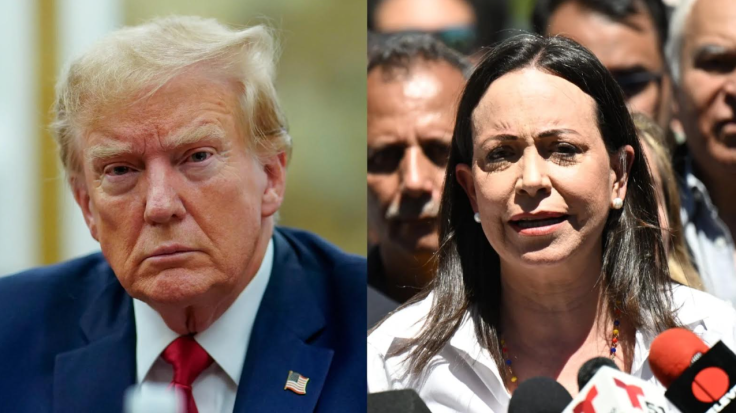
Senior advisers to President Donald Trump sidelined Venezuelan opposition leader María Corina Machado during deliberations over Venezuela's post-Maduro transition, viewing her insistence on a full democratic overhaul as incompatible with Washington's short-term stability calculations, according to a detailed report by Spain's ABC.
The report says the decision was not driven by improvisation or personal animus but by an internal assessment that installing Machado and her ally Edmundo González after Nicolás Maduro's removal would require a large-scale U.S. military presence.
U.S. security officials cited by ABC warned that such a move would involve thousands of American troops, control of Venezuelan airspace, protection of critical infrastructure and the neutralization of senior military commanders—effectively a regime-change occupation reminiscent of Iraq and Afghanistan, scenarios Trump had ruled out.
Against that backdrop, Trump publicly distanced himself from Machado on Jan. 3, as Maduro was already in U.S. custody. "I think it would be very tough for her to be the leader," Trump said, adding that she lacked "the internal support or the respect within the country."
-
Vladimir Padrino And Diosdado Cabello Can Make Or Break The Interim Presidency Of Delcy Rodriguez In Venezuela: Report

-
Maria Corina Machado Says 'Venezuelan People Want To Share' Nobel Peace Prize With Trump After He Reportedly Soured On Her For Keeping It
-
The Three Main Demands The U.S. Made To Venezuela's New Interim President: Report


ABC reports that Machado's uncompromising refusal to engage with regime figures or accept partial measures—such as negotiating the release of a limited number of political prisoners—reinforced perceptions inside the administration that she was unwilling to accommodate a gradual or negotiated transition.
Trump's special envoy to Venezuela, Richard Grenell had sought such gestures but later conveyed a critical view of Machado to Trump, according to sources cited by the outlet.
Other U.S. media have echoed similar accounts. The New York Times reported that Trump officials grew frustrated by what they saw as a lack of operational detail from Machado about how she would govern and manage the armed forces. A CIA assessment, cited by multiple outlets, concluded that regime insiders would be better positioned to manage a temporary transition.
The Washington Post reported that Trump was also irritated by Machado's acceptance of the Nobel Peace Prize, which he has long coveted. One person close to the White House described the decision as the "ultimate sin," though ABC noted that administration sources deny the Nobel was decisive.
The administration has since shifted toward conditional engagement with interim leader Delcy Rodríguez, delivering a list of demands that includes cooperation on narcotics, expelling foreign operatives and redirecting oil policy, while postponing any discussion of elections.
© 2025 Latin Times. All rights reserved. Do not reproduce without permission.


