
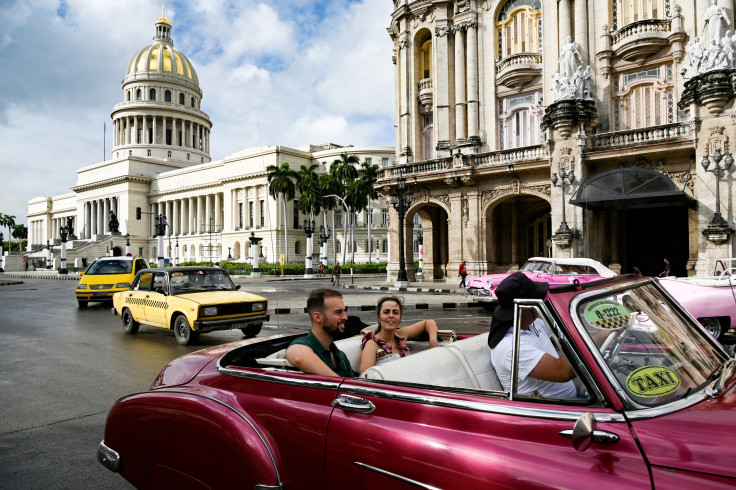
The Cuban government appears to be shifting away from its economic approach and is now expected to allow nationals living abroad to invest in the private sector and own businesses in their homeland.
In an exclusive interview with NBC News, Cuba's deputy prime minister and minister of foreign trade and investment, Oscar Pérez-Oliva Fraga, said that the ongoing blockade by the United States is hindering the strategy from coming to fruition. The remarks were made before yet another country-wide blackout hit the island.


"Cuba is open to having a fluid commercial relationship with U.S. companies as well with Cubans residing in the United States and their descendants," Fraga said, adding that the reform seeks to create what he described as a "dynamic business environment" that could help revive multiple sectors of Cuba's economy.
"This extends beyond the commercial sphere. It also applies to investments — not only small investments, but also large investments, particularly in infrastructure," Fraga added.
The Cuban official added that U.S. sanctions and blockades have slowed the implementation of this new strategy, as a lack of resources such as fuel has deprived the Cuban government of access to financing, technology and other markets.
Havana confirmed on March 13 that it was holding talks with the Trump administration for the first time, as a lack of fuel has triggered additional problems, including power outages, a decline in tourism, garbage piling up in the streets and even mass protests.
After the capture of Venezuela's authoritarian President Nicolás Maduro prompted Venezuela to stop sending oil shipments to the Caribbean nation, Cuban President Miguel Díaz-Canel said last week that it has been three months since the last shipment reached Cuban shores.
Unrest among the population has increased to the point that protesters attacked a Communist Party building in the city of Morón over the weekend, a rare escalation of dissent in a country where public protests are tightly controlled. Demonstrators threw stones at the local party headquarters, entered the building and set furniture on fire, according to reporting by The New York Times.
The incident began late Friday as a peaceful gathering of several hundred people protesting prolonged power outages and shortages of food and fuel. Protesters marched through the city banging pots and pans and shining cellphone flashlights during a blackout that had left many homes without electricity for more than a day.
Some demonstrators shouted slogans including "Electricity and food," "Freedom," and "Down with the dictatorship," according to videos circulating on social media cited by DW.
Experts say the attack marks one of the most significant episodes of unrest in Cuba in recent years. Andrés Pertierra, a historian of Cuba at the University of Wisconsin, told The New York Times that attempts to burn a Communist Party building are "extremely unusual," noting that past protests typically focused on demands for electricity or basic services.


© 2025 Latin Times. All rights reserved. Do not reproduce without permission.


