
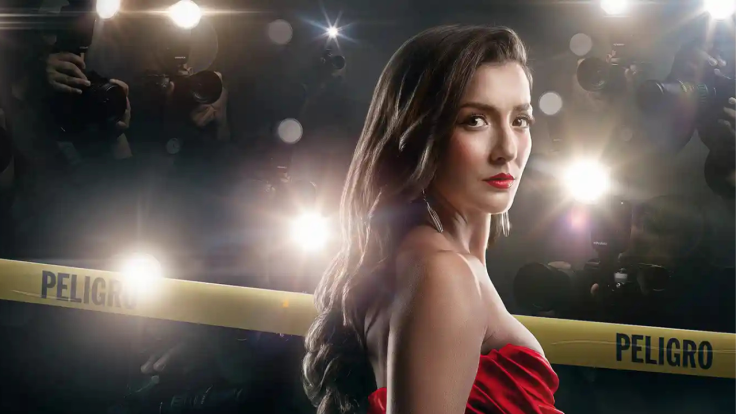
After 'Sense8' and 'The Matrix Resurrections,' Eréndira Ibarra could have chased the kind of glossy international roles that come with franchise heat and global recognition. Instead, the Mexican actress and producer has leaned into stories in Spanish with a pulse, projects that poke at power, identity, image, and the emotional cost of being seen.
Her new ViX series, 'El Precio de la Fama,' may be one of the sharpest examples yet and she chose it just for that. "It was important to go deep into the dark corners of our world," she said to this reporter in a Zoom interview, together with her co-star Andrés Palacios.
The thriller, which premiered May 29, stars Ibarra, Palacios, and Mane de la Parra in a story about celebrity, ambition, trauma, and the brutal machinery of an industry always looking for the next face, the next body, the next number, the next viral name. It is not a series about becoming famous. It is a series about surviving fame once it starts eating away at the person underneath.
Ibarra plays Mía Moreno, an actress whose life is shaped by glamour, insecurity and a tragedy that continues to echo years later. Palacios plays Germán, a journalist connected to the same emotional wound from a different place, a man watching the profession around him shift under the weight of social media and public appetite.
Ibarra and Palacios said they did not overbuild their relationship before filming. That choice gives the first episodes a tense, uncertain charge, as if both characters are circling truths neither fully knows how to name. "We each did our own table work," Ibarra said. "We only talked about certain strategic moments. We wanted that freshness to be felt. I wanted to surprise him a little, and for him to surprise me."
Palacios said the decision helped preserve something actors can lose when everything is too rehearsed.
"When we work too closely or construct everything together, we run the risk of spoiling the surprise factor," he said.
-
Adam Rodríguez Has Been Holding Down Latino Representation on Crime TV for 20 Years, and He's Not Done Yet as He Returns to 'Criminal Minds Evolution'

-
Diego Boneta's Fidel Castro Transformation in 'Killing Castro' Started With the Team Behind Luis Miguel - EXCLUSIVE

-
Nicolas Cage Intimidated Her at First, Then Karen Rodríguez Created Marvel's Most Unexpected Latina Heroine in Spider-Noir - INTERVIEW


That surprise is essential to Mía. At first glance, she looks like the kind of woman who knows exactly how to control a room. She is glamorous, guarded and mysterious. But Ibarra plays her as someone vibrating from the inside, a woman whose control is less strength than survival.
For Ibarra, the key was not to treat Mía as unstable.
"One of the ideas we had a lot with Mía is that actresses, especially a certain kind of actress who has been very pampered, very cared for, and too spoiled, become little girls," Ibarra said. "So she has childish outbursts. She has been so protected and so indulged that she reacts like a spoiled child."
Then she sharpened the point.
"The idea was not to say, 'Mía is crazy,'" Ibarra said. "It was, 'Mía is a spoiled child who wants people to solve things for her, and they always have.' Nobody tells her no. So how are they going to tell her no now?"
It is a fascinating lens for a character in a series about fame, because 'El Precio de la Fama' understands something cruel about celebrity culture: the same industry that infantilizes stars can also discard them the second they stop being convenient.
Palacios sees that danger clearly."That is also dangerous when someone is wrapped in a certain level of fame," he said. "Spoiled children have no tolerance for frustration. Then suddenly time has passed, someone new arrives, fresher, maybe less expensive, perhaps without the same experience or connection with the public, and that becomes shocking."
That is where the series hits a nerve beyond fiction. Mía is not just afraid of losing a role. She is afraid of being replaced by a new system with new rules, one in which youth, cost and followers can outweigh experience.
For Palacios, whose character moves through the world of journalism, that theme felt familiar. The series arrives at a time when actors, reporters and entertainers are all being asked some version of the same question: how many followers do you have?
"It is a reality," Palacios said. "We have witnessed how certain concepts become fashionable."
He compared the obsession with followers to older casting demands that once dominated the industry.
"At different times, it was height, eye color, size, nationality," he said. "Now there is this thing with technology and followers. Of course, that gives reach, almost like globalization from a phone. But it does not necessarily support the artistic need, the rigor, the commitment or the sacrifice this requires."
For Palacios, popularity may open a door, but it cannot sustain a career.
"Getting there can be relatively easy," he said. "But staying there and proving all the time that you have the tools, the passion, the respect, the talent, the resources and the language, that only comes with preparation."
That tension gives 'El Precio de la Fama' its bite. The series is not wagging a finger at influencers. It is asking what happens when an entire industry begins confusing reach with craft.
The project also carries a personal layer for Ibarra. Her sister, Natasha Ybarra, is one of the creative forces behind the series, along with Michelle Renaud, who co-created the project. Ibarra said she was originally involved as casting director before eventually becoming Mía.
"Natasha and I have had the fortune and privilege of working together for a long time," Ibarra said, recalling projects including Camelia La Texana, Ingobernable, Las Aparicio, Capadocia and Infames.
The role of Mía was not initially hers. According to Ibarra, Renaud had planned to be more directly involved on camera, but her pregnancy changed the path of the project. That opened the door for Ibarra to take on the role.
"There were several moments when I said, 'How am I going to do this? Natasha, how are you going to make me do this?'" Ibarra said, laughing. "But it is something recurring in our lives."
Casting Palacios, however, seemed obvious.
"We needed a Latino Clark Kent," Ibarra said. "And look at him. He checked all the boxes."
Palacios laughed through the compliment, but the description fits the version of Germán seen in the early episodes: elegant, controlled, and apparently solid, with the suggestion of something more complicated underneath. However, not as complicated as 'El Precio de la Fama.'
© 2025 Latin Times. All rights reserved. Do not reproduce without permission.


