
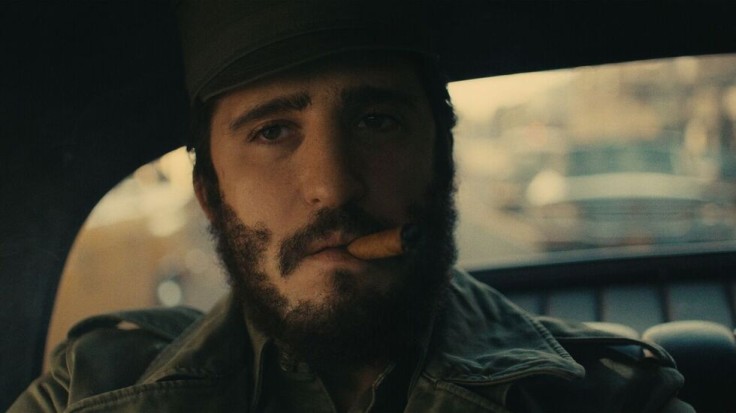
For Diego Boneta, the most shocking part of becoming Fidel Castro was not the fear, although there was plenty of that. It was not the politics either, even though he says the role arrived at a moment when Cuba feels newly urgent again. It was the discovery that the thing audiences are most likely to talk about first, how uncannily he looks like Fidel in his new movie 'Killing Castro,' came down to something surprisingly small.
"The most impressive thing is that it was minimal," Boneta said to this reporter, after recalling the long road to the role. "It was only the nose."
That small detail is the kind of Hollywood alchemy that sounds too neat to be true, until Boneta explains who was standing behind it. The secret weapon, he says, was Bill Corso, the veteran makeup artist who had already helped transform him once before, in Luis Miguel. "It was the same makeup artist who did the Luis Miguel series with me," Boneta said, naming Corso directly and adding that the artist already knew his face intimately. Corso is an Academy Award winner for Lemony Snicket's A Series of Unfortunate Events and also earned Oscar nominations for Click and Foxcatcher. He is also the makeup artist behind the transformation of Jaafar Jackson into Michael Jackson in the King of Pop biopic 'MICHAEL'
@netflixlat Así es como @diego se transforma en Luis Miguel. #LuisMiguelLaSerie
♬ Suave - Diego Boneta
That continuity is part of Boneta's career.
The Mexican actor, producer, and author has one of those before-and-after arcs that actors spend years trying to build. In one chapter, he played Luis Miguel, one of the most recognizable music idols in Latin America. In the next, he disappears into Fidel Castro, one of the most controversial political figures of the 20th century. In the middle there have been spectacular roles, as in 'Father of the Bride,' 'Quién lo mató,' 'Juegos de Seducción,' and many more projects both in front of and behind the camera. Also, his fist novel 'The Undoing of Alejandro Velasco.'
-
Michael Kelly and Wendell Pierce Bring Jack Ryan Back as Venezuela Echoes Follow the Franchise Into Ghost War - INTERVIEW

-
From Griselda to M.I.A., Alberto Guerra Keeps Redefining the Latino Antihero - INTERVIEW

-
Teary Eyed and Deeply Vunerable: Alfonso Herrera Alfonso Herrera Says 'La Casa de los Espíritus' Is The Pain of Latin America - INTERVIEW


Now, 'Killing Castro' is arriving at this year's Tribeca Film Festival, and Cuba is dominating the headlines again, Boneta is filled with "excited nervousness" and "more than eager to show the world his Fidel'. According to him, becoming Fidel actually required less visible intervention than becoming Luis Miguel. "It was much less makeup than with Luis Miguel, even though looking at the photos you'd think it was more," he said. "It was easier to transform me into Fidel than into Luis Miguel."
That is not to say the role itself came easily. Boneta was emphatic about that. "It's the hardest role I've ever done. It's the biggest risk I've taken as an actor," he said, adding that he spent a year and a half preparing for the part. He used the stop-and-start nature of an independent film schedule to his advantage, pouring time into dialect, history, acting work and cultural context.
By his own account, the preparation was almost obsessive. Boneta said he worked with three dialect coaches, acting teacher Juan Carlos Corazza in Madrid, and Cuban historian Rafael Rojas, whom he described as a specialist in the Cuban Revolution. He said the experience of playing Luis Miguel had already taught him how important preparation is when portraying a real figure whose image carries enormous cultural weight. In Fidel's case, he felt that responsibility even more intensely.
That seriousness is written all over 'Killing Castro', which Tribeca describes as a political thriller that reimagines Fidel Castro's 1960 stay in Harlem as "a charged encounter between surveillance and solidarity." The official festival synopsis says the film follows a young translator drawn into a tightening web of power as competing forces converge around Castro in New York. Tribeca also confirmed the film will have its world premiere at the 2026 festival and lists a cast that includes Al Pacino, Xolo Maridueña, KiKi Layne, Ron Livingston, Alexander Ludwig, Nicole Beharie and Kendrick Sampson alongside Boneta.
It was produced by Brad Feinstein and Christina Weiss Lurie and directed by Eif Rivera.
Boneta's own summary of the film is even more vivid. He said the movie focuses on the week Fidel traveled to New York to deliver his first speech at the United Nations, and on everything that happened in those days that ultimately pushed him toward the Soviet Union instead of the Americans. "It's one of those real stories that very few people know," he said.
That little-known historical corridor is part of what seems to excite him most. Boneta does not talk about Fidel as an imitation exercise. He talks about him as a collision of politics, performance and timing. In your interview, he noted that the film is arriving while Cuba is once again very much in the global conversation, even if that timing was never planned. "It seems like it was planned, but obviously it wasn't," he said, calling the coincidence one of those strange moments you simply have to trust.
He also made clear that this was not just an acting assignment. Boneta produced the movie too, which changes the stakes. It means he was not merely stepping into one of the most loaded faces in modern Latin American history, he was also helping steer the project behind the camera. That may explain why he speaks about it with a mix of pride and residual disbelief.
© 2025 Latin Times. All rights reserved. Do not reproduce without permission.


