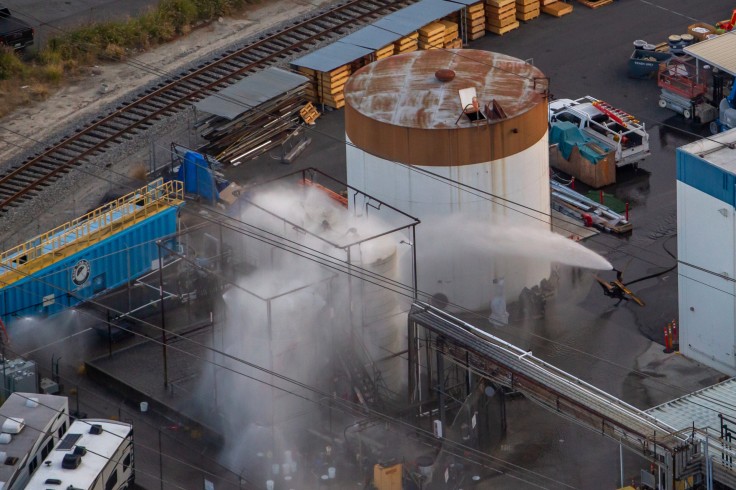
GARDEN GROVE, Calif. — When firefighters arrived at the GKN Aerospace facility on Western Avenue last Thursday afternoon, they found a 34,000-gallon storage tank overheating with no clear way to stop it. Inside: approximately 7,000 gallons of methyl methacrylate, a highly toxic, flammable, and volatile industrial chemical used to manufacture acrylic glass and aircraft components.
Five days later, more than 50,000 Orange County residents remain under mandatory evacuation orders. A state of emergency has been declared. The federal government has stepped in. And the crisis — on one of the most consequential holiday weekends of the year — is not over.
But beyond the dramatic aerial footage of water cannons dousing an overheating tank, three critical stories remain undertold: what this chemical actually does to the human body, the environmental damage that could outlast the emergency itself, and the faces of the tens of thousands of ordinary people sleeping on cots in evacuation shelters, waiting for news that lets them go home.
What Is Methyl Methacrylate — and Should You Be Afraid of It?
The name sounds clinical. Methyl methacrylate — known in industrial settings as MMA — is the substance that emptied an entire section of Orange County and activated every layer of California's emergency apparatus. Most residents in the evacuation zone had never heard of it before last Thursday. Here is what they — and you — need to know.
MMA is a colorless, strong-smelling liquid used to produce acrylic glass (Plexiglas), paints, adhesives, resins, and plastics. In aerospace manufacturing — GKN's core business — it is used to fabricate military canopies, cockpit windows, and passenger aircraft glass. In controlled industrial quantities, it is manageable. Inside a 34,000-gallon tank with a faulty valve, a rising internal temperature, and a discovered crack in its structure, it becomes something else entirely.
"This is highly volatile, it's highly toxic, it's highly flammable. This is not precautionary. This is gonna happen unless some brilliant guy behind me here figures out how we can mitigate this incident."
— OCFA Division Chief Craig Covey, May 22 Press Briefing
What Happens If You Breathe It?
Officials have confirmed that MMA vapor is heavier than air — meaning if released, it settles low to the ground rather than dispersing upward, concentrating its effects precisely where people live and breathe. Exposure primarily occurs through inhalation of vapors, though skin and eye contact with liquid MMA are also medically serious.
According to the California Department of Public Health and the U.S. Environmental Protection Agency, short-term inhalation exposure can cause a range of symptoms depending on concentration and duration of exposure:
Mild exposure: coughing, wheezing, eye irritation, nasal and throat irritation, headache, lightheadedness.
Moderate exposure: chest tightness, shortness of breath, nausea, dizziness, skin irritation, heaviness in the arms and legs.
Severe exposure: pulmonary edema (fluid buildup in the lungs), severe respiratory distress, multi-organ effects, and potential hospitalization.

Orange County Deputy Health Officer Dr. Regina Chinsio-Kwong was direct at a press briefing: "At very high levels, it can really cause severe respiratory distress and hospitalization, and this is where we really need everybody to heed all the evacuation orders."
Health authorities issued a specific additional warning for pregnant women: MMA can affect a developing fetus. Children and elderly individuals with pre-existing respiratory conditions also face elevated risk at concentrations lower than those that would affect a healthy adult.
What to Do If You've Been Exposed
If you believe you have been exposed to MMA — through the smell of the chemical, proximity to the evacuation zone, or onset of symptoms — officials advise the following steps:
1. Move immediately to fresh air. Do not re-enter the affected area.
2. Remove clothing that may have contacted MMA vapor or liquid, and wash exposed skin thoroughly with soap and water.
3. Do not touch liquid MMA or attempt to handle the substance.
4. Seek medical attention at any onset of respiratory symptoms, even mild ones. MMA irritation can escalate rapidly.
5. Note: No medical test can directly measure MMA in the body. Inform your physician of the exposure and describe your symptoms.
How Far Away Is Safe?
The mandatory evacuation zone — bounded by Ball Road (north), Trask Avenue (south), Valley View Street (west), and Dale Street (east) — was established by the Orange County Fire Authority as the minimum safe perimeter given two possible failure scenarios: a spill of 6,000 to 7,000 gallons into the surrounding area, or a full thermal explosion capable of igniting nearby tanks containing additional chemicals and fuel.

The EPA deployed 24 stationary air monitors operating around the clock around the perimeter. As of Sunday, no toxic readings had been recorded outside the immediate zone. Residents outside the evacuation boundary were advised to keep windows closed and monitor official air quality alerts. That status, officials cautioned, remains subject to change.
Storm Drains, Waterways, and the Long Shadow of a Chemical Spill
Most coverage has focused on explosion risk. But what happens in the weeks and months after — if the tank fails and its contents flow outward — is a story that will outlast the emergency declaration by years.
MMA is water-soluble and highly volatile. If the tank ruptures and releases its approximately 7,000 gallons into the surrounding area, the most immediate environmental concern shifts from the air to the ground. Garden Grove sits within a dense urban grid laced with storm drains that feed into Orange County's waterways and, ultimately, the Pacific Ocean.
Firefighters have already laid down sand and other materials to intercept any flow of the chemical toward nearby storm drains. Containment barriers have been placed around the GKN Aerospace facility perimeter. The goal is to ensure that any leaked MMA pools on-site rather than entering the city's drainage infrastructure. Whether those barriers would hold in a worst-case pressure-driven rupture scenario is a question officials have not publicly answered.
"We've created containment barriers. Firefighters have already laid down sand and other materials to try and stem the flow of the chemical into nearby storm drains and waterways."
— OCFA Division Chief Craig Covey
The Environmental Risks
According to environmental toxicology literature, MMA in aquatic environments is acutely toxic to fish and aquatic invertebrates at elevated concentrations. It can inhibit algae growth and disrupt local aquatic ecosystems. In soil, MMA degrades relatively quickly under aerobic conditions — but in the saturated or low-oxygen soils common near urban drainage systems, degradation slows substantially.
Long-term monitoring of nearby waterways has not yet been formally announced by any agency. That gap in the public record, environmental advocates say, is one worth watching closely.
Sleeping on Cots, Hugging Strangers: Life Inside the Evacuation Centers
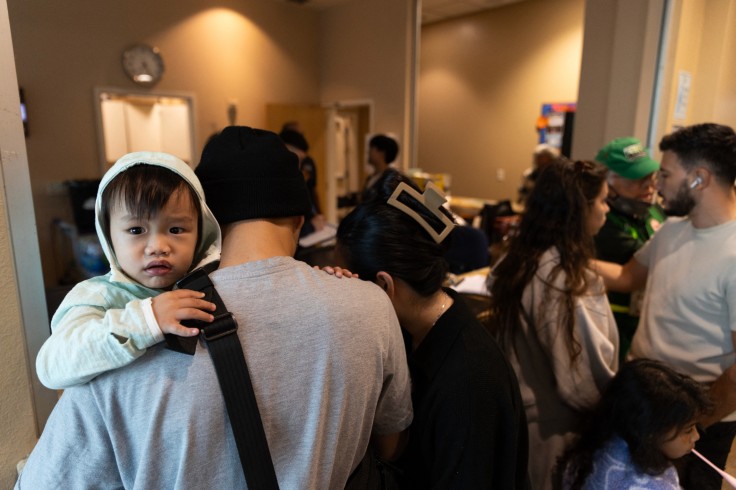
The numbers tell part of the story: 50,000 people displaced. Red Cross shelters at or near capacity. A city-wide emergency declared on a holiday weekend. But numbers do not tell you about the family that left Thursday thinking they would be back by dinner, now entering their fifth night away from home. Or the elderly couple who left their medications behind. Or the single mother wondering whether her apartment inside the evacuation zone has been broken into.
Photos from inside the Garden Grove Sports & Recreation Center showed evacuees embracing one another — strangers becoming temporary community over donated meals. World Central Kitchen, the nonprofit known for feeding people in disaster zones around the world, arrived Sunday to supplement Red Cross operations. All Planet Fitness locations across Orange County opened their facilities, showers, and WiFi to evacuees and first responders, free and without membership requirements.
Who Was Affected
The mandatory evacuation zone encompasses not only Garden Grove but portions of Buena Park, Anaheim, Stanton, Westminster, and Cypress — a densely populated, multiethnic stretch of Orange County where many residents are working-class families, renters without emergency savings, and immigrant communities navigating a crisis with limited English-language access to official information.
The City of Garden Grove issued emergency alerts and updates in English, Spanish, and Vietnamese. Over a dozen schools temporarily closed. The Garden Grove Unified School District established a reunification center at 13641 Deodara Drive and announced support services for affected families. Schools adjacent to — but technically outside — the evacuation zone also cancelled outdoor activities as a precaution.


© 2025 Latin Times. All rights reserved. Do not reproduce without permission.


