
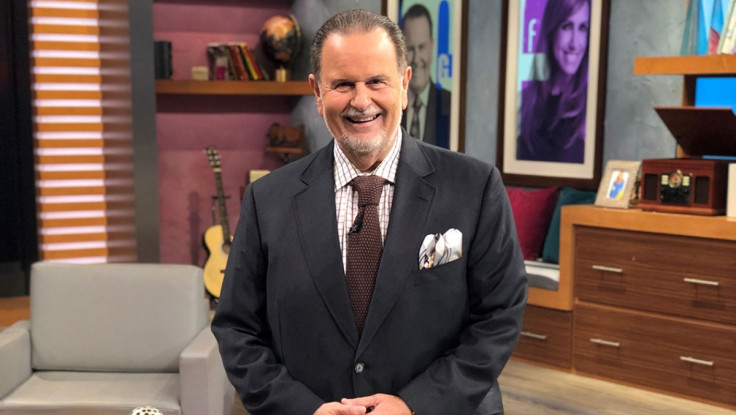
Raúl "El Gordo" de Molina breaks his silence after the New Year's controversy and sends a clear message: he will continue to defend immigrants, no matter what. The Cuban presenter, one of the most recognizable faces on Spanish-language television in the United States, found himself at the center of a national debate after what happened during the New Year's Eve broadcast in Times Square.

The night of December 31st was, as every year, a massive celebration marked by music, lights, and speeches of good wishes. De Molina hosted Univision's special from New York and was also invited to participate briefly in the CBS broadcast, an unusual gesture that underscored his media influence beyond the Latino audience. However, what was meant to be a closing greeting turned into a viral controversy.
While Raúl was speaking about his wishes for 2026, he managed to say words related to "freedom" and "the well-being of Latino immigrants" before his audio was cut off and replaced by music and another image on screen. The CBS signal abruptly changed. His message was cut and replaced by a musical transition to another segment. The audio was never heard in its entirety, although it was possible to hear the host expressing words of support for the immigrant community.
The moment sparked an immediate storm on social media. Users and analysts accused CBS of censorship and of editorially aligning itself with Donald Trump, in a political context where immigration has once again become a central and highly polarizing issue in the public debate. For many, the cut was not accidental but a conscious decision to avoid an uncomfortable message during prime time.
One of the most forceful voices was that of María Celeste Arrarás , who harshly criticized what happened in editorials and online publications. The journalist questioned the silencing of a message of support for immigrants on a symbolic night for the country and focused on the role of major media outlets in the current political climate.
Faced with media pressure, Raúl de Molina decided to speak publicly. He did so on his own show , El Gordo y la Flaca, where he explained that he learned of the controversy the following day through social media. "I didn't know what had happened," he recounted. "I don't know if they cut me off because of what I was saying about immigrants or if it was something technical. I don't know exactly what happened, but it went viral and spread around the world."
De Molina avoided directly accusing the network and left open the possibility of a technical glitch. Even so, he acknowledged the global impact of the episode and the unease it generated among those who expected to hear his full message. The scene, repeated thousands of times on digital platforms, fueled the narrative that certain discourses are being censored on American television.
What the host did make clear is that his stance will not change. "I will continue to support immigrants as long as this country, where the right to free speech exists, continues to express itself," he stated. "I hope this was a coincidence and not what many are saying happened. We must continue to support immigrants because in this country we are all immigrants; the only ones who are truly from the United States are the Native Americans."
The controversy also reignited the debate about the relationship between major networks and political power. For critics and advocates of free speech, the New Year's episode symbolizes a growing tension between public discourse and editorial lines in times of high polarization.
While CBS has offered no detailed explanation beyond technical references, Raúl de Molina continues with his regular programming on Univision, reinforcing a message that has defined his career. Amid the noise, the host seems to have one thing clear: his voice will continue to be, with or without someone else's microphone, a voice in favor of immigrants in the United States.


