
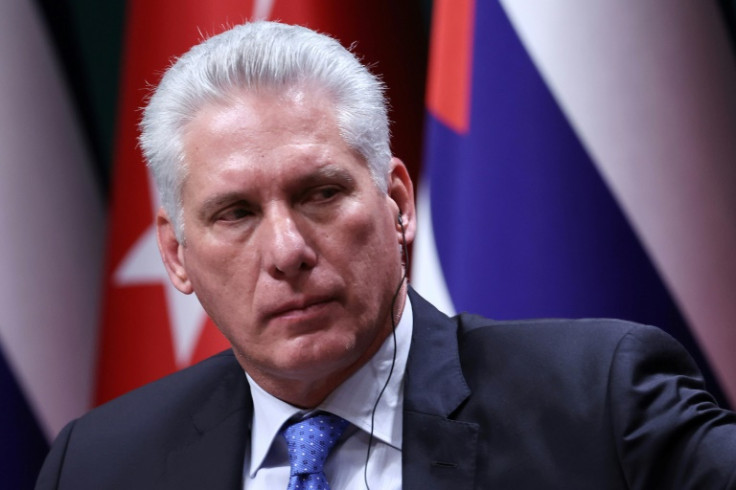
The Trump administration has signaled that Cuban President Miguel Díaz-Canel may need to be replaced as part of potential negotiations over economic and political changes on the island, according to a new report.
A source familiar with the discussions said U.S. officials view Díaz-Canel as "an obstacle" to reforms Washington would like to see in Cuba.
The assessment has been communicated during back-channel contacts between advisers to Secretary of State Marco Rubio and individuals connected to Cuba's ruling establishment, including Raúl Castro's grandson, Raúl Guillermo Rodríguez Castro.
The meeting, first reported by the Miami Herald, appears to have taken place in Saint Kitts during the annual conference of Caribbean Community leaders (CARICOM). Rodríguez Castro is a close aide of Raúl Castro and is involved in running GAESA, the military conglomerate that controls roughly 40% of Cuba's economy. Sources said U.S. officials discussed the possibility of gradually easing sanctions in exchange for reforms on the island.
President Donald Trump has publicly suggested a potential shift in relations. Speaking to reporters at the White House, he said the Cuban government "is talking with us" and added that "we could very well end up having a friendly takeover of Cuba."
The contacts with Rodríguez Castro reflect the belief among some U.S. officials that the Castro family remains the ultimate decision maker in Cuba. One official described the discussions as "discussions about the future," adding that "the U.S. government's position — is the regime has to go."


Removing Díaz-Canel would represent a major shift in Cuba's political system, where Raúl Castro continues to wield influence despite formally stepping aside, as Ricardo Torres, an economist at American University, told the Herald:
"If they do it, it would have to be the result of negotiations with guarantees from both sides, because that would be a drastic change in Cuba. One of the things they have always been careful about is maintaining the idea of institutional stability"
Removing Díaz-Canel, "is not impossible, but it would have to be part of a comprehensive agreement for a major transformation because that decision would be a scandal" in Cuba, he added.
Armando Chaguaceda, a Cuban political scientist at the Mexican think tank GAPAC, added that leadership changes carry symbolic weight even if they do not alter the core power structure. "In these systems, even though we know that power is exercised harshly, symbols matter," he said.
© 2025 Latin Times. All rights reserved. Do not reproduce without permission.


