
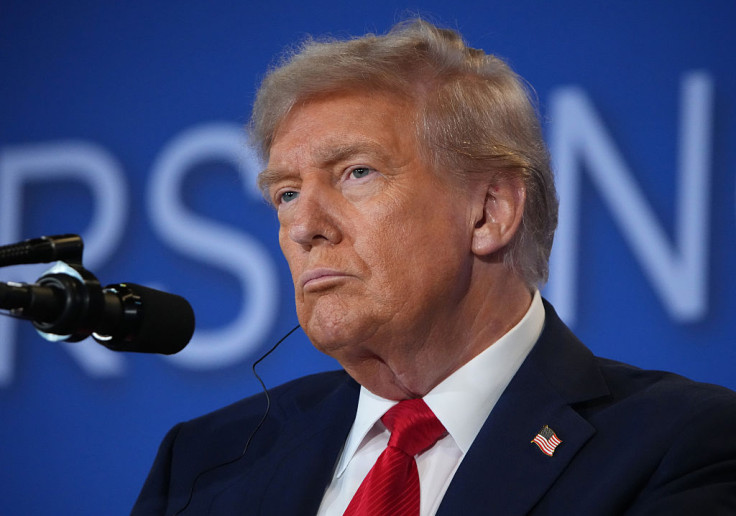
President Donald Trump said that "people" have discussed the possibility of the United States taking control of Iranian oil as the war with the country continues, though he declined to elaborate on whether Washington would pursue such a move.
"Certainly people have talked about it," Trump told NBC News when asked whether the U.S. might pursue such a move.
Trump pointed to Venezuela as an example of how the United States has already sought to secure foreign energy resources. "You look at Venezuela," he told the outlet. "People have thought about it, but it's too soon to talk about that."
The comments came as global energy markets reacted sharply to the conflict. Oil prices briefly surged above $100 per barrel over the weekend amid fears that fighting between the United States, Israel and Iran could disrupt supplies from the Middle East, particularly through the Strait of Hormuz, a shipping route that typically carries roughly one-fifth of the world's oil.
Prices later retreated after Trump suggested the conflict could be short-lived. Oil fell below $90 a barrel on Tuesday after he said the war was "very complete, pretty much," raising hopes that supply disruptions may not last long.
Trump also warned Iran against disrupting oil shipments through the Strait of Hormuz in a Truth Social post on Tuesday, saying the country would be "hit by the United States twenty times harder than they have been hit thus far" if it interferes with the flow of crude.
Energy analysts say the conflict underscores how central oil remains to global geopolitics. Elliott Abrams, who served as a special representative for Iran and Venezuela during Trump's first administration, told The New York Times on Monday that recent events show that "the old game is back more than people thought it would ever be."
The war has already disrupted energy flows across the region. Several refineries have reduced operations and shipping traffic through the Strait of Hormuz has slowed sharply. Qatar has also halted the cooling of natural gas for export, sending gas prices higher in Europe and Asia.
Although oil now accounts for less than 30% of global energy consumption, the world still uses nearly twice as much oil as it did in the early 1970s. "The post-oil world remains far in the future," said David Sandalow of Columbia University's Center on Global Energy Policy to The New York Times.
Higher fuel costs could carry economic consequences for the United States and other major economies. Gasoline prices have already begun rising again in some markets, renewing concerns about inflation.
-
Trump and Putin Have 'Frank and Constructive' Conversation About Venezuelan Oil as Iran War Shakes Global Energy Markets

-
Lindsey Graham Slams Arab Allies Over Iran War: 'I Go To South Carolina And I'm Asking Them To Send Their Sons And Daughters To The Mideast'

-
Trump Reportedly Open To Killing New Iranian Supreme Leader Mojtaba Khamenei If He Doesn't Cave To U.S. Demands


© 2025 Latin Times. All rights reserved. Do not reproduce without permission.


