
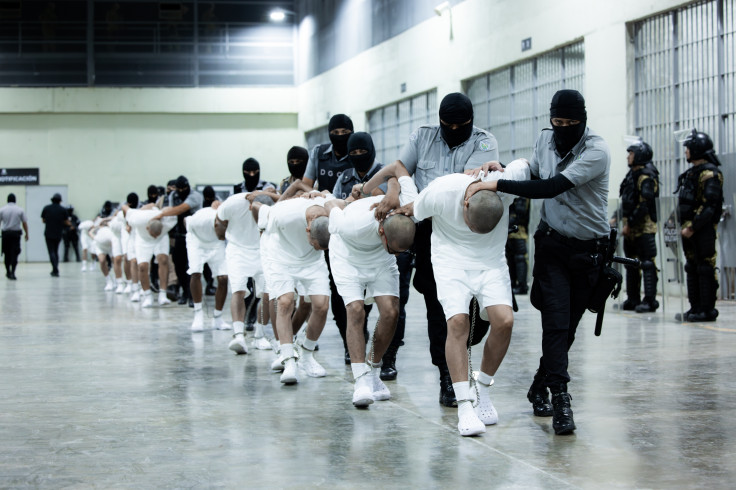
A Venezuelan man deported from the United States and detained in El Salvador's CECOT mega-prison has filed a federal lawsuit seeking at least $1.3 million in damages, alleging he was subjected to abuse amounting to torture.
Neiyerver Adrián Leon Rengel, 28, told CBS News that his time in the prison was "total hell," adding: "There came a point when I thought about hanging myself with the sheet they gave us."
The lawsuit, filed in the U.S. District Court in Washington, D.C., marks the first known case of a former detainee suing the U.S. government over deportations that sent Venezuelan migrants to El Salvador. Leon Rengel alleges false imprisonment and emotional distress after spending roughly four months incommunicado in CECOT before being released in a July 2025 prisoner swap.
In his account, Leon Rengel said detainees were beaten by guards, denied adequate medical care and forced to drink the same water they bathed in.
His claims mirror findings from a joint investigation by Human Rights Watch and Cristosal published back in November which concluded that the treatment of Venezuelan detainees in CECOT constituted "arbitrary detention" and, in some cases, "torture" under international law. The report documented "constant beatings," sexual abuse and severe restrictions on food, hygiene and communication.
-
More Venezuelans Recall Harrowing Experiences At El Salvador's Mega Prison: 'There Was Blood Everywhere'

-
U.S., El Salvador Disappearing and Arbitrarily Detaining Salvadorans Deported From the U.S., Human Rights Watch Claims

-
Secretary of State Rubio Says the U.S. Lost Track of Over 100 Venezuelans Deported Last Year


Additional allegations surfaced after the July 2025 prisoner exchange, when Venezuelan authorities presented testimonies from returned detainees who described solitary confinement, lack of sunlight and physical and psychological abuse. Some detainees reported being targeted based on tattoos that authorities allegedly linked to criminal groups, though those claims were disputed by family members and advocates.
Leon Rengel was among more than 200 Venezuelan men deported to El Salvador in March 2025 under the Alien Enemies Act, a wartime law invoked by the Trump administration. Officials accused the men of ties to the Tren de Aragua gang, but investigations by CBS News and "60 Minutes" found that many had no apparent criminal record.
He also denied any gang affiliation, saying he was identified as a suspect because of a tattoo related to his work as a barber. His lawyers say he was deported despite having an active immigration case and no formal removal order.
The Department of Homeland Security shared a statement with CBS News maintaining that Leon Rengel was a "public safety threat" linked to Tren de Aragua but has not publicly provided evidence, citing national security concerns.
© 2025 Latin Times. All rights reserved. Do not reproduce without permission.


