
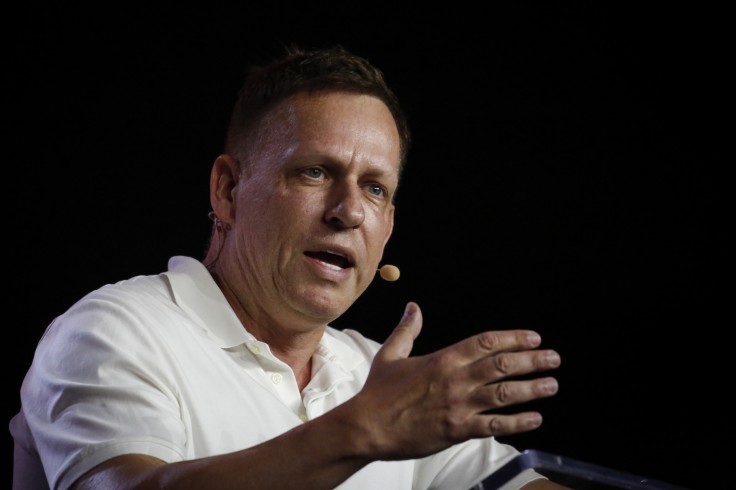
Peter Thiel has spent decades selling the future. Now he appears to be buying an exit ramp in Argentina, and it comes with a Buenos Aires mansion, a presidential friendship, and enough geopolitical intrigue to make Silicon Valley look almost boring.
The billionaire co-founder of PayPal and Palantir, one of the most influential and controversial figures in American tech, has reportedly moved his family to the South American country, purchased a mansion in one of Buenos Aires' most exclusive neighborhoods, and placed himself closer than ever to President Javier Milei, the libertarian leader turning the country into the world's boldest free-market experiment.
The question now hanging over Buenos Aires, Washington, and Silicon Valley is simple: Is Thiel escaping the United States or scouting Argentina as the next frontier for Palantir?
What is confirmed is that Thiel has deepened his presence in Argentina. He met with Milei at the Casa Rosada in April, a meeting the Argentine president later described as "wonderful." Milei said they discussed taxes, agribusiness, and the future of liberalism. He also said the two men share a view of taxes as theft.
"He is an anarcho-capitalist, just as I am philosophically," Milei said of Thiel after the meeting, acording to reporting from the Buenos Aires Times. The president added that Thiel "acknowledged the achievements and asked how they can be sustained over time. " Milei's answer, according to his own account, was politics and cultural war. "I told him that the culture war is what guarantees the long-term outcome," Milei said.
That line alone explains part of the attraction.
-
Bolivia Protests One Month In: 93 Blockade Points, Arrest Warrants Dropped, and a Fragile Opening for Dialogue
-
Colombia's Presidential Election Goes to a Runoff: De la Espriella Leads

-
Trump Admin Targets Brazil's Largest Criminal Networks With Terror Designation, Vows 'Unwavering Commitment to Dismantling Cartels'


Argentina under Milei has become a laboratory for the kind of anti-statist politics Thiel has long supported lower taxes, deregulation, hostility toward bureaucracy and a near-religious belief in markets as a civilizing force. For a billionaire who has warned for years about stagnation, centralized power and Western decline, Milei's Argentina offers something rare: a government that speaks his language out loud.
But Thiel's Argentina story is not only about aligning ideas and goals, since now it has a neighborhood, an address book, and, reportedly, a school run. Local and international reports place him in Barrio Parque, also known as Palermo Chico, the aristocratic pocket of Buenos Aires where embassies, tree-lined streets, and French-style mansions make the neighborhood feel less like the city's beautiful chaos and more like a diplomatic village with better steak. His reported $12 million mansion purchase on Dardo Rocha Street is not just expensive by Argentine standards. It reset the ceiling for one of the capital's most coveted residential markets.
Reports also say Thiel temporarily relocated with his husband, Matt Danzeisen, and their children, and enrolled the children in a local school. The school has not been publicly identified in reliable reporting and should not be named unless a confirmed source does so. But the detail changes the tone of the story, as it suggests a test run for life in Argentina.
According to regional reports, Thiel's Buenos Aires itinerary also included lunch with presidential adviser Santiago Caputo, dinner at Deregulation Minister Federico Sturzenegger's home, and attendance at the River Plate vs. Boca Juniors derby at Monumental Stadium.
Still, the timing of Thiel's reported move has made the story bigger than a luxury real estate purchase. The New York Times said Thiel has spent extended time in Buenos Aires, bought the high-end property, enrolled his children in local school and considered Argentina as a long-term alternative to the United States. Other reports said Thiel's concerns include high taxes, political instability in the United States, artificial intelligence risks and even the possibility of nuclear war. So Argentina may be another hedge. It may also be a prize.
Thiel's company Palantir, where he remains chairman, was built around data integration, intelligence analysis and government work. Its business has long depended on contracts with defense, policing, immigration and national security agencies. In its own 2025 annual filing, Palantir said it derives a significant portion of revenue from contracts with "federal, state, local, and foreign governments and government agencies" and expects its growth to keep depending on government procurement.
Several Argentine and regional outlets speculated after his meeting with Milei and other officials about a possible data or intelligence-related agreement involving Palantir. Neither Milei's government nor Palantir has publicly confirmed such a deal. That caveat is crucial. There is no public proof that Argentina has signed a Palantir contract tied to Thiel's visit.
Still, the suspicion is justified. Palantir has become one of the defining companies of the new security state, a firm that turns scattered public and private data into operational intelligence. In the United States, its software has been used by military, law enforcement, and immigration agencies. In 2025, Palantir secured a major U.S. Army contract worth up to $10 billion over 10 years, reinforcing its role as a central player in government AI and defense technology.
Argentina, meanwhile, is moving closer to Washington under Milei. His government has aligned itself openly with President Donald Trump's administration, pursued deeper defense cooperation and embraced a foreign policy that marks a sharp break from Argentina's previous balancing acts. For Palantir, a pro-U.S., pro-business, anti-bureaucracy government in South America could be more than friendly terrain. It could be strategic terrain.
Thiel has done this before. New Zealand government records confirmed years ago that he received New Zealand citizenship after spending very little time in the country, a decision that later became controversial. Reports have also linked him to efforts to secure additional residency or citizenship options elsewhere.
© 2025 Latin Times. All rights reserved. Do not reproduce without permission.


