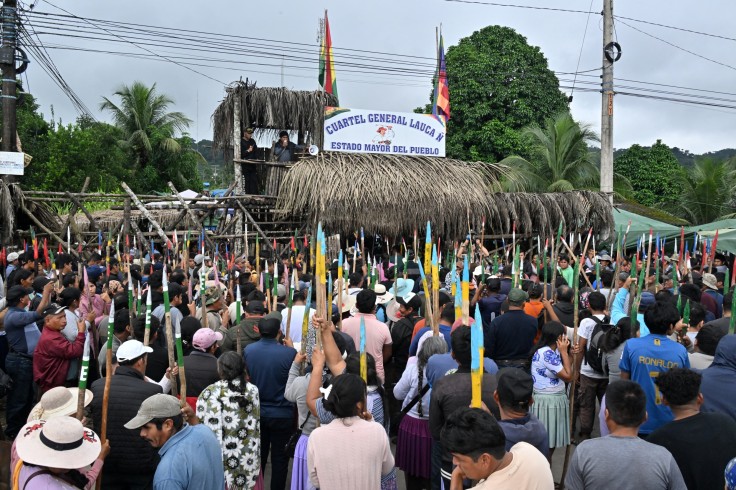
Bolivia has reached over 30 days of nationwide blockades and protests, ignited by President Rodrigo Paz's neoliberal reforms, proposed privatization of indigenous lands, and judicial actions against workers' unions and former socialist presidents Luis Arce and Evo Morales.
The social conflict has had immense repercussions for the country's democracy, stability, and endurance. Paz has said the country is at a "breaking point."
So far, seven people have died, dozens injured, and hundreds arrested. There are now 94 blockade points throughout the country, effectively cutting off the Department of La Paz, and with it the capital, from essential goods and services. Almost no food, fuel, or medicine is entering, and inflation has skyrocketed as a result.
The Paz government has pursued a highly dissonant approach to the protests, reflecting the wide ideological spectrum within its coalition. This ranges from figures formerly affiliated with the MAS and close to indigenous social movements, such as Vice-President Edmand Lara, to more hardline right-wing figures like anti-drug czar Ernesto Justiniano. Though Paz's government openly calls itself "centrist" and "moderate," this dual approach has brought discord to the cabinet's response.
On one hand, the government has prioritized "dialogue and negotiation" with various social sectors. It has issued decrees, repealed laws, and introduced bills to meet their demands. Superminister Jose Luis Lupo and Vice-President Lara have been highly supportive of this diplomacy-forward approach.
Deputies and senators from Paz's Christian Democratic Party (PDC) have even joined marchers. One PDC deputy, who requested anonymity for fear or professional backlash, told Latin Times in La Paz's Plaza Murillo, "Democracy is a continuous process. People have their demands, and we must meet them where they are." Senator Ana Maria Crispin and Deputy Rodolfo Garcia have begun a hunger strike, attracting insults from other PDC politicians.
These politicians have been largely embraced by the mobilizations.


A leader of the Federación Sindical Única de Trabajadores Campesinos de Pando, a trade union, told The Latin Times, "We are glad to see representatives of the government here. This is how we got Law 17-20 (on land titles) abrogated." The person also requested anonymity as they were not authorized to speak for the union. Paz and the vice president have since launched a Social Economic Council and national dialogues to pursue "peaceful resolutions."
However, not all of the government favors this approach. Paz himself has said he will prioritize dialogue only "with those who wish to comply with the law," warning of legal consequences for those who refuse to negotiate.
His foreign affairs minister, Fernando Aramayo, threatened media reporting "false information" or participating in blockades with legal reprisal. Arrest warrants have been issued against leaders of the Bolivian Workers' Center (COB) trade union federation and the Tupac Katari Federation, an indigenist political movement. The government coalition in Congress repealed law 1341, thus authorizing Paz to declare a state of exception.
Some in government have linked protesters to criminal activity. The Vice Minister for the Coordination of Social Movements claimed protesters are "being paid and coordinated by Evo Morales, and linked to drug trafficking." To that end, Justiniano has negotiated cooperation agreements with the U.S. Drug Enforcement Agency (DEA), which then-president Morales had expelled over political interference.
Prominent right-wing figures in Santa Cruz, including former president Tuto Quiroga and Comité Pro Santa Cruz Vice President Agustín Zambrana, argue Bolivia risks becoming a failed state. Zambrana insists, "the law should be applied to the criminal blockades."
This right flank has called for a "state of exception," with some even urging U.S. or regional military intervention. Representatives of the Trump administration, an ally of Paz, have called protesters "terrorists and drug traffickers." Yet Vice-President Lara has openly criticized this repression campaign, creating rifts within Paz's big-tent government.
Facing this heavy-handed approach, some groups, including the COB and the Katarista Federation, have refused negotiations entirely, committing to continue blockades until Paz resigns, and warning that any splinter group negotiating will be considered "traitors."
Fernando Cerimedo, a close advisor to Paz linked to right-wing politicians including Argentina's Javier Milei and the Bolsonaro family in Brazil, has said all calls for Paz's resignation are illegitimate and should be treated criminally.
These splits within the cabinet and among mobilized sectors have created an air of unpredictability in La Paz, where debates between dialogue and repression could lead to highly varied outcomes for the country's democratic and institutional survival.
Author Bio:
Joseph Bouchard is a contributing reporter for Latin America Reports. He's a journalist and researcher from Québec covering security and democracy in Latin America, currently based in La Paz, Bolivia. His articles have appeared in Drop Site News, The Intercept Brasil, Responsible Statecraft, and Le Devoir, among others.
© 2025 Latin Times. All rights reserved. Do not reproduce without permission.


