

A joint operation involving U.S. and Mexican forces in the town of Tapalpa, Jalisco, ended with the capture and killing of Nemesio Oseguera Cervantes, also known as "El Mencho," the leader of the Cártel Jalisco Nueva Generación (CJNG).
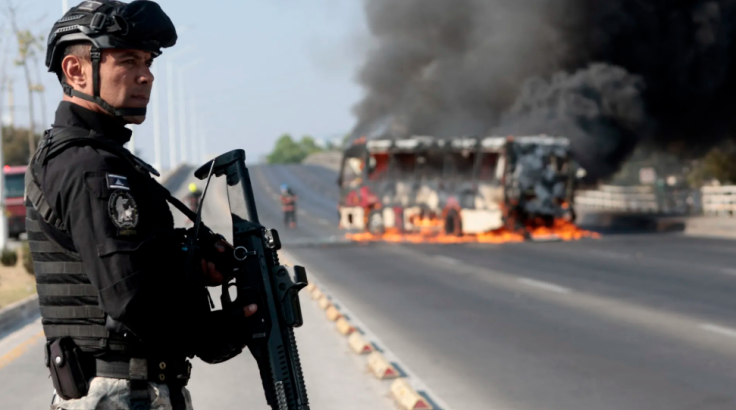
After news of the operation broke, several areas of Jalisco descended into chaos as alleged members of the Jalisco cartel set fire to businesses, blocked highways and caused damage in apparent retaliation for the death of their leader.
Similar to what has happened in Culiacán, Sinaloa, when Mexican authorities captured key members of the Sinaloa cartel, an expert warned that the violence unleashed by organized crime in Jalisco is only a glimpse of the broader consequences stemming from the operation to capture El Mencho.


According to security consultant and analyst Eduardo Guerrero, the cartel leader's death was a significant blow that will likely trigger widespread fragmentation within the CJNG. He warned that the Mexican government will now face what he described as "a wounded beast."
"Without a doubt, this is an event of enormous significance. We are talking about the death of the leader of Mexico's largest criminal organization. A cartel that, since its birth about 10 years ago, has done nothing but expand in a highly aggressive and highly effective manner," Guerrero told Mexican outlet Letras Libres.
"Precisely because of the enormous size of this organization, the probability of fragmentation is very high. What remains to be seen is how many people from El Mencho's inner circle were arrested. If authorities only detained him and his close leadership circle remains intact, the fragmentation would be more limited. It is very likely there will be collaboration and coordination among them to defend the cartel's survival and guarantee a minimum level of unity," he added.
When asked about the consequences of an operation of this magnitude, Guerrero said he hopes the Mexican government has a post-arrest strategy in place, as that will determine how authorities respond to reprisals by the CJNG.
"I hope that in the coming days we see arrests of regional leaders. While it is true that the CJNG has a presence throughout the country, its level of control and influence varies significantly across the national territory. There are places such as the state of Jalisco where not even a leaf moves without the cartel knowing about it," Guerrero said, pointing to the cartel's control over local and state law enforcement, the courts and even parts of the business sector.
"The restructuring that will take place within the cartel, the uncertainty, and the fears among regional leaders that they could lose their areas of influence will generate enormous internal tension, which serves as a trigger for more violence," the expert added.
Guerrero said one important factor to consider is the role of the United States in the operation, which for years had been "obsessed with El Mencho's capture."
He pointed to a statement issued weeks ago by the Bureau of Western Hemisphere Affairs in which the U.S. government rejected the gradualist strategy of President Claudia Sheinbaum's administration and called for more forceful blows against organized crime in Mexico.
"That statement was issued at the same time as other conciliatory messages following a meeting between Marco Rubio and Mexico's foreign minister. That's when it became clear to me that, beyond diplomatic courtesies, security in Mexico was a priority for them — and that they were pushing for a shift toward a much more aggressive strategy. This pressure and demand from the United States for more drastic, more forceful actions with short-term results is a key element we must consider in explaining this action by the Mexican government," Guerrero said.
Mexico's top security official, Omar García Harfuch, said the operation triggered reprisals by the cartel in 11 states, including highway blockades. Harfuch said that in Jalisco, six attacks were reported, resulting in the deaths of 25 National Guard members, one official from the Jalisco state prosecutor's office, one woman and 30 alleged criminals.
© 2025 Latin Times. All rights reserved. Do not reproduce without permission.


