
Forty days after launching military strikes in Iran, the armed conflict involving the United States, Iran and Israel persists despite reports of a ceasefire that lasted only a few hours.
In the 40 days since the start of Operation Epic Fury, the U.S. code name for its joint military operations with Israel against Iran, the conflict has left thousands of people dead across the Middle East, as well as 13 U.S. service members killed and 381 others wounded, according to data from U.S. Central Command.
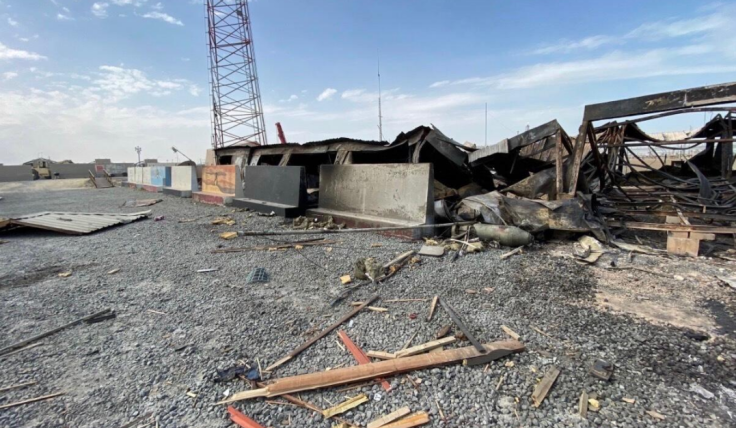
In the deadliest Iranian attack on U.S. forces since the war began, six service members were killed when a missile struck a tactical operations center in Kuwait on March 1.
At the time, Defense Secretary Pete Hegseth described the drone as a "squirter," suggesting it slipped through the radars and defenses of the fortified unit. But according to a CBS News report, some survivors dispute that account, saying their base in Kuwait was left dangerously exposed.
"Painting a picture that 'one squeaked through' is a falsehood," one of the injured soldiers told CBS News. "I want people to know the unit ... was unprepared to provide any defense for itself. It was not a fortified position."


The service members, who spoke on condition of anonymity due to military media restrictions, said that despite the chaos inside the facility, those present responded with speed and valor that saved many lives.
"I don't think that the security environment or any leadership decision diminishes in any way their sacrifice or their service," one member of the Army's 103rd Sustainment Command said. "Those soldiers put themselves in harm's way and ... I'm immensely proud of them, and their family should be proud of them."
Hours before the March 1 attack, service members at the Kuwait base said incoming missile alarms prompted a crew of about 60 troops to take cover as a ballistic missile flew overhead. Shortly after, an all-clear was issued and troops returned to their activities until about 30 minutes later, when "everything shook," one soldier told CBS News, describing the scene as something out of a movie.
"Head wounds, heavy bleeding, lots of perforated eardrums, and then just shrapnel all over, so folks are bleeding from their abdomen, bleeding from arms, bleeding from legs."
According to the report, U.S. troops stationed in Kuwait were asked to relocate to positions in Jordan and Saudi Arabia in an effort to move farther from Iranian missile range, with leadership telling troops the relocation was temporary and to leave behind most personal equipment, including military-issued computers.
For members of the Army's 103rd Sustainment Command in Kuwait City, CBS News reported the orders were different. They were told to pack everything and relocate to the Port of Shuaiba, a tactical operations center with steel-reinforced concrete barriers designed to protect against mortar or rocket blasts, but offering no protection from aerial attacks such as drones or missiles.
One soldier told the outlet troops were protected by little more than a thin layer of vertical blast barricades that provided no overhead cover.
"From a bunker standpoint, that's about as weak as one gets," he said.
The accounts from witnesses and survivors sharply contrast with Hegseth's description. While the defense secretary said the drone strike hit a fortified operations center, those on the ground say that was far from the reality.
"It's not my intent to diminish morale or to disparage the Army or the Department of War more holistically, but I do think that telling the truth is important, and we're not going to learn from these mistakes if we pretend these mistakes didn't happen," one soldier said.
Asked whether the attack was preventable, one soldier told CBS News: "In my opinion, absolutely, yes."
"I am very sad for their loss and it's something I'll carry with me for the rest of my life," he said. "But I'm also immensely proud of them and their sacrifice, and their family should be too."


© 2025 Latin Times. All rights reserved. Do not reproduce without permission.


