
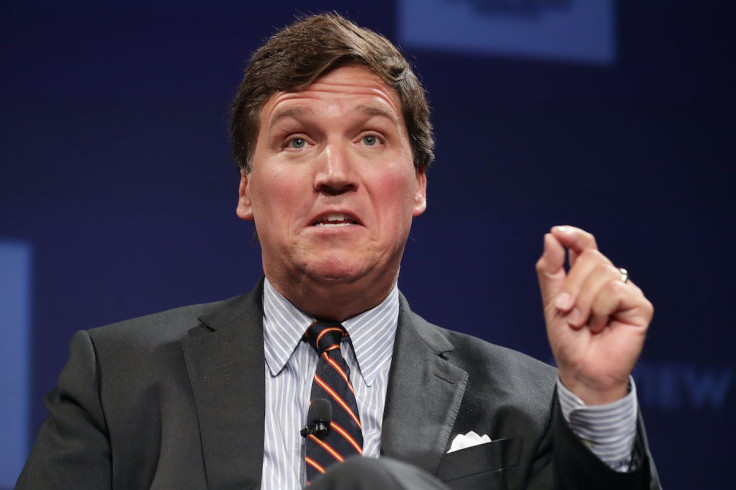
Conservative pundit Tucker Carlson is taking his media brand deeper into publishing with a new Skyhorse partnership, but the launch is drawing immediate attention not just for its politics but also for the baggage attached to its first slate of authors.
The new imprint, Tucker Carlson Books, will publish through Skyhorse Publishing in partnership with Carlson's Tucker Carlson Network, according to a report published Monday by The Wall Street Journal. Among the first announced authors are British comedian Russell Brand (Katy Perry's ex,) Milo Yiannopoulos, and Dr. Patrick Soon-Shiong, three figures whose names each carry their own mix of controversy, notoriety, and public debate. Brand's upcoming title is listed as How To Become a Christian In Seven Days, Yiannopoulos' as Ex Gay, and Soon-Shiong's as Killing Cancer.
That lineup gives the launch a sharper edge than a typical celebrity publishing announcement. Carlson and Skyhorse are not just entering the book business; they are doing so by centering writers who already live at the intersection of politics, scandal, and culture-war branding. Skyhorse publisher Tony Lyons told the Journal that his company is known for backing books other publishers reject, while Carlson framed the imprint as a home for original ideas and arguments outside the mainstream.
The most combustible name on the list is Brand.
The British comedian and media personality is currently facing a criminal case in the United Kingdom. London's Metropolitan Police said in April 2025 that Brand had been charged with one count of rape, one count of indecent assault, one count of oral rape and two counts of sexual assault involving four women and alleged incidents between 1999 and 2005. Prosecutors later authorized two additional charges, and Reuters reported last month that Brand's trial on seven charges relating to six women is now scheduled for October 2026. Brand has denied the allegations and pleaded not guilty.
-
Pope Leo to Trump: I'm Not Afraid, and I Won't Stop Preaching Peace

-
'Cuba After Castro': A Bold Documentary that Shows Díaz Canel's Positions Before the Current U.S. Crisis and Why Things Could Be Different - INTERVIEW

-
Donald Trump Post a Religious Style Image of Himself as God After Attacking the Pope Twice


That legal backdrop is likely to shape coverage of the new imprint far more than Brand's book title itself. Carlson's decision to put Brand at the front of the launch turns what might have been a business story into a broader test of how far personality-driven publishing can lean into controversy without letting the controversy become the product. That is especially true because the case against Brand is not historical gossip or civil litigation alone. It is an active criminal matter in Britain.
Yiannopoulos brings a different kind of reputational history. Reuters reported in 2017 that he resigned from Breitbart after backlash over comments that appeared to condone certain sexual relationships between adult men and teenage boys. The fallout also cost him a book deal at the time. His inclusion in Carlson's opening roster reinforces the impression that the imprint is deliberately marketing itself around figures who were pushed out of more conventional publishing lanes.
Skyhorse, for its part, has long cultivated that niche. The independent publisher has built a reputation for picking up titles or authors seen by supporters as "canceled" and by critics as radioactive. Carlson's imprint appears designed to plug directly into that model while extending his brand beyond video, commentary, and subscription media into books that can keep his audience engaged between broadcasts and election cycles. The Journal said the arrangement includes a revenue-sharing agreement, underscoring that this is not a one-off licensing deal but part of a broader business expansion for Carlson and his network.

Soon-Shiong's presence in the launch also adds a different layer of intrigue. Unlike Brand and Yiannopoulos, he is better known as a billionaire surgeon, biotech entrepreneur, and owner of the Los Angeles Times than as a culture-war provocateur. But his recent appearances on Carlson's show suggest the imprint is being built as an extension of Carlson's interview universe, where guests can move from long-form conversation into book publishing under the same ideological umbrella.
In that sense, Tucker Carlson Books is launching less like a traditional imprint and more like a branded ecosystem. The message is clear. Carlson is not trying to compete for the literary middle. He is building a publishing lane where controversy is not a liability to work around, but part of the commercial pitch.
© 2025 Latin Times. All rights reserved. Do not reproduce without permission.


