
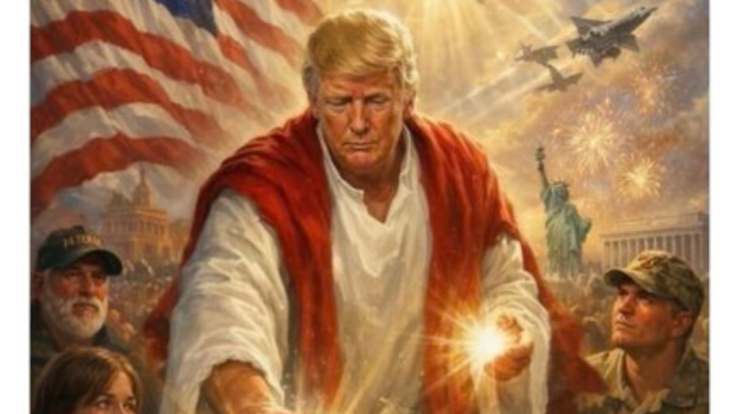
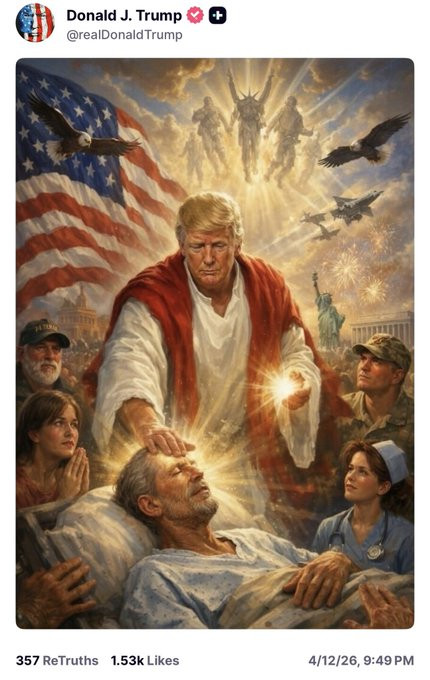
President Donald Trump deepened his already fraught clash with the Vatican and Pope Leo XIV late Sunday by posting a striking, religiously charged image of himself with glowing hands over a man in a hospital bed, surrounded by soldiers, a nurse, angels, fighter jets, and an enormous American flag.
The image, shared after a day of attacks on the pontiff, was a personal escalation in a relationship that has been deteriorating for months.


The post came after Trump had already lashed out at the first American pope in a lengthy social media message, calling him "WEAK on Crime" and "terrible for foreign policy," demanding that Leo "get his act together as Pope," language that underscored how openly combative the White House has become toward a Vatican that has increasingly challenged the administration on war and policies about immigration.
I doubt Pope Leo XIV will lose any sleep over this, before he begins his pilgrimage to Africa tomorrow. But the rest of us should. Because it is unhinged, uncharitable and unchristian. Is there no bottom to this moral squalor? pic.twitter.com/XRr9lpv4ZF
— James Martin, SJ (@JamesMartinSJ) April 13, 2026
Hours later, after returning to Washington from Florida, Trump took the criticism from the screen to the tarmac as he told reporters he was not a "big fan" of Pope Leo and questioned the pontiff's performance, intensifying what is already one of the sharpest public disputes between a US president and the leader of the Roman Catholic church in recent memory.
Reporter: Why did you attack Pope Leo?
— Acyn (@Acyn) April 13, 2026
Trump: I don’t think he’s doing a very good job. He likes crime I guess. We don’t like a pope who says it’s ok to have a nuclear weapon. We don’t want a pope that says crime is ok. I am not a fan of Pope Leo. pic.twitter.com/cj3oh1jSIL
Soon after was the post on Truth Social.
The immediate backdrop was CBS's 60 Minutes, which aired a segment on Sunday night that put Pope Leo's own criticism of war and deportation policy in front of a large American audience and then amplified it through three senior US cardinals: Joseph Tobin of Newark, Robert McElroy of Washington, and Blase Cupich of Chicago.
CBS reported that the men were unusually direct in discussing Iran, immigration, and the moral consequences of government power and that they had been emboldened by the Pope's own increasingly outspoken tone.


Leo's words in the interview, which was taped in March, were measured but hardly mild. Asked about the Middle East, he said, "I am praying for peace," adding that he hoped "ceasefire would be the most effective way" to find "peace for all parties." CBS also noted that the pope had recently called Trump's threat to destroy Iranian civilization "truly unacceptable," a remarkable rebuke from a Vatican that is often careful to avoid direct confrontation with world leaders.
The pope then moved beyond moral language into something closer to civic instruction. "Contact the authorities, political leaders, and congressmen to ask them and tell them to work for peace and to reject war always," he said. CBS also highlighted a Palm Sunday warning in which Leo said Jesus "does not listen to the prayers of those who wage war," a line widely interpreted as a response to the religious framing some administration figures have used around the conflict with Iran.
The cardinals made the critique even sharper. McElroy said bluntly that the Iran conflict did not meet Catholic standards for a just war, telling CBS, "No, in the Catholic teaching this is not a just war," before calling it "a war of choice." Cupich attacked the administration's online presentation of the conflict, saying, "We're dehumanizing the victims of war," and called that style of messaging "sickening." On immigration, McElroy said fearful parishioners "live under fear," while Cupich rejected the idea that voters had endorsed indiscriminate mass deportation, saying, "We really didn't vote for this."
For the first time, three of America's most influential cardinals and archbishops agreed to a joint interview, sharing their candid take on war in Iran, immigration, and the future of the Catholic Church. Sunday on 60 Minutes. https://t.co/mEN4CWeXMW pic.twitter.com/7iXl6MTR1P
— 60 Minutes (@60Minutes) April 11, 2026
The tensions between Washington and the Vatican did not begin with Sunday's broadcast.
The feud has been building in public and in private, especially since Leo emerged as a pointed critic of Trump's foreign policy.
One of the clearest signs of strain came in January, when Cardinal Christophe Pierre, then the Vatican's ambassador to the United States, was hosted at the Pentagon for what The Washington Post described as a rare and highly unusual meeting. The Post reported that the discussion followed Vatican concern over administration actions in Venezuela, Minneapolis, and elsewhere and that one senior Vatican official later described the encounter as "unusual" and "not a walk in the park." The same report said Pentagon officials sought to justify US military activity as a legitimate path to peace, exposing a deep divide with the Vatican over war, power, and diplomacy.
Vice President JD Vance, a Catholic who has often been seen as one of the administration figures most sensitive to church politics, tried to cool that episode, at least publicly.
Vance said he wanted to speak directly with Cardinal Pierre and with US officials "to figure out what actually happened." Soon afterward, both the Pentagon and the Vatican described the meeting in softer terms, with the Vatican saying narratives of a hostile confrontation were "completely untrue."
Even so, Vance has not entirely closed the distance between the administration and the Vatican. In separate comments, the vice president stopped short of echoing Trump's declaration that God was on the side of the United States in the Iran war, saying instead that he prayed America was "on God's side."
The timing of Trump's late-night image also sharpened the symbolism. On Monday, Pope Leo begins a 10-day Africa tour through Algeria, Cameroon, Angola and Equatorial Guinea, a demanding trip that is meant to draw attention to Africa's needs, the exploitation of natural resources, Muslim-Catholic dialogue, and political corruption in parts of the continent. In other words, just as Leo is trying to project a global pastoral vision, Trump has chosen to answer with grievance, spectacle, and an image that many critics are already reading as messianic self-mythology.
© 2025 Latin Times. All rights reserved. Do not reproduce without permission.


