
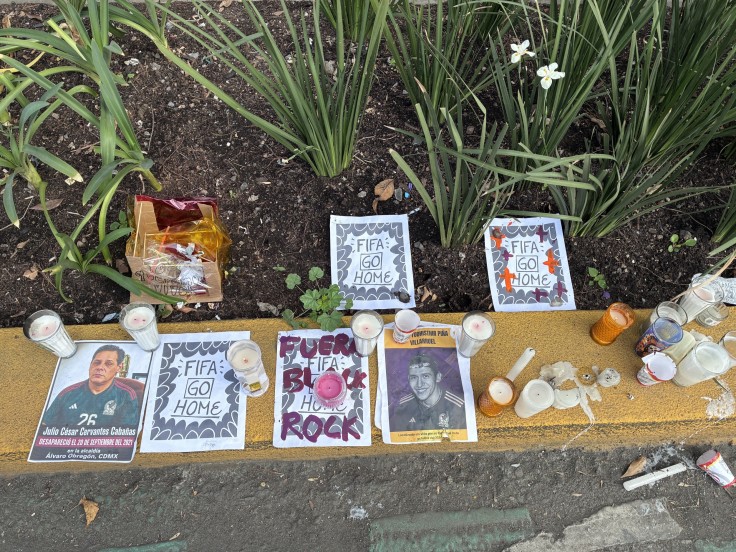
While much of the world's attention was focused on the opening match of the 2026 FIFA World Cup at the Mexico City Stadium, relatives of missing persons took to the streets on June 11 to draw attention to a crisis that has gripped Mexico for decades: more than 130,000 people who have disappeared all across the country.
When Mexican authorities have been unable to provide answers, citizen groups have often stepped in to search for clues about the fate of their loved ones. Among the most prominent groups are the Madres Buscadoras, collectives made up largely of women searching for their missing relatives who, for years, have traveled to some of Mexico's most remote regions in search of clandestine graves and burial sites where many of those who disappeared have ultimately been found.
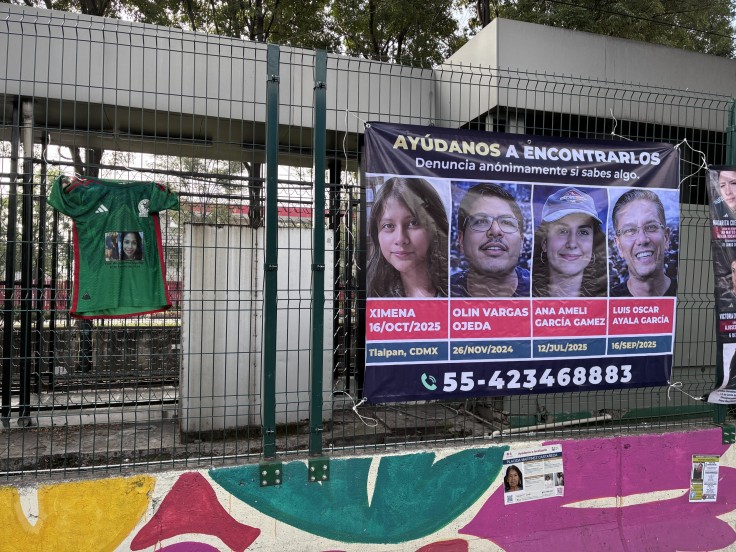
The June 11 protests featured signs and banners bearing the faces of children, adolescents, adults and even the elderly. Among the hundreds of faces placed against walls, sidewalks and even pedestrian bridges one could see Olin Vargas Ojeda's face, a young man who vanished on Oct. 15, 2025, just a few miles from where the World Cup opening match was held.

There was also the face of Alfonso Cruz Pérez, a 47-year-old man who was last seen July 30, 2024, in Yajalón, Chiapas. Another was Jeshua Cisneros Lechuga, a young man who disappeared in Cuautitlán Izcalli, in the State of Mexico, on Nov. 13, 2025. According to relatives and activists, he was last seen getting into a municipal police vehicle and his whereabouts have remained unknown ever since.
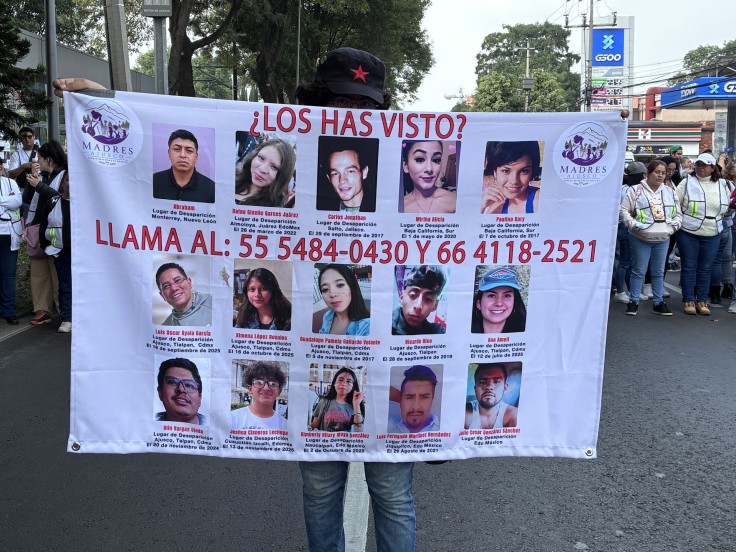
And although the photographs cannot speak, the faces on the banners tell a cruel story about Mexico that is often hidden from the international spotlight. That is why multiple groups of Madres Buscadoras from across the country chose June 11 to take to the streets and share their stories.
"Let the world know that Mexico has more than 132,000 missing persons, 14 femicides a day and, from January to now, 40 transfemicides," a protester dressed as the iconic Angel of Independence, one of Mexico City's most recognizable monuments, told The Latin Times. "We are living through a crisis of violence, and it is important for the world to know it."
As the woman noted, the number of missing people in Mexico over the past several decades would be enough to nearly fill two Azteca Stadiums. She urged people in Mexico and abroad not to remain indifferent to the pain of families who, after months and in many cases years, continue searching for their loved ones.
Many of the people interviewed during the protest agreed on two points: that Mexico remains a violent country and that the government, rather than helping them, has sought to silence their voices.
The Madres Buscadoras groups held their peaceful march just minutes from the stadium, hoping to reach the gates of the venue and bring their message to a global audience. But those plans were cut short when a group allegedly affiliated with a "contingent for peace" blocked their path.
Vanessa Gámez, one of the leaders of Madres Buscadoras del Ajusco and the mother of Ana Amelí García Gámez, who disappeared in July 2025 about six miles from the Mexico City Stadium, told The Latin Times that members of the contingent of peace group had been paid by the government to prevent protesters from reaching their destination.
"We just wanted to pass, but riot police and people working with the government blocked our way," said the mother of Ximena López Rosales, a young woman who disappeared in October of last year in the Tlalpan borough of Mexico City. She said the purpose of the protest was to raise awareness of Mexico's missing persons crisis, despite what she described as government efforts to downplay it.
César García told The Latin Times that this type of response from authorities has become familiar at the many demonstrations he has attended.
"It's incredible how the government wants to create confrontations between civilians. We came here for a peaceful march," he said.
García is another indirect victim of Mexico's missing persons crisis. His mother, Plácida Martínez Castañeda, left her home one October morning in the Tlalpan borough and has not returned since.
"Our theory is that my mother disappeared when she went to a street market near her home on Oct. 20, 2024. We've spent more than a year and a half searching for her."
During her daily news conference on June 12, Mexican President Claudia Sheinbaum was asked about the protests that took place across Mexico City on the day of the World Cup opener, but her response left many questions unanswered.
"Some people wanted to project a different image of Mexico," Sheinbaum said. "But the image of Mexico is the joy and happiness of its people. The ones who had a bad time are those who want Mexico to do badly."
Smiling as she responded, Sheinbaum emphasized that the celebration inside the stadium had not been overshadowed by any of the demonstrations.
@latinus_us La presidenta Claudia Sheinbaum afirmó este viernes que durante la inauguración del Mundial de Futbol algunas personas intentaron mostrar otra imagen de México, en alusión a las manifestaciones de maestros, madres buscadoras y otros colectivos en las inmediaciones del Estadio Azteca. En conferencia de prensa, la mandataria afirmó que hubo una fiesta en México, la cual se vio reflejada con la celebración del triunfo de la Selección Nacional en distintas partes del país. #Latinus #InformaciónParaTi
♬ original sound - Latinus - Latinus
The sense of joy and celebration Sheinbaum described was far removed from what could be seen on the faces of the families of those missing who attended the march.
María de Jesús Soria joined the protest in solidarity with families still searching for their loved ones. She eventually located her son, Iván Yan Carlos Ibarias Soria, but only after his remains were found in a clandestine grave in the state of Veracruz.
"The National Guard and the Veracruz state prosecutor's office had my son's remains as far back as 2018. In 2019, 2020 and 2021, they kept showing me a skull that wasn't Iván's," she said.
After years of searching for answers, Soria said investigators were able to identify her son's remains thanks to discoveries made by search groups in Arbolillo, Veracruz.
Soria said a soccer match pales in comparison to the suffering endured by families still searching for answers.
"There are so many faces that people need to look at. Claudia Sheinbaum is giving so much importance to an event that, for families of the disappeared, means nothing. They say 'the ball returned home,' but the children of my fellow mothers, of my sisters in this search, when will they return?"


© 2025 Latin Times. All rights reserved. Do not reproduce without permission.


