
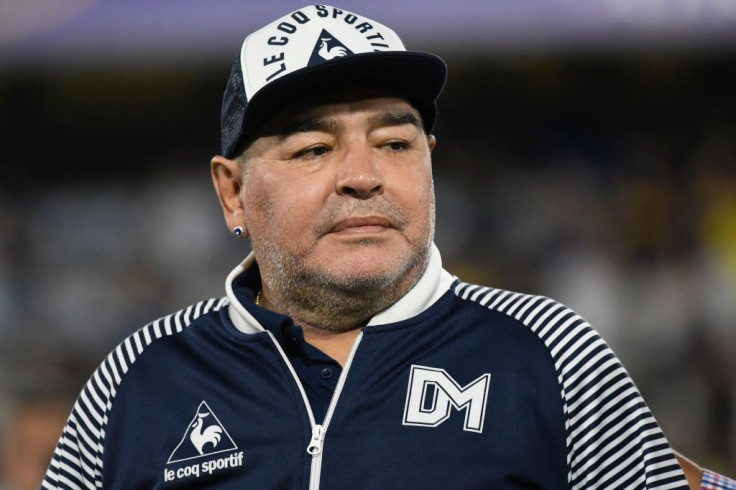
A psychologist accused in the death of Diego Maradona told an Argentine court that the soccer legend had bipolar disorder and narcissistic personality traits, testimony that shifted attention to the star's mental health, addiction history, and the medical care he received in his final weeks.
Carlos Díaz, a psychologist and addiction specialist who treated Maradona shortly before his death, testified in Buenos Aires that the former Argentina captain had multiple chronic conditions, including substance addiction, bipolar disorder, and narcissistic personality disorder. He is one of seven medical professionals on trial for alleged criminal responsibility in Maradona's death.

"There was bipolar disorder and narcissism," Díaz said, according to Argentine newspaper Clarín. "He could bring a country to its knees, but one glass of alcohol could bring him to his knees."
Maradona remains one of the most revered and controversial figures in soccer history. He led Argentina to the 1986 World Cup title, played for clubs including Boca Juniors, Barcelona, and Napoli, and spent decades as both a sporting idol and a public symbol of excess, genius, and vulnerability.
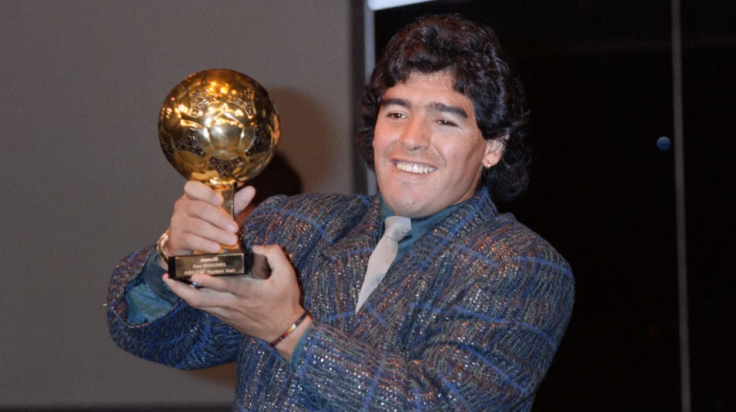
Now, nearly six years after his death, the trial is forcing Argentina to revisit the final chapter of a national icon whose life was often treated as public property.
He died on Nov. 25, 2020, at age 60, while recovering at a private home outside Buenos Aires after surgery for a subdural hematoma, a blood clot between the brain and its outer covering. Prosecutors say members of his medical team failed to provide proper care and left him in conditions that were dangerously inadequate. The defendants deny wrongdoing.
The current proceedings are a retrial. A first trial began in March 2025 but collapsed two months later after a judge resigned for breaching judicial protocols, Reuters reported. The new trial began April 14 in San Isidro, near Buenos Aires, and is expected to include testimony from nearly 100 witnesses, including members of Maradona's family.
The seven defendants include doctors, a psychiatrist, the psychologist, and nurses who were involved in Maradona's care. They are charged with negligent homicide, which could carry prison sentences of eight to 25 years if convicted. An eighth nurse is expected to be tried separately.
Díaz, 34, is accused of manslaughter with reckless intent for allegedly prescribing improper medication. In court, he argued that his role was focused on addiction treatment and that Maradona required a strict alcohol-free plan because of his psychological and substance use history.


Diaz said he met Maradona less than a month before the star died and was alarmed by his alcohol use. He also testified that Maradona wanted to change and that his treatment plan was based on abstinence, while adding that toxicology reports showed Maradona had remained drug-free for 23 days before his death.
The testimony gives the defense another argument in a trial centered on whether Maradona died because of medical negligence or because of an already fragile health condition worsened by years of addiction and chronic illness. Prosecutors have described the home-care setup as grossly inadequate, while the defense has argued that Maradona's death was sudden and linked to his complex medical history.
The trial has already included emotional testimony from people close to Maradona. Verónica Ojeda, Maradona's former partner and the mother of his youngest son, told the court that the defendants "killed the father of my son," according to El País. A doctor who was called to the house on the day of Maradona's death described what he saw as signs of neglect and said the home lacked adequate medical equipment, the newspaper reported.
Neurosurgeon Leopoldo Luque, another defendant and one of the most visible figures in the case, has denied responsibility, althought he admited that Maradona's home-care arrangement was suitable, though not equivalent to intensive care.
© 2025 Latin Times. All rights reserved. Do not reproduce without permission.


