
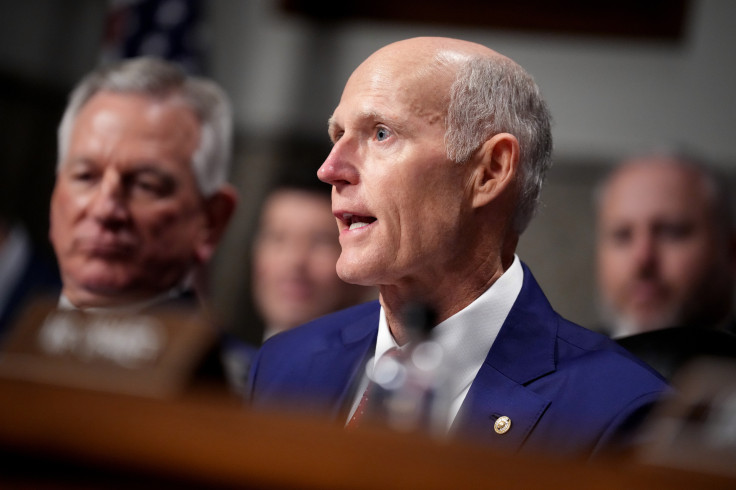
Florida Senator Rick Scott issued a warning to Venezuela's interim president over the appointment of a regime loyalist after the ousting of longtime Defense Minister Vladimir Padrino Lopez.
Reacting to the appointment of Gustavo Gonzalez Lopez, Scott said that while Padrino Lopez's departure is welcome news, his replacement is "NOT progress."
Good to hear Vladimir Padrino López was removed from his position — but replacing one regime loyalist with another is NOT progress.
— Rick Scott (@SenRickScott) March 20, 2026
If Delcy Rodríguez truly wants to collaborate with the United States, she must stop recycling the same corrupt and brutal insiders like Gustavo… https://t.co/a6HvGZfJD6
"If Delcy Rodríguez truly wants to collaborate with the United States, she must stop recycling the same corrupt and brutal insiders like Gustavo González López. The Maduro regime will NOT fool us — we are watching every step," Scott added in a social media publication.
Venezuelan human rights watchdog Provea said the appointment is a "recycling of impunity." Gonzalez Lopez was the head of Venezuela's intelligence service Sebin between 2014 and 2018 and 2019 and 2024.
Juanita Goebertus, director of the Americas division of Human Rights Watch, told the BBC that the appointment means "keeping the repressive structure intact and rewarding someone who should be investigated for very serious human rights violations, including torture or arbitrary detentions".
He was sanctioned during the second Barack Obama administration, with the White House then claiming that he was "responsible for or complicit in ... significant acts of violence or conduct that constitutes a serious abuse or violation of human rights".
He is believed to hold a "prominent role in the repressive actions against the civil population during the protests" in the country, with crimes including "hundreds of forced entries and extrajudicial detentions."
A recent report detailed that Venezuela transferred an estimated $64 billion in oil wealth to Cuba over two decades, helping build a Cuban-led intelligence and security apparatus tied to political repression and social control.
Obtained by The Miami Herald, it traces the origins of the alliance to a 2000 agreement between Hugo Chávez and Fidel Castro. While publicly framed as an exchange of oil for social services such as doctors and teachers, researchers say the relationship evolved into a deeper security partnership.
Through loosely defined agreements, Cuban personnel provided intelligence training, strategic advising and operational support that expanded over time.
Central to that effort was the creation of GRUCE, a coordination structure established in 2008 that embedded Cuban intelligence within Venezuela's security apparatus. Alongside the civilian intelligence agency SEBIN and the military counterintelligence body DGCIM, the system formed what analysts describe as a coordinated structure aimed at detecting and neutralizing dissent.
The United Nations' Independent Fact-Finding Mission on Venezuela has linked those institutions to systematic abuses. In a May 2025 statement, the mission said detentions carried out by state security forces are part of a "deliberate plan" to silence opponents and "instill fear among the population." It warned that holding detainees in isolation and incommunicado conditions is "an illegal and perverse practice that can constitute an international crime."


© 2025 Latin Times. All rights reserved. Do not reproduce without permission.


