
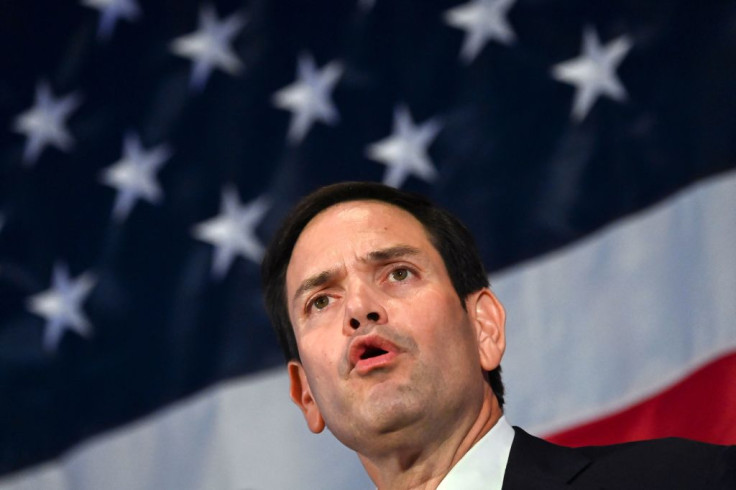
Secretary of State Marco Rubio accused Cuba's government of blocking a major U.S. humanitarian aid offer, saying during his visit to Italy and the Vatican that Washington wants to help Cubans struggling under worsening shortages but that Havana is standing in the way.
"We've offered the regime there $100 MILLION dollars of humanitarian aid that, unfortunately, so far, they have not agreed to distribute to help the people of Cuba," Rubio said. "So we did the hurricane relief, but we're offering more, and it's the regime that's not accepting it."
The comments came as Rubio met with Pope Leo XIV and Italian officials during a diplomatic trip that included discussions about Cuba, Venezuela, Iran, Lebanon, and other global flashpoints. The Vatican said Rubio's meetings included attention to countries facing "political tensions" and "difficult humanitarian situations," while U.S. officials said Cuba was among the Western Hemisphere topics discussed.
🚨 MARCO RUBIO WANTS TO MOVE ON CUBA
— Eric Daugherty (@EricLDaugh) May 8, 2026
"We've offered the regime there $100 MILLION dollars of humanitarian aid that unfortunately, so far, they have not agreed to distribute, to help the people of Cuba!"
"So we did the hurricane relief, but we're offering more, and it's the… pic.twitter.com/XYftFMdzEq
While the Secretary of State was in his fence-mending mission in Italy, ABC news was broadcasting an interview with Cuban Foreign Minister Bruno Rodríguez, who warned that the United States is on a "dangerous path" that could lead to a "bloodbath in Cuba"-
"It seems that the U.S. government has chosen a dangerous path, a path that could lead to unimaginable consequences, to humanitarian catastrophe, to genocide, and to the loss of Cuban and young American lives. It could also lead to a bloodbath in Cuba, he added.
-
Marco Rubio Just Hit One of Cuba's Most Powerful Military Companies With New U.S. Sanctions

-
Green Cards for Cubans Plunge 99.8% as ICE Arrests From the Island Surge, Libertarian Cato Group Finds

-
Trump Crackdown on Cuban Doctors Leaves Several Countries Without Care: 'People in Rural Conditions Are the Ones Who Will Suffer'


Rubio's claim fits a broader Trump administration push to channel aid to Cuba through the Catholic Church and Caritas rather than through the Cuban state. Earlier this year, the U.S. announced millions in humanitarian aid after Hurricane Melissa, with Washington saying the assistance would be distributed through church networks to avoid diversion or politicization by the government.
The U.S. has publicly documented at least $9 million in Cuba aid tied to Hurricane Melissa, including an initial $3 million package and an additional $6 million announced later. Rubio and U.S. officials have also described a broader offer that reportedly includes humanitarian aid, Starlink internet access, agricultural support, and infrastructure assistance. AP reported that a broader package comes with conditions, including the release of political prisoners and greater openness to the U.S. private sector.
"It's the regime that's standing in the way of it," Rubio said. "So we discussed that, and we hope we can do it because we do want to help the people of Cuba who are being hurt by this incompetent regime." Rubio also talked about the recent sanctions on one of Cuba's most powerful companies and its executives: "Our sanctions are against a company named GAESA. This is a holding company set up by generals in Cuba that has generated billions... Not one cent of it benefits the Cuban people."
.@SecRubio educates the Fake News: "Our sanctions are against a company named GAESA. This is a holding company set up by generals in Cuba that has generated billions... Not once cent of it benefits the Cuban people." pic.twitter.com/Xtees2AV6l
— Rapid Response 47 (@RapidResponse47) May 8, 2026
The Cuban government has rejected Washington's framing, arguing that U.S. sanctions and fuel restrictions are worsening the island's humanitarian crisis. Rodríguez has described recent U.S. measures as "collective punishment," while U.N. human rights experts warned this week that the U.S. fuel pressure campaign risks deepening hardship for civilians. The aid dispute is unfolding against one of the most tense periods in U.S.-Cuba relations in years. The United States has maintained a comprehensive economic embargo on Cuba since President John F. Kennedy proclaimed it in 1962, and the relationship has swung between confrontation and limited engagement since Fidel Castro took power in 1959.
Under President Barack Obama, Washington and Havana restored diplomatic relations and eased some restrictions. Many of those openings were later rolled back during the first Trump administration. Recently, the White House intensified pressure on the Cuban government through sanctions, restrictions on oil shipments, and measures targeting military-linked businesses, like the GAESA sanctions.
Rubio, one of Washington's most prominent Cuba hard-liners, is raising the pressure on the Castrista regime and, while not officially, seems to be looking in Europe for support against Castrismo.
© 2025 Latin Times. All rights reserved. Do not reproduce without permission.


