There are moments when success and failure switch places in an instant. For Dmitry Saksonov, that moment came in 2018. One day, he was running a thriving cryptocurrency mining company in Eastern Europe. The next, he was in pre-trial detention, accused of fabricated charges, his assets frozen, and his reputation destroyed.
Those who knew him then remember a disciplined, ambitious operator—someone consumed by his work but grounded in reality. What followed dismantled everything he had built and yet, paradoxically, became the foundation for something far larger.
Isolation That Became Reinvention
For more than two years, Saksonov lived in confinement—stripped of freedom, structure, and certainty. No meetings, no deals, no decisions. Only time. Time to reflect on how quickly success can disappear.
Many would have surrendered to bitterness or regret. He chose to rebuild from within.
"In detention, you understand what can be taken—and what can't," he said later. "They took my company, but not my discipline. They took my freedom, but not my will."
When he walked out in 2020, the man who emerged was different. Gone was the entrepreneur chasing metrics. In his place was someone determined to build systems that could not be corrupted—technology rooted in transparency, not dependency.
Out of that conviction, the idea for Blockchain Sports began to form.
Starting Again
Starting again was brutal. He left detention with nothing—no capital, no connections, not even a home of his own. He borrowed equipment, rented a small workspace, and worked up to eighteen hours a day rebuilding a mining operation from scratch.
Slowly, profits returned. But the victory was moral, not financial.
It wasn't until 2022 that his purpose truly revealed itself.
Brazil: The Moment That Changed Everything
He traveled to Brazil to study football academies and youth development systems. But what he found in the favelas of Rio de Janeiro was something else entirely.
Children playing barefoot on dirt fields. Boys laughing in the sun. Armed teenagers guarding the edges of the neighborhood. A collision of innocence and survival.
"That moment stayed with me," he said. "No child should have talent without opportunity."
He promised local leaders he would build proper football fields. Few believed him—too many outsiders had promised the same in the past. But he returned with workers, materials, and funds. Concrete replaced dirt. Goalposts replaced makeshift sticks. The fields were built.
That act earned him local respect—and personal redemption.
From that promise, Blockchain Sports took shape.
The Birth of a Global Ecosystem
The vision was bold: connect athletes, fans, and clubs directly through blockchain and artificial intelligence. In this model, a talented player from anywhere in the world could receive support from fans thousands of miles away. Every contribution, every action, could have a measurable impact.
By 2023, Blockchain Sports had grown rapidly, employing more than 1,500 people. But growth brought turbulence—mismanagement, inefficiency, and hard decisions. After restructuring, 270 core team members remained, the ones aligned with the long-term mission.
What emerged from that reset was not just a company, but an infrastructure for the future of sport.
Blockchain Sports built two football academies in Brazil with IoT-based training systems, launched Atleta Network, its proprietary Layer-1 blockchain, and developed AI tools to evaluate athletic performance in real time.
A Stage That Symbolized the Journey
In February 2024, Blockchain Sports made its global debut at Dubai's Coca-Cola Arena. Sixteen thousand people attended—including 120 well-known football players who joined as ambassadors. For Saksonov, the moment carried personal weight.
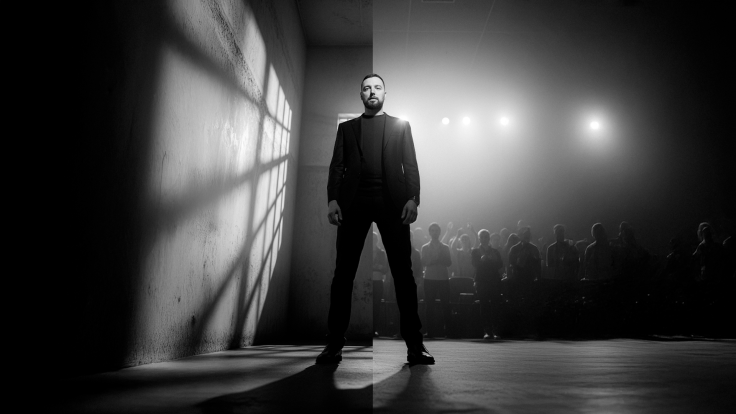
A man who once stood behind concrete walls now stood under stadium lights—surrounded by belief instead of suspicion.
The Vision Ahead
Today, the company is valued at more than $250 million, and its next chapter—Blockchain Sports Arena—is set to connect three billion fans and 300,000 clubs through gamified engagement and blockchain-driven loyalty systems.
But behind the technology lies a quieter truth.
Saksonov's story is not only about innovation. It is about reinvention. The stillness of isolation became the spark for a vision that gives others hope. His lowest moment became the beginning of a movement.
He proved that even when the world takes everything away, purpose can still be rebuilt—stronger, clearer, and impossible to erase.

© 2025 Latin Times. All rights reserved. Do not reproduce without permission.


