
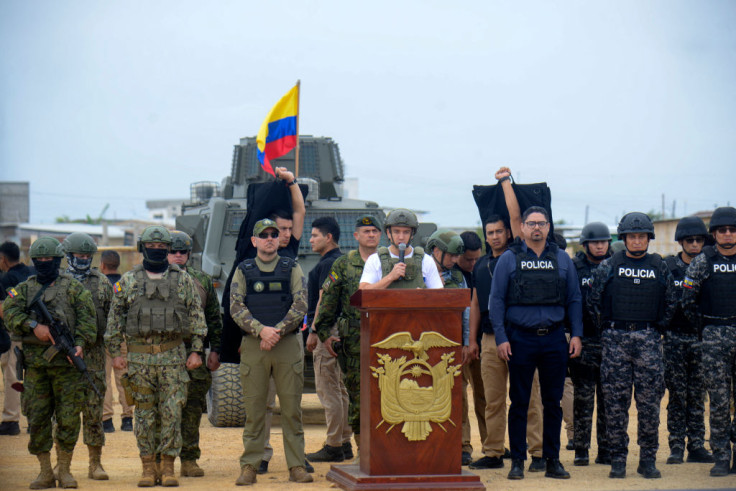
The Southern Command announced that U.S. forces have played a role in operations in Ecuador aimed at weakening "designated terrorist organizations" inside the South American country.
Although few details were released about what the operations entail, the military suggested the effort is an extension of the strikes carried out by the Trump administration against suspected drug cartels in the region.
Starting in September of last year, the Trump administration approved at least 45 military strikes against alleged drug boats in South America and the Caribbean, which left more than 150 people dead.
On March 3, Ecuadorian and U.S. military forces launched operations against Designated Terrorist Organizations in Ecuador. The operations are a powerful example of the commitment of partners in Latin America and the Caribbean to combat the scourge of narco-terrorism.
— U.S. Southern Command (@Southcom) March 4, 2026
Together,… pic.twitter.com/MrkKZcrDbs
"We commend the men and women of the Ecuadorian armed forces for their unwavering commitment to this fight, demonstrating courage and resolve through continued actions against narco terrorists in their country," said Marine Gen. Francis L. Donovan, commander of U.S. Southern Command.
U.S. Special Forces soldiers are advising and supporting Ecuadorian commandos on raids across the country targeting suspected drug shipment facilities and other drug related sites, according to a U.S. official who spoke to The New York Times on condition of anonymity to discuss operational matters.
The Americans are not believed to be participating in the actual raids but are helping Ecuadorian troops plan operations and providing intelligence and logistical support, the official said.
Once considered one of the safest countries in Latin America, Ecuador has been transformed by drug trafficking and organized crime. The 2025 Country Conditions Report from the U.S. Committee for Refugees and Immigrants found that Ecuador's homicide rate rose from 6.7 per 100,000 people in 2020 to 44.5 in 2025, the highest in South America.
In an attempt to fight organized crime and the wave of violence gripping the country, President Daniel Noboa has sought closer cooperation with the United States. In November, he met with Homeland Security Secretary Kristi Noem to discuss reopening a former U.S. military base in Manta, a coastal city in Ecuador, a proposal that was rejected in a referendum by Ecuador's Constituent Assembly.
As noted by Politico, the United States had previously conducted military operations near the South American country but had not publicly disclosed any operations on Ecuadorian soil until now.
The Coast Guard had been deployed in the eastern Pacific, off the coast of Ecuador, Colombia and other countries, helping interdict cocaine shipments in a mission known as Operation Pacific Viper.
After the operation to capture Maduro on Jan. 3, President Donald Trump did not rule out using military force against targets in other countries in the name of combating drug trafficking, but as noted by the reports, the expectations were for the administration to conduct strikes in Mexico and Colombia, both of which play a more significant role in the drug trade.
On X, Noboa confirmed that during the month of March Ecuador will carry out joint operations with "regional allies," including the United States, in what he described as a new phase in the fight against narco-terrorism and illegal mining.
"The security of Ecuadorians is our priority and we will fight to achieve peace in every corner of the country," Noboa wrote. "To obtain that peace, we must act forcefully against criminals, wherever they may be. The pursuit of justice and national dignity will never be persecution, but a promise we will fulfill to Ecuadorians."


© 2025 Latin Times. All rights reserved. Do not reproduce without permission.


