
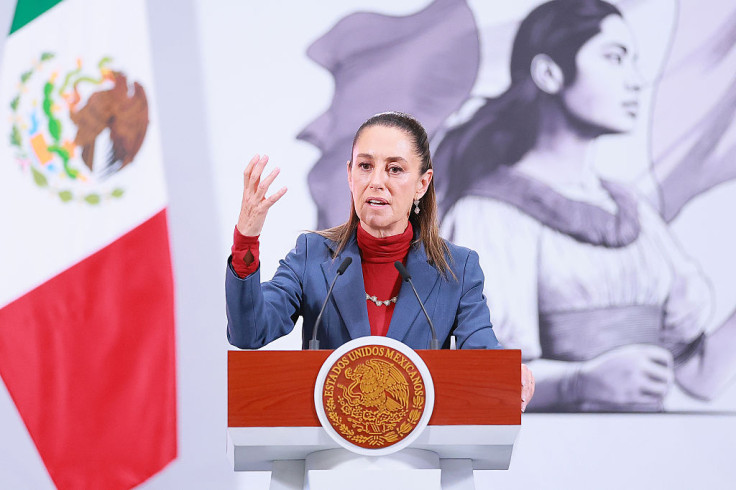
President Claudia Sheinbaum sent a letter to Mexico's governors Friday reminding them that any security cooperation with foreign agencies must go through federal channels, a move that turns the deaths of two reported CIA officers in Chihuahua into a test of presidential authority, sovereignty, and the limits of U.S.-Mexico anti-cartel cooperation.
The letter came after two U.S. officials and two Mexican investigators died in a vehicle crash in Chihuahua following an operation linked to the dismantling of clandestine drug laboratories. The U.S. officials were initially described as embassy personnel, but The Washington Post, citing people familiar with the matter, reported that they worked for the CIA. The CIA has declined to comment publicly on their identities.
Sheinbaum said that governors who want to collaborate with U.S. security agencies, or agencies from any other country, must follow the Constitution and Mexico's National Security Law. "They must comply with the law, no matter what, because sovereignty is not negotiable," she said during her morning news conference.
The president said the letter instructs state governments to notify the Foreign Relations Ministry or contact the federal security cabinet before engaging in any foreign security cooperation. The warning was aimed not only at Chihuahua but also at any governor tempted to build direct channels with U.S. agencies as cartel violence and fentanyl pressure dominate the bilateral agenda.


The Chihuahua case remains murky. Chihuahua Attorney General César Jáuregui initially said the Americans died while returning from an operation to destroy drug labs in rugged mountain territory. He later said they were U.S. Embassy instructors involved in training work and were not part of the lab raid itself. AP reported that Mexican officials have offered conflicting accounts of whether federal authorities knew about the U.S. role.
El director general de la Agencia Estatal de Investigación de Chihuahua, Pedro Oseguera Cervantes, junto con un policía ministerial y dos oficiales instructores de la Embajada de los #EEUU, murieron en un accidente automovilístico cuando realizaban un operativo para desmantelar… pic.twitter.com/9DzcPRHS21
— David de la Paz 戴维 (@daviddelapaz) April 19, 2026
The Washington Post reported that the CIA officers were returning from meetings with Mexican officials after the operation and that the agency has expanded intelligence sharing, training, and drone surveillance in Mexico under President Donald Trump and CIA Director John Ratcliffe. U.S. Ambassador Ronald Johnson wrote that the deaths were a reminder of "the risks faced by Mexican and U.S. officials dedicated to protecting our communities."
For Sheinbaum, the issue is not whether Mexico should cooperate with Washington. Her government has repeatedly said it shares intelligence with U.S. agencies. The red line is operational control. "There are no joint operations on land or in the air," Sheinbaum said earlier this week, according to AP, describing cooperation as information-sharing under a legal framework.
That distinction has deep roots. In 2020, Mexico approved changes to its National Security Law that restricted the work of foreign agents, required them to share intelligence with Mexican officials and stripped some protections that had long allowed U.S. law enforcement agencies, especially the DEA, to operate with broad latitude. Former DEA international operations chief Mike Vigil warned at the time that the changes would significantly diminish U.S. agency work in Mexico, as reported by The Guardian.
The Chihuahua crash revives old tensions from the Mérida Initiative era, when the United States provided billions in security assistance, training, and equipment for Mexico's drug war. It also follows years of distrust after the 2020 U.S. arrest of former Mexican Defense Secretary Salvador Cienfuegos, a case that infuriated Mexico's government and helped trigger the legal crackdown on foreign agents.
Politically, the letter is also a message to Mexico's governors. Chihuahua Gov. Maru Campos, a PAN opposition figure, now sits at the center of a dispute over whether a state government can coordinate with U.S. intelligence without federal approval. Sheinbaum's response signals that she will not allow what critics might call "rebel governors" to run their own foreign security policy, especially with Washington.
The confrontation comes as Sheinbaum tries to show strength in two directions at once. To Trump, she is signaling that Mexico will cooperate against cartels but will not accept U.S. operations on Mexican soil. To governors, she is asserting that security and foreign policy remain federal powers, not state-level bargaining chips.
© 2025 Latin Times. All rights reserved. Do not reproduce without permission.


