
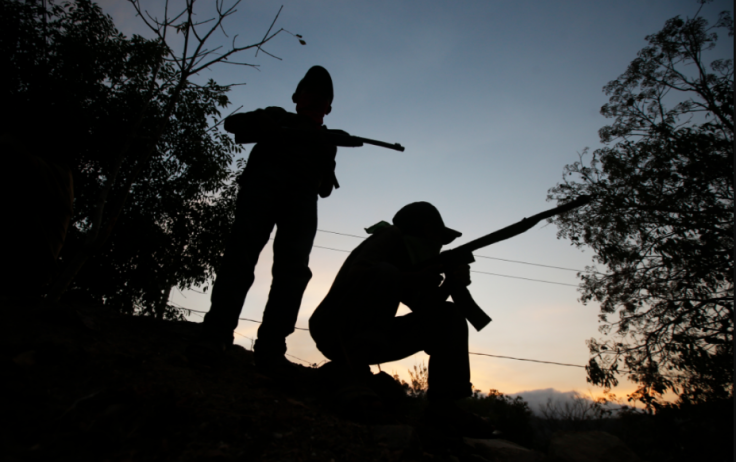
Amid a lack of opportunities and a broken system, many children and young people in Mexico are exposed to falling into the grip of organized crime.
As drug cartels in Mexico continue to grow, so do their ranks. That is why they have developed a recruitment mechanism, sometimes voluntary but more often forced, targeting children and adolescents who are lured in with deception and promises that are never fulfilled.
To address the problem, the administration of former President Andrés Manuel López Obrador launched in 2018 a series of social programs offering monthly financial stipends, known as "becas," along with opportunities for young people to learn a trade, aimed at steering them away from organized crime.

But according to an investigation by Animal Político, despite heavy federal investment, the recruitment of young people, as well as their involvement in crimes linked to organized crime, has increased by nearly 150% in recent years, rising from 56,502 cases between 2012 and 2018 to 140,444 cases between 2018 and 2024.
Under the slogan "Grantees yes, hitmen no," López Obrador's government spent nearly $7 billion during his administration to fund these programs. In the first year of Claudia Sheinbaum's administration, the federal government approved an additional $1.3 billion to continue funding them, which authorities say has helped contain recruitment and violence.
Despite the heavy investment, the number of people ages 18 to 29 arrested for drug dealing and homicide has continued to rise. According to Animal Político's analysis, between January and May 2025, state prosecutors reported 9,309 arrests of young people linked to drug-trafficking cases.
The monthly average, 1,862 young people arrested, is more than 300% higher than in 2012, the first year of Enrique Peña Nieto's administration.
Among minors, arrests increased by nearly 80% between 2018 and 2024 compared with the 2006–2012 period, and by 2.2% compared with 2012–2018.
Child rights expert Juan Martín Pérez García told Animal Político that the figures should not be read solely as an increase in youth crime, but as an indicator of high vulnerability and recruitment by criminal groups that view adolescents as a readily available and replaceable population.
In that sense, he said, the issue is not how many children and young people commit crimes, but how many are in vulnerable conditions that make them susceptible to recruitment by organized crime.
In recent years, Mexican drug cartels have adopted new recruitment strategies to convince children and young people to join their ranks. Beyond traditional street recruitment, criminal groups now use fake job postings and deceptive offers on social media. Those who fall for the schemes are later kidnapped and forced to join the groups.
As previously noted by The Latin Times, Mexican drug cartels increasingly target vulnerable teenagers online.
Social media platforms such as Facebook, Snapchat and TikTok, along with encrypted messaging apps like Telegram and WhatsApp, are used by the cartels to display wealth, cars and weapons, as well as to intimidate rival groups by publicizing crimes and issuing threats.
In its analysis, Animal Político noted that Mexico lacks a precise way to measure the recruitment of minors and young people because it is not classified as a specific crime.
Juan Martín Pérez García, coordinator of the organization Tejiendo Redes Infancia, told the outlet there are no records or databases that allow authorities to determine how many children and young people are actually being recruited.
"If it's not classified as a crime, it doesn't exist: there's no data, no obligation to account for it," Pérez said.

© 2025 Latin Times. All rights reserved. Do not reproduce without permission.


