
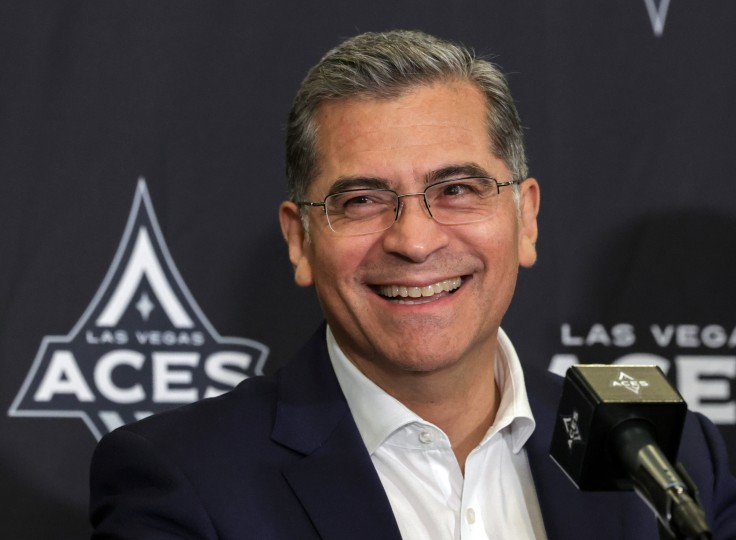
Xavier Becerra is asking California voters to believe that the next governor does not need to be the loudest person in the race. He is betting that experience, biography, and the promise of the California Dream can still cut through a primary dominated by billionaire spending, voter fatigue, and political chaos.
The former U.S. health secretary, California attorney general, and longtime congressman has moved near the front of the crowded 2026 race for governor, raising the possibility that California could elect its first Latino governor in 151 years.
The last was Romualdo Pacheco, a Mexican American Republican from Santa Barbara, who became governor in 1875 after Gov. Newton Booth resigned to serve in the U.S. Senate. Pacheco served about 10 months. Since then, California, a state where Latinos now make up about 40% of the population, has never elected a Latino governor.
Becerra wants to change that.
"We have to fight to make it possible for all of us to have the California Dream, and that's why I'm running for Governor," Becerra says on his campaign website.
His campaign has made that phrase, the California Dream, the emotional center of his run. In announcing his candidacy, Becerra framed the race around affordability, arguing that the state is failing the working families who built it.


"California is at a crossroads," Becerra said in his launch statement. "From housing to healthcare, childcare to college, working families are facing an affordability crisis. The California Dream is slipping away."
That message has started to land.
A May Emerson College Polling and Inside California Politics survey found Becerra leading the field with 19%, followed by Republican Steve Hilton and billionaire Democrat Tom Steyer at 17% each. Katie Porter was at 10%, Matt Mahan at 8% and 12% of voters remained undecided.
The race remains volatile. California's June 2 top-two primary sends the two highest vote-getters to November, regardless of party. With more than 50 candidates on the ballot and Democrats split across several well-known names, the possibility of a surprise finish has kept both parties on edge.
Steyer has transformed the race with record-shattering spending. The Associated Press reported that the billionaire environmental activist has poured about $195 million into advertising, more than 20 times what Becerra has spent. Hilton, a former Fox News host and Trump ally, has tried to consolidate Republican voters and could benefit from Democratic fragmentation.
Becerra's answer has been to present himself as the candidate who already knows how government works.
"I'm running for governor to protect and build upon our California way of life," Becerra says in his campaign platform. "To build our economy, defend our communities, and protect your rights and freedoms in the state that we love."
It is a pitch rooted in his own life story. Becerra was born in Sacramento, the son of Mexican immigrants, and became the first person in his family to graduate from college. He earned both his undergraduate degree and law degree from Stanford University, worked in legal aid and later served in the California Department of Justice.
He was elected to the California Assembly in 1990, then to Congress in 1992, representing Los Angeles for more than two decades. He chaired the Congressional Hispanic Caucus and later became chair of the House Democratic Caucus. In 2017, then-Gov. Jerry Brown appointed him California attorney general, making him the first Latino to hold the office. He later served as President Joe Biden's secretary of Health and Human Services, becoming the first Latino to lead the department.
At the Commonwealth Club earlier this year, Becerra called the race a "break-glass moment" for Californians struggling economically.
That urgency has become central to his closing argument. Becerra is not running as a celebrity candidate or a political disruptor. He is presenting himself as a son of immigrants, a career public servant and a Democrat who says he can deliver in a state where many voters feel priced out of their own future. For Latino voters, his candidacy carries historic weight. California has produced Latino mayors, lawmakers, Cabinet members and members of Congress, but not a Latino governor in the modern era. Becerra's rise has put that absence back in the spotlight.
Still, Becerra has been careful not to campaign only on identity. His message is broader: housing, health care, rights, wages and whether ordinary families can still afford to live in California.
If Becerra survives primary and wins in November, he would not only succeed Gavin Newsom. He would close one of the longest representation gaps in American politics.
© 2025 Latin Times. All rights reserved. Do not reproduce without permission.


