
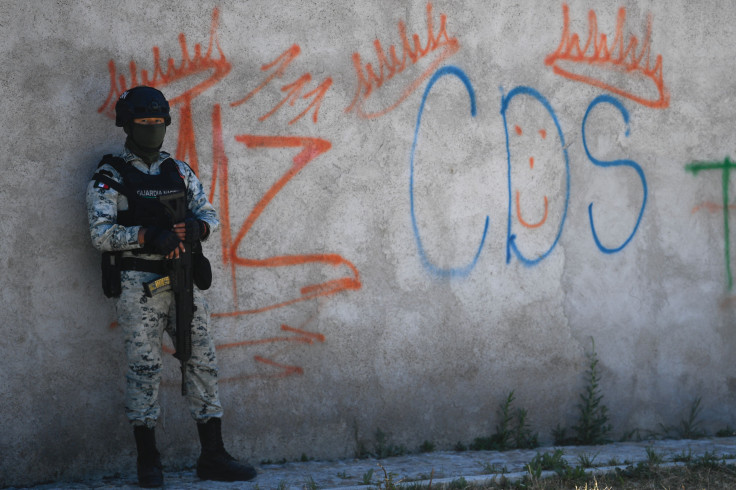
Mexican federal authorities seized a suspected illegal fuel storage and transfer site in the border city of Matamoros, dealing a near half-million-dollar blow to a fuel-trafficking operation allegedly linked to the Gulf Cartel faction known as Los Escorpiones.
The operation was carried out this weekend by the Secretariat of the Navy and the Attorney General's Office in Ejido Progreso Agrario, a rural area of Matamoros, Tamaulipas, where authorities executed a search warrant on a property allegedly used to store and move stolen fuel, a crime widely known in Mexico as huachicol.
Authorities arrested two people and seized the property, 13 frac-tank-style storage containers, eight extraction pumps, five tanks, two tanker trucks, and a dry box trailer, according to reports citing federal officials.
The Navy's role was to secure the perimeter while federal prosecutors carried out the search, according to Mexican media reports. The detainees and seized equipment were turned over to federal authorities as prosecutors opened the corresponding case file.
A blow to Los Escorpiones
Federal sources cited by Infobae México said the equipment was tied to Los Escorpiones, a Gulf Cartel faction active in Matamoros and involved in fuel theft and trafficking along Mexico's northern border. The estimated financial loss to the organization is about 8 million pesos, roughly $440,000 at current exchange rates.
The raid highlights the importance of fuel theft to organized crime in Tamaulipas, where cartels have long diversified beyond drug trafficking into extortion, migrant smuggling, kidnapping, and hydrocarbon theft. In Mexico, huachicol can involve tapping pipelines, storing stolen fuel, moving it in tanker trucks, or reselling it through criminal networks.


Matamoros is especially strategic. The city sits across from Brownsville, Texas, and has historically been one of the Gulf Cartel's most important border strongholds. Control of the area gives criminal groups access to smuggling corridors, safe houses, money flows and legal and illegal cross-border commerce.
All about Los Escorpiones and the relationship with the Gulf Cartel
Los Escorpiones emerged as an armed protection cell for Antonio Ezequiel Cárdenas Guillén, alias "Tony Tormenta," after the Gulf Cartel's rupture with Los Zetas. Mexican authorities confirmed the group's existence in 2010, the year Cárdenas Guillén was killed during a military operation in Matamoros.
The faction later remained active in Tamaulipas, where it developed links and rivalries with other Gulf Cartel cells, including Los Ciclones and Los Metros. Mexican reports have described shifting alliances among those groups as they compete for territory and smuggling routes in the state.
The name Los Escorpiones drew international attention in March 2023 after four U.S. citizens were kidnapped in Matamoros. Two of them were killed, and a Mexican woman also died during the attack. AP reported at the time that a letter claiming to be from the Scorpions faction of the Gulf Cartel said the group had handed over five men allegedly responsible for the violence.
Mexican forces have continued targeting Gulf Cartel leaders in Tamaulipas.
In July 2024, authorities arrested Antonio Guadalupe Pérez Domínguez, alias "Escorpión 17," described as a Gulf Cartel leader in the state.
Saturday's operation does not appear to target a high-profile boss. Its significance is logistical. By seizing tanks, pumps, trucks, and storage infrastructure, authorities hit the equipment needed to keep illegal fuel moving, not just the people guarding it. The Mexican Navy said coordinated operations like this are intended to weaken the financial and logistical capacity of criminal groups operating in the region.
© 2025 Latin Times. All rights reserved. Do not reproduce without permission.


