
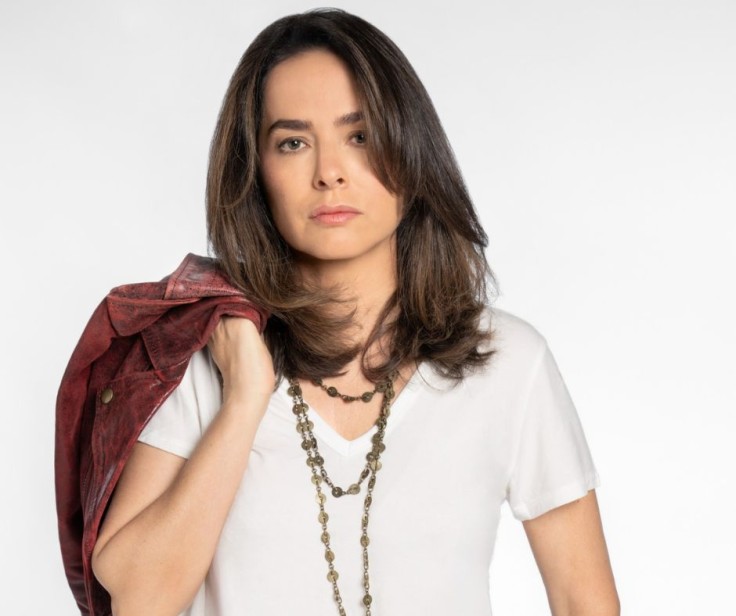
For more than three decades, Danna García has been one of the defining faces of Latin American television. She became famous as a teenager in Colombia, conquered Mexican television before turning 20 and later transformed into one of the most recognizable queens of the modern telenovela era thanks to hits like 'Pasión de Gavilanes,' 'Un Gancho al Corazón,' 'Qué Bonito Amor' and 'Bella Calamidades.'
But now, after years of playing women audiences rooted for instantly, García says Rebeca from 'Hermanas: Un Amor Compartido' may be the most emotionally demanding character she has ever carried.
"She's intense," García said during an interview with this reporter. "Sometimes sweet, many times toxic."
The Mexican melodrama, starring García alongside Adriana Louvier, Osvaldo Benavides, and Juan Martín Jáuregui, which ends today, Friday, March 22, in Mexico, focuses on two sisters balancing the complicated concept of motherhood. Who is the real mother, the woman who carries the baby to term or the one who raises her? It's a dilemma that lands close to García's personal story, part of the reason she chose Rebeca for her return to telenovelas after several years focusing on other genres.
However, what quickly became a conversation starter among telenovela audiences was Rebeca's volatility. She reacts explosively, lives emotionally cornered, and seems permanently trapped in survival mode.
For García, that emotional instability was not accidental. It became the foundation of the role.
"She has to stay on alert all the time," García explained. "Where is the next hit coming from? Where is the next blow coming from?"
A woman far far away
The actress said Rebeca fascinated her precisely because she felt so distant from her own personality.
"Usually, with some characters, you connect and think, 'I could be this woman,'" García said. "With Rebeca, that never happened to me."
Instead, she approached the role almost like an anthropological study. "There was a very particular process of character creation with her," she explained. "How she walks, how she sits, how she grabs a cup, how she pushes someone, how she reacts."
Many of those choices were not written into the script. "So many things we did were not in the screenplay," García said. "That impulsiveness, that hyper-reactivity."
The actress revealed she initially envisioned Rebeca less as a traditional telenovela heroine and more as the type of morally complex woman seen in streaming dramas. "I saw her more as a series character," García said. "Rougher. More aggressive."
She even proposed dramatic physical changes, including shaved sides and a punk-inspired hairstyle, but producers felt the look was too extreme for traditional broadcast television.
"They kept telling me, 'No, no, no, that can't appear on Canal de las Estrellas (Televisa's main TV channel,)'" she recalled laughing.
Instead, García transformed Rebeca through physical tension and emotional energy. The actress minimized glamour, reduced makeup and built a character whose nervous system always seemed seconds away from explosion. "Because if you don't react that way in prison, they kill you," she said.
That realism, audiences noticed immediately.
That prison mentality became central to Rebeca's psychology. Even in ordinary moments, she behaves like someone expecting violence. The role demanded a kind of sustained emotional intensity García says she had rarely experienced before, even after decades working in melodrama. And García knows melodrama intimately.
Born in Medellín, Colombia, García started acting as a child and became part of the famous Latin American entertainment generation that moved fluidly between Colombia, Mexico, Miami, and the broader Spanish-speaking television market. By the early 2000s, she had already become one of the most recognizable Latina actresses in the world thanks to 'Pasión de Gavilanes,' the global phenomenon that turned its cast into international stars from Argentina to Eastern Europe.
Unlike many telenovela actors who remain tied to one country, García built a career that crossed borders. She starred in Colombian productions, dominated Mexican prime time and later worked in the United States while balancing motherhood and international projects.
That immigrant experience unexpectedly helped her connect with Rebeca.
"I left Colombia very young," García said. "I left when I was 17."
The actress moved alone to Mexico as a teenager to begin filming a telenovela ('Al Norte del Corazón',) something she now sees very differently as the mother of an eight-year-old son.
"At the time I thought I was so grown up," she said. "Now I look back and think, 'She was just a child.'"
García said she is amazed by how disciplined she was at that age.
"I would set my own curfews," she recalled laughing. "'I have to be home by 11 p.m.' I was basically parenting myself."
That early independence shaped both her career and her emotional connection to stories about survival, sacrifice and family.
One of the most moving aspects of 'Hermanas: Un Amor Compartido' for García involves food. Rebeca often expresses tenderness through cooking, combining memories of childhood with modern recipes and emotional healing. Those scenes became deeply personal because they reminded her of her grandmother, who largely raised her.
"The smells of childhood," García said. "The smells of my grandmother."
She explained that while her mother, Colombian singer Claudia Osuna, worked, it was her grandmother who cooked, cared for her, and created the emotional rituals of home, a full circle story with the conflict in 'Hermanas'... Who is the real mother...
"My grandmother was the one who brought me into the kitchen," García said.
That connection to food also reflects García's bicultural identity. Though Colombian, she has now spent most of her life in Mexico and speaks about Mexican cuisine almost like a native daughter of the country.
"I love Mexican food," she said. "Just talking about it makes my mouth water."
During filming, García worked closely with chefs on set who taught her about regional dishes she had never encountered before.
"They would explain everything to me," she said. "Chile pasilla, chile mori..."
The actress said she realized how little she still knew about the depth of Mexican gastronomy despite living there for years.
"Mexico's gastronomy is incredible," she said.
Then there is Camilo, Rebeca's love interest, played by Jáuregui.

Their romance has become one of the emotional anchors of the telenovela because it mixes tenderness, trauma and danger. García laughed while acknowledging that many viewers may not fully realize how morally questionable Camilo actually is, but also how open her is in his love for Reneca.
"May all men be like Camilo," she joked. "Committed and devoted."
Then she paused and laughed again.
"Well... maybe not completely."
Because in true telenovela fashion, love in 'Hermanas: Un Amor Compartido' is never clean. It is messy, emotional, dangerous and addictive.
All the episodes of 'Hermanas un amor compartido' will live in TelevisaUnivision streaming platform VIX, while the telenovela is still being broadcasted in TelevisaUnivision in the U.S.


© 2025 Latin Times. All rights reserved. Do not reproduce without permission.


