
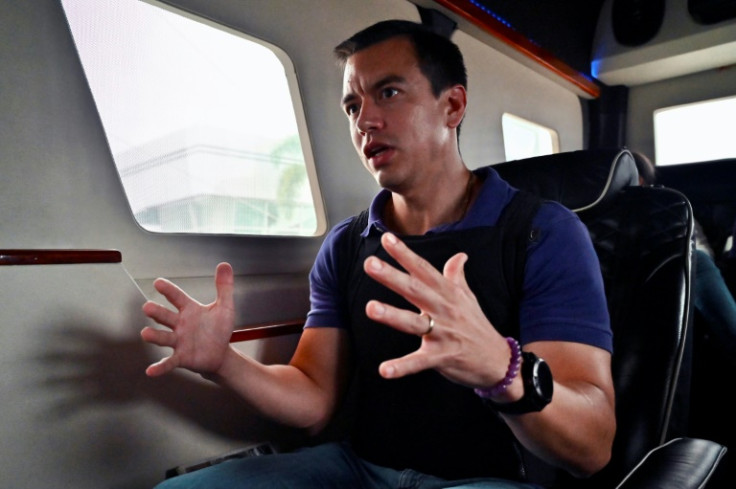
Ecuadorian President Daniel Noboa said he would welcome the presence of U.S. troops to help confront the country's "security crisis," emphasizing that any deployment would not constitute foreign interference but rather cooperation.
"It's not an invasion, it's not an intruder coming to our country," Noboa told Bloomberg. "It's actually international collaboration against crime."
During the interview Noboa also said U.S. forces would operate under the direction of Ecuadorian armed forces and could be deployed as early as this year. He pointed to existing U.S. support, including intelligence and tracking technology, as already contributing to a nearly 35% year-over-year drop in violent crime in some areas near the Colombian border during the first quarter of 2026.
Noboa added that his strategy combines force with broader policy goals. "It's not only an iron fist," he said, "it's an iron fist with a heart."
Noboa has strengthened ties with United States and aligned closely with the administration of Donald Trump on security policy, particularly in combating drug trafficking. Ecuador has increasingly relied on U.S. intelligence and advisory support in operations targeting criminal groups.
In early March, U.S. commandos participated in a joint mission known as "Lanza Marina," assisting Ecuadorian forces in an operation against a suspected drug trafficking hub linked to Los Choneros. U.S. officials described the mission as part of a broader regional effort to combat "narco-terrorism."
However, the expanded cooperation has also drawn scrutiny. An investigation cited by The New York Times raised questions about one U.S.-backed operation in which a site described as a drug camp was reportedly a dairy farm, with local residents alleging abuse by Ecuadorian troops. Ecuador's military has maintained that the site was used by criminal groups and that weapons were recovered.
Ecuador's push for deeper U.S. involvement comes as the country faces a sharp rise in violence tied to drug trafficking routes. The homicide rate has increased significantly in recent years, transforming Ecuador into one of the most violent countries in the region. Noboa, who took office in 2023, has declared an internal armed conflict and labeled more than 20 criminal groups as terrorist organizations, deploying the military nationwide.
The security strategy also unfolds amid growing regional tensions, specifically with neighboring Colombia. Colombian President Gustavo Petro described former Ecuadorian Vice President Jorge Glas as a "political prisoner" on Tuesday prompting Ecuador to issue a formal diplomatic protest and recall its ambassador from Bogotá.
Noboa's government rejected Petro's claims, stating Glas had been convicted through legitimate judicial processes and warning that attempts to question those rulings constitute "a flagrant violation of the principle of non-intervention" under international law.


© 2025 Latin Times. All rights reserved. Do not reproduce without permission.

