

The United States announced that it's placing Cuban former leader Raúl Castro in one of the most extraordinary categories in modern international law: presidents and former heads of government charged in U.S. criminal courts.
The Trump administration unveiled criminal charges against the 94-year-old former Cuban president over the 1996 shootdown of two Brothers to the Rescue planes, a case that has haunted Miami's Cuban exile community for three decades and helped freeze U.S.-Cuba relations after a brief opening in the 1990s. The announcement was made today in Miami during a Justice Department event honoring the four men killed in the attack.

The case centers on Feb. 24, 1996, when Cuban fighter jets shot down two civilian aircraft operated by Brothers to the Rescue, a Miami-based exile group that searched the Florida Straits for Cuban rafters fleeing the island. The victims were Carlos Costa, Mario de la Peña, Armando Alejandre Jr. and Pablo Morales. Three were U.S. citizens and one was a U.S. legal resident. The International Civil Aviation Organization later concluded the planes were shot down over international waters, while Cuba has long argued the aircraft had violated Cuban airspace.
There is also an audio connecting him to the orders of shooting down the planes.
🇨🇺🇺🇸📹 La confesión de Raúl Castro por la que podría ser juzgado en Estados Unidos: “Tumben las avionetas en el mar cuando se aparezcan”
— EL PAÍS América (@elpais_america) May 19, 2026
🖋️ Carla Gloria Colomé
https://t.co/9MIiOjme6F pic.twitter.com/LRpHX72QaX
Raúl Castro was Cuba's defense minister at the time, serving under his brother, Fidel Castro. Reuters reported that U.S. officials have framed the expected charges as part of a broader pressure campaign against Havana.
Secretary of State Marco Rubio also used Cuban Independence Day to offer $100 million in food and medical aid to the Cuban people, saying it should be distributed through the Catholic Church or trusted charities, while blaming Cuba's leadership for the island's shortages. Cuba's embassy rejected the message and accused Washington of using sanctions to worsen the crisis.
The legal move would not mean Castro is likely to appear in a U.S. courtroom. Cuba does not extradite its leaders to the United States, and Cuban officials have rejected Washington's pressure as an attack on sovereignty. But an indictment would still carry symbolic weight, especially in South Florida, where the Brothers to the Rescue case remains one of the most painful episodes in exile history.
It would also put Castro alongside a small but striking group of foreign presidents, former presidents and de facto rulers who have been targeted by U.S. prosecutors.
The U.S. Justice Department against foreign leaders
The most direct modern comparison is Nicolás Maduro of Venezuela. In 2020, the Justice Department charged Maduro and other current and former Venezuelan officials with narco-terrorism, drug trafficking, corruption and weapons offenses. U.S. prosecutors accused Maduro of helping lead a drug-trafficking conspiracy tied to the Revolutionary Armed Forces of Colombia, or FARC, while he was still claiming Venezuela's presidency.

Another major case is Juan Orlando Hernández, the former president of Honduras. Hernández was indicted on drug-trafficking and firearms charges and extradited to the United States in 2022, shortly after leaving office. Prosecutors accused him of turning Honduras into a corridor for cocaine shipments headed to the United States. He was convicted in 2024 and sentenced to 45 years in prison. He was recently pardoned by Donald Trump.
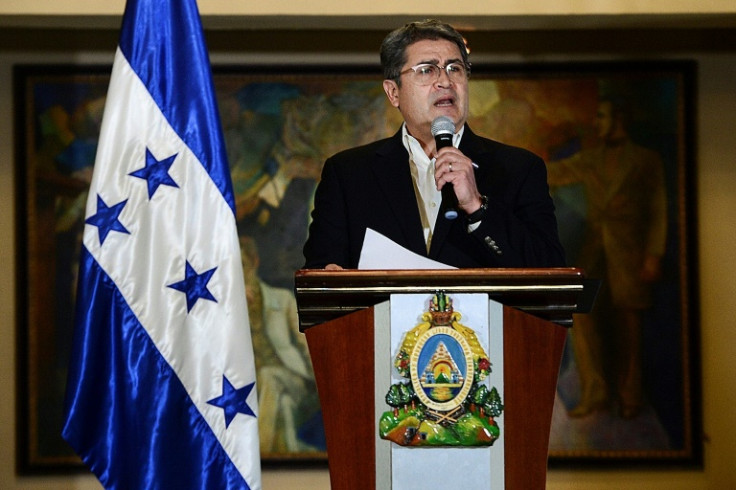
Alfonso Portillo, Guatemala's former president, faced a different kind of case. He was extradited to New York in 2013 on a money-laundering charge and later pleaded guilty to laundering millions of dollars through U.S. bank accounts. Prosecutors said the money included funds connected to bribes from Taiwan. He was sentenced in 2014 to 70 months in prison.
Rafael Callejas, another former Honduran president, was charged not over state power but soccer corruption. Callejas, who led Honduras from 1990 to 1994 and later headed the Honduran soccer federation, pleaded guilty in Brooklyn in 2016 to racketeering conspiracy and wire fraud conspiracy in the FIFA corruption investigation. Prosecutors said the case involved bribes tied to media and marketing rights for World Cup qualifying matches.

Then there is Manuel Noriega, Panama's military strongman, who was never president in the formal democratic sense but ruled the country as its de facto leader. He was indicted by federal grand juries in Florida in 1988 on drug-trafficking, racketeering and money-laundering charges before the U.S. invasion of Panama. He was captured, brought to the United States and convicted.
Raúl Castro's case would be different from all of them because it is tied not to drugs, corruption or money laundering, but to the alleged killing of civilians in an international aviation incident. It would also reopen one of the central wounds in the Cuban American political memory: four men killed in the sky, a Cold War-style confrontation over the Florida Straits and a demand for accountability that never disappeared in Miami.
© 2025 Latin Times. All rights reserved. Do not reproduce without permission.


