
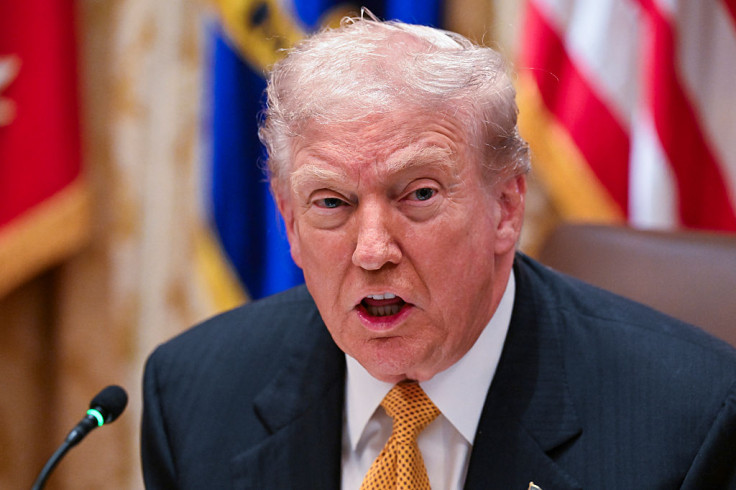
President Donald Trump is heading into a pivotal election cycle with warning signs emerging across multiple polls. A survey by The New York Times published earlier this week found his approval rating hovering in the high 30s, reflecting a steady decline since the start of his second term.
An April 21 AP-NORC Center for Public Affairs Research survey, also from this week, echoed the Times' findings, placing Trump's overall approval at roughly one-third of Americans, with even weaker ratings on the economy and cost of living, issues that historically drive midterm outcomes.
Inside Republican circles, the political implications are already being debated. GOP strategists have warned that the Iran conflict could weigh heavily on the party's midterm prospects, while some major conservative voices—including media figures and Marjorie Taylor Greene have questioned whether the administration is fully accounting for the electoral risks ahead.
The first major primaries of the 2026 midterm cycle offered an early snapshot of the political forces shaping the remainder of the president's term. In Texas, the Democratic Senate primary saw state Rep. James Talarico defeat Rep. Jasmine Crockett, while on the Republican side, Sen. John Cornyn failed to secure a majority, forcing a runoff against Attorney General Ken Paxton—a contest defined largely by questions of loyalty to Donald Trump and the direction of the party.
In North Carolina, the race quickly crystallized into a high-stakes general election matchup between former Democratic Gov. Roy Cooper and Republican Michael Whatley, setting up one of the most competitive Senate contests of the cycle.
-
Marjorie Taylor Greene Says GOP Risks Defeat In 2028 Presidential Elections After Dems Flip Florida District: 'Keep Putting Americans Last'

-
Steve Bannon Says ICE Deployment To Airports Can Be Used As a 'Test Run' To 'Perfect ICE's Involvement In The 2026 Midterms'

-
Megyn Kelly Says She'd Back Trump 'Even If He Dropped a Nuke' as Iran War Divides Conservative Voices


Here are some of the most consequential electoral battles in the upcoming months:
May 16, 2026 — Louisiana Tests Trump's Grip on the GOP
Louisiana's Senate primary has emerged as one of the clearest tests of Donald Trump's influence within the Republican Party. Incumbent Sen. Bill Cassidy, who supported much of Trump's policy agenda but voted to convict him after the January 6 attack, now faces a Trump-endorsed challenger in Rep. Julia Letlow, alongside other Republicans like State Treasurer John Fleming.
What makes this race particularly consequential is not the general election outcome—Louisiana is safely Republican—but the intra-party dynamic. As Politico has reported, Cassidy's path to renomination depends on whether Republican voters prioritize legislative experience and incumbency or alignment with Trump, whose endorsement of Letlow has reshaped the race and consolidated support against the incumbent.
The structure of the contest adds another layer of uncertainty. Louisiana is using a partisan primary system, meaning a runoff is likely if no candidate secures a majority—a scenario that could prolong the fight and intensify divisions within the party. As Punchbowl News has noted, the race has already become fragmented and unpredictable, reflecting broader tensions inside the GOP between establishment figures and Trump-aligned challengers.
May 19, 2026 — Georgia and Kentucky Expose GOP Fault Lines
The May 19 primaries in Georgia and Kentucky are set to become one of the clearest indicators of where the Republican Party is headed—and how firmly Donald Trump still shapes that trajectory.
In Georgia, Republicans will select a Senate nominee to challenge Democratic Sen. Jon Ossoff in what is expected to be one of the most competitive races of the cycle in a state Trump carried in 2024. The field, which includes Reps. Buddy Carter and Mike Collins as well as Derek Dooley, backed by Gov. Brian Kemp, reflects competing visions of electability and alignment within the party.
At the same time, Georgia's gubernatorial primary highlights those tensions even more explicitly. Secretary of State Brad Raffensperger—who resisted Trump's efforts to overturn the 2020 election—faces Lt. Gov. Burt Jones, a Trump-endorsed candidate tied to efforts to challenge those results.
The contest has already turned combative, with early attack ads underscoring how unsettled the Republican field remains, according to NBC News, and raising questions about whether the party will coalesce around a candidate capable of winning a general election in a battleground state.
In Kentucky, a different but equally consequential dynamic is playing out. With Sen. Mitch McConnell retiring, Republican candidates including Rep. Andy Barr, Daniel Cameron and Nate Morris are competing to define the post-McConnell era—while largely embracing Trump-aligned messaging.
As reporting from News From the States has highlighted, that race has been shaped by candidates distancing themselves from McConnell's legacy even as they share ties to his political network, signaling a broader shift away from establishment leadership.
June 2, 2026 — California and Iowa Shape the Map
In California, the race to replace Gov. Gavin Newsom has drawn a crowded and high-profile field, with Democrats including Xavier Becerra, Katie Porter and Antonio Villaraigosa competing alongside Republican contenders such as Chad Bianco and Steve Hilton.
Under the state's top-two system, all candidates appear on the same ballot, meaning the primary will determine not just frontrunners but the ideological shape of the general election. As the Los Angeles Times reports, the contest has already sharpened divisions over policy direction and electability, with candidates seeking to define themselves in a fragmented field.
The dynamics of the race shifted further after Rep. Eric Swalwell withdrew following allegations of sexual misconduct, a development that reshaped the field and potentially strengthened candidates like Porter by consolidating parts of the Democratic vote.
In Iowa, the stakes are different but no less significant. The state features both an open gubernatorial race and a Senate contest following the retirement of Sen. Joni Ernst. Democrat Rob Sand is seeking to flip the governor's seat, while Republicans such as Rep. Randy Feenstra aim to maintain control.
The Senate race similarly pits GOP frontrunner Ashley Hinson against a Democratic field led by Zach Wahls and Josh Turek. These contests will test whether Democrats can regain ground in a state that has trended Republican in recent cycles, particularly among rural voters.
November 3, 2026 — Midterm Elections Decide the Balance of Power
The midterm elections will determine control of Congress and might reshape the political landscape for the remainder of the president's term. All 435 seats in the House of Representatives and 35 Senate seats will be contested, along with 36 governorships and thousands of down-ballot races across the country.
Republicans currently hold a 53–47 advantage in the Senate, while the House majority is narrowly divided, meaning even minimal shifts could alter control of either chamber.
The math is tight. Democrats need a net gain of just three seats to flip the House, a margin small enough that outcomes in a handful of competitive districts could decide control. In the Senate, the path is steeper: Democrats would need to gain four seats to secure a majority, a challenge given a map that favors Republicans and offers limited pickup opportunities. Still, a few key races, including in states like Georgia and Maine, could prove decisive.
A Republican hold would preserve legislative momentum and allow the administration to continue advancing its agenda in policies like immigration. A Democratic takeover of either chamber would likely usher in gridlock, intensified oversight, and investigations, sharply limiting the White House's ability to act.
© 2025 Latin Times. All rights reserved. Do not reproduce without permission.


