
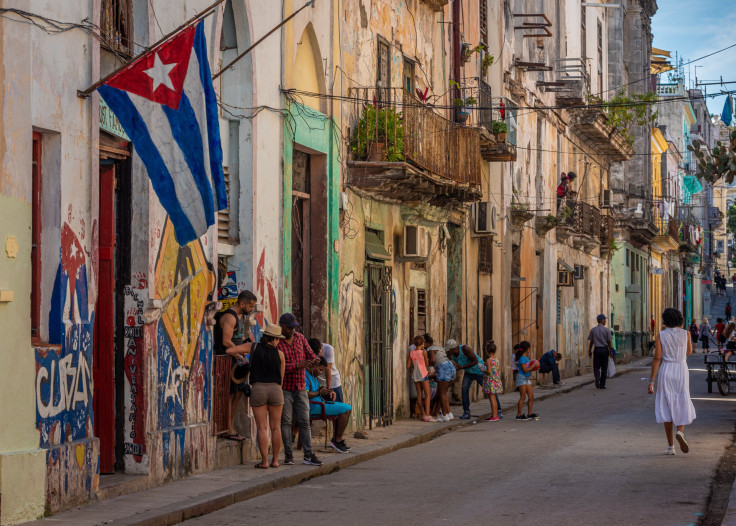
Two Mexican Navy ships docked in Cuba on Thursday to deliver humanitarian aid to the beleaguered Caribbean island, but refrained from sending oil due to the ongoing U.S. blockade.
The ships are carrying over 800 tons of humanitarian aid, according to The Associated Press. They include milk, rice, beans, sardines, meat products, cookies, canned tuna and vegetable oil, as well as powdered milk and hygiene products.
Mexican President Claudia Sheinbaum said that the country will send "more support of different kinds" while it continues to seek diplomatic means to get oil to the country.
"We have stated to both the U.S. State Department and the U.S. Embassy in Mexico that Mexico is doing everything possible to foster a dialogue that, within the framework of Cuba's sovereignty, creates the conditions for peaceful dialogue and ensures that Cuba, without any country imposing sanctions, can receive oil and its derivatives for its daily operations."
Sheinbaum has rejected President Donald Trump's threat to sanction countries sending oil to the country, recently saying "you can't hurt the people just because you disagree with the government." "It's not right. They don't have fuel for hospitals or schools. The people are suffering," she added.
In the meantime, the head of the U.S. diplomatic mission in Cuba said Washington is in talks with senior figures inside the Cuban government and suggested a Trump-friendly successor comparable to Venezuela's interim president has been identified, pointing to what he described as the start of a political transition on the island.
In an interview with Telemundo in Miami, Mike Hammer said there are ongoing contacts with high-level officials in Havana, adding that not all members of the ruling structure are aware of them. "Obviously there are conversations with some very high within the regime. Others will not be aware," he said. Hammer added that Cuba has "a Delcy Rodríguez," referring to Venezuela's interim president, but declined to give a name.
Cuban officials have denied any negotiations beyond routine migration and counternarcotics coordination. Vice Foreign Minister Carlos Fernández de Cossío told EFE earlier this month that claims of internal divisions or secret talks are "a mistaken interpretation" and said any dialogue must occur "with mutual respect."
In earlier comments to Telemundo 51 in Miami, Hammer said discussions with Havana are being handled discreetly under White House and State Department supervision. He declined to confirm reports that Alejandro Castro Espín, son of Raúl Castro, is acting as an intermediary. He also criticized restrictions on civil liberties and said more than 1,000 political prisoners should be released, including those detained after the July 2021 protests.

© 2025 Latin Times. All rights reserved. Do not reproduce without permission.


