
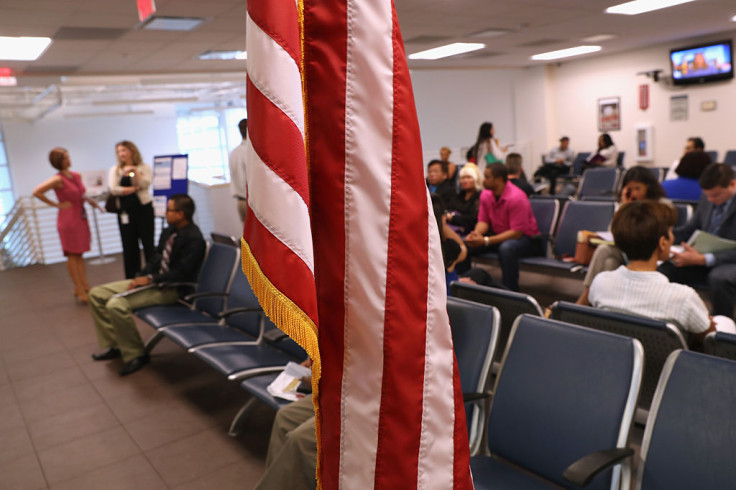
President Donald Trump's return to the White House in January 2025 led to a surge in interest among people seeking to become U.S. citizens. Whether driven by concerns over his immigration policies, ongoing political shifts or a desire for more secure legal status, nearly 300,000 people applied for citizenship between February and April of last year.
But newly released data from U.S. Citizenship and Immigration Services shows that last year's figures were marked by fluctuations in applications and a decline in approvals.
From January to May, applications submitted to USCIS rose steadily, with April nearing 90,000 approvals. But as the Trump administration's policies became stricter, the number of approvals declined later in the year, falling to about 33,000 by December.


According to experts and former officials who spoke to NPR, the drop in applications reflects declining confidence in the U.S. immigration system.
"The fear is pretty pervasive," Felicia Escobar Carrillo, former USCIS chief of staff under the Biden administration, told the outlet. "I think that people are just going to think twice about whether to apply."
During the early months of Trump's second term, the administration approved a record number of naturalizations. April saw 88,388 approvals, the highest monthly total since USCIS began tracking such data in 2022. That figure later dropped to 32,862 approvals in January of this year, the lowest since the agency began publishing monthly data.
"What we see from this administration, just at a very high level, is an effort to define who is an American," Margy O'Herron, a senior fellow at the Brennan Center for Justice, told NPR. "Giving somebody citizenship is granting somebody status as an American. There's an effort to control that."
In a statement to NPR, USCIS said it is pausing decisions on some applications from migrants from countries the administration considers high risk. The agency is also weighing stricter screening and vetting measures.
"This includes reimplementing the 2020 naturalization civics test for 2025, strengthened English language requirements, screening social media for anti-American activities, and restoring neighborhood investigations to ensure applicants demonstrate good moral character and an attachment to the Constitution," USCIS spokesman Matthew Tragesser said.
Changes to the civics test were first signaled in September, when lawful permanent residents applying for naturalization began encountering a revised version that is longer, more demanding and more subjective than earlier formats.
Among the most significant changes is an expanded question bank, now featuring 128 questions on U.S. history and government, up from 100.
The oral interview portion has also been expanded from 10 to 20 questions, with applicants now required to answer at least 12 correctly to pass.
Beyond stricter requirements, the Trump administration also paused certain immigration processes, including naturalizations, for people from 39 countries as part of new restrictions following an incident in which an Afghan national was accused of shooting two National Guard members in Washington, D.C., in late November.
Those changes, along with broader immigration policies implemented during Trump's second term, have also contributed to the decline in applications and eroded public trust in immigration authorities, experts say.
"There is an understanding that we're in a political climate where it is unsafe for a lot of immigrants to engage with federal agencies. Whether that is true or perceived, it is still a hugely influential factor," Gianina Horton, a city council member in Aurora, Colorado, told NPR. "Do I really want to put my name on a list where I could be targeted? So there is a risk assessment that folks are doing in real time."


© 2025 Latin Times. All rights reserved. Do not reproduce without permission.


