
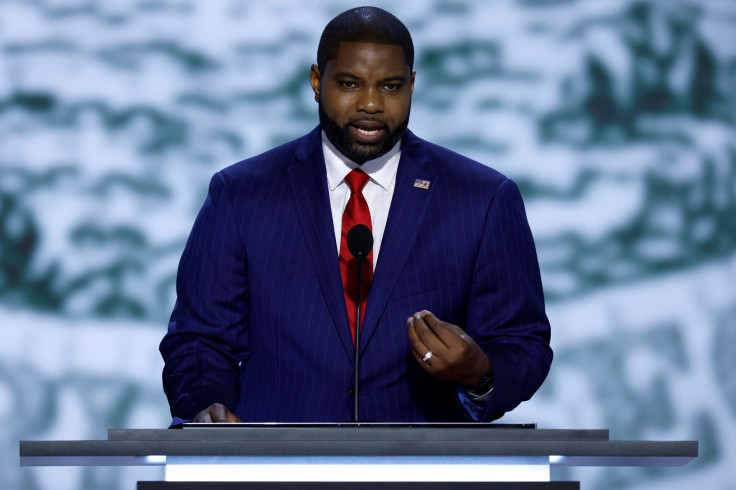
Rep. Byron Donalds leads the Republican primary field for Florida governor to replace Ron DeSantis with 46% support, but nearly 4 in 10 of likely voters (39%) remain undecided, according to a new Emerson College Polling survey.
The poll shows a fragmented race despite Donalds' early advantage. "Byron Donalds is the clear favorite among Republicans to succeed Governor DeSantis," said Spencer Kimball, executive director of Emerson College Polling. "Donalds leads all age groups and holds majority support among voters over 60, at 54%."
In a hypothetical matchup that includes Florida First Lady Casey DeSantis, Donalds maintains a wide lead, 44% to 7%, according to Emerson College. Separate polling conducted in February by the University of North Florida suggested that Donald's advantage may be closely tied to backing from Donald Trump. In that survey, Trump's endorsement boosted Donald's support to 47%, while DeSantis' fell by half.


On the Democratic side, the Emerson College survey found 53% of voters undecided, with David Jolly leading with 21%, followed by Jerry Demings at 10%. General election matchups remain competitive. In a hypothetical contest, Donalds leads Jolly 44% to 39%, with 15% undecided. A separate scenario shows Jolly narrowly ahead of Casey DeSantis, 40% to 39%, within the margin of error.
The poll also highlights divisions among key voting groups. Latino voters are nearly split between Donalds and Jolly, while men favor Donalds by a 14-point margin and women slightly prefer Jolly. These splits suggest potential volatility as the race develops.
Beyond the governor's race, the survey found Republican Sen. Ashley Moody leading prospective Democratic challengers, including Alex Vindman and Angie Nixon, by margins ranging from 8 to 11 points.
The poll also measured broader political sentiment in Florida. Trump's job approval stands at 46%, with 47% disapproving, while Gov. Ron DeSantis holds a 50% approval rating and 40% disapproval. Independent voters break against Trump but are slightly favorable toward DeSantis.
Economic perceptions may also shape the race as a plurality of voters, 45%, say they are worse off financially than a year ago, compared with 27% who say they are better off.
FLORIDA POLL
— Emerson College Polling (@EmersonPolling) April 2, 2026
Hypothetical 2026 Matchup for Governor
Byron Donalds (R) 44%
David Jolly (D) 39%
Someone else 2%
15% undecided
Donalds (R) 45%
Jerry Demings (D) 36%
Someone else 2%
17% undecidedhttps://t.co/yroDKKeJqB pic.twitter.com/e2tSfyI6vH
The stakes of the 2026 Florida governor's race extend well beyond Tallahassee. With Ron DeSantis leaving, the contest will determine who leads one of the most politically influential states in the country at a moment when Florida has solidified its position as a Republican stronghold. As the third most populous state, Florida plays an outsized role in shaping national debates on immigration, economic policy, and election laws, meaning the outcome will resonate far beyond state lines.
The race is also widely seen as a launching pad for national ambitions. Florida has a recent track record of producing figures with presidential aspirations, and the next governor could quickly emerge as a contender in the 2028 cycle. At the same time, the election will test the direction of the Republican Party after DeSantis, raising questions about whether voters will embrace a continuation of his policies or signal a shift in tone and priorities.
For Democrats, the contest represents both a challenge and an opportunity. While the party has struggled in recent statewide races, a competitive showing would signal potential for rebuilding in a critical Sun Belt state and offer insight into shifting voter dynamics, particularly among Latino communities. In that sense, the 2026 race is not just a state-level decision but a key indicator of where the broader political map may be heading.
-
Coral Spring Police Investigate the Killing of South Florida Vice Mayor Nancy Metayer Bowen as Domestic Violence: Husband in Custody

-
Utah, Michigan and Florida Lead the Way Among the States With the Biggest Gas Price Hikes Since the Iran War Began

-
Coalition of Trump Loyalists Releases Playbook Urging Administration to Target Worksites for Mass Deportations


© 2025 Latin Times. All rights reserved. Do not reproduce without permission.


