
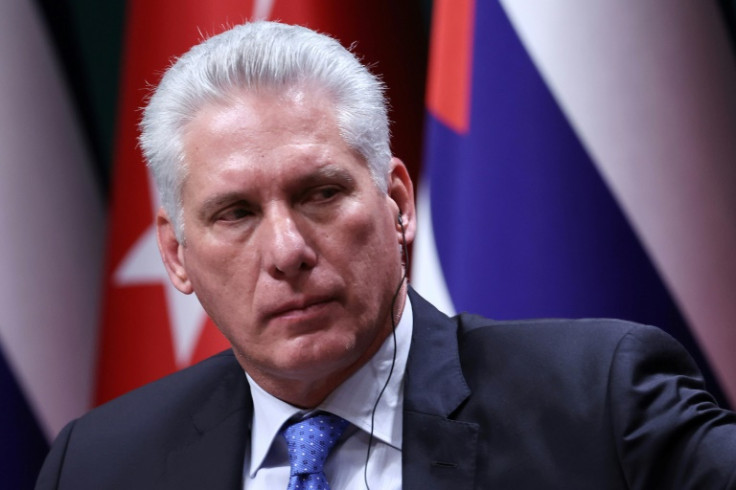
Cuban President Miguel Díaz-Canel said negotiations with the United States will not move forward unless Washington agrees to Havana's conditions, underscoring a hardening stance as bilateral talks unfold amid mounting tensions and a deepening economic crisis on the island.
"If the United States does not accept negotiating on Cuban terms, there is no negotiation," Díaz-Canel said in a televised interview recorded at Havana's Palace of the Revolution. He emphasized that dialogue must be built on "respect" for Cuba's political system, sovereignty, and independence, adding that "imposing does not allow negotiation."
⚠️⚠️#Ahora. Díaz-Canel descarta negociar un cambio de régimen en #Cuba con los EE.UU. y amenaza con cortar las conversaciones si se pone sobre la mesa esa exigencia pic.twitter.com/ynY1Pk6slI
— Mag Jorge Castro🇨🇺 (@MagJorgeCastro) April 22, 2026
His remarks come days after reports that the administration of Donald Trump issued a two-week ultimatum urging Cuba to release high-profile political prisoners, including artist Luis Manuel Otero Alcántara and rapper Maykel Osorbo. Cuban authorities recently rejected an appeal seeking Otero Alcántara's early release, signaling limited movement on one of Washington's key demands.


Díaz-Canel reiterated that Cuba's internal affairs are not subject to negotiation. "Our internal problems are not on the table," he said, framing any talks as contingent on equality and reciprocity. While acknowledging that conversations with U.S. officials have taken place since March, he described the process as sensitive and largely undisclosed.
The Cuban leader has publicly acknowledged the severity of the country's ongoing crisis. "Everyday life in Cuba hurts," he said during a separate public appearance marking the anniversary of the socialist revolution, citing widespread shortages, prolonged power outages and disruptions to transport and industry.
He attributed the situation primarily to U.S. sanctions, while also recognizing "our own mistakes" in governance.
Díaz-Canel also warned in that speech that a potential military confrontation with the United States remains a possibility, stating that Cuba must be prepared "to avoid it and, if it were inevitable, to win it."
The president's latest remarks align with a broader communication strategy seen in recent weeks, in which he has repeatedly balanced calls for dialogue with warnings about sovereignty and defense. In previous interviews with international outlets, Díaz-Canel has described talks with Washington as "difficult, but possible," while insisting they must occur without preconditions or coercion.
Despite speculation about a potential economic agreement between the two countries, Díaz-Canel made clear that any deal would not include political concessions or changes to Cuba's system. "We have always been willing to dialogue," he said, "but only from a position of respect... and without conditions."
© 2025 Latin Times. All rights reserved. Do not reproduce without permission.


