
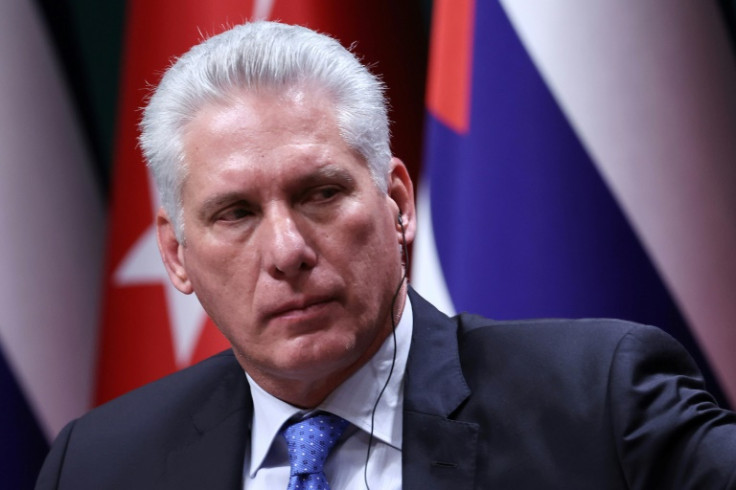
Cuban President Miguel Díaz-Canel said his government would resist any U.S. military action with a doctrine of mass civilian defense, while also insisting that dialogue with Washington remains possible despite months of escalating tension under President Donald Trump during an interview published on Tuesday by Newsweek.
Díaz-Canel said Cuba's strategy is based on a "war of all the people," which he described as a defensive doctrine involving broad public participation. "If military aggression occurs, we will fight back, we will battle, we will defend ourselves," he said. He also warned that any U.S. attack would cause "immense losses for both nations and peoples," with "incalculable" human and material costs.
Despite the remarks, Díaz-Canel also tried to leave the door open to negotiations, telling Newsweek that "dialogue is possible" and listing potential areas for cooperation, including migration, security, anti-drug trafficking efforts, science, trade, education and culture. But he said any talks would have to be conducted "on equal footing," with respect for Cuba's sovereignty and political system.
-
Cuban President Denounces Trump Admin In Meeting With Democratic Reps. In Havana: 'Criminal Damage'
-
Cuba Frees More than 2,000 Prisoners in Holy Week Following Vatican-Mediated Engagement

-
Sheinbaum Admin Reportedly Bought $12 Million in Cancer Drugs From Company Linked to Cuban Regime Despite Aid Claims


The Cuban leader framed the current crisis as the product of a long-running U.S. blockade that has worsened since Trump's first term, something he recently repeated in a separate interview with Spanish political analyst Pablo Iglesias. In that encounter Díaz-Canel said 2019 marked a turning point because Washington intensified restrictions under the Helms-Burton Act and later tightened financial and energy pressure.
He also told Iglesias that Cuba had gone "three months" without receiving fuel and described the current situation as the result of an accumulated economic and energy squeeze.
In both interviews, Díaz-Canel argued that the shortages affecting transportation, hospitals, schools, food supplies and electricity stem from the blockade rather than from a separation between state and society. "We are part of the same people," he told Iglesias, rejecting the idea that U.S. pressure harms only the government.
Díaz-Canel told Newsweek that he was not concerned about his personal safety, arguing that Cuba's leadership is collective and that "betrayal becomes extremely difficult" because of what he described as ideological cohesion and popular participation.
He rejected comparisons with other countries where governments have been destabilized from within, saying Cuba's institutions and its population's willingness to resist made that scenario unlikely.
Elsewhere in the interview, he defended the continued centrality of the Communist Party, saying it had kept the Cuban Revolution alive under "a permanent aggression" from the United States, while pointing to achievements in healthcare, education and biotechnology.
© 2025 Latin Times. All rights reserved. Do not reproduce without permission.

