
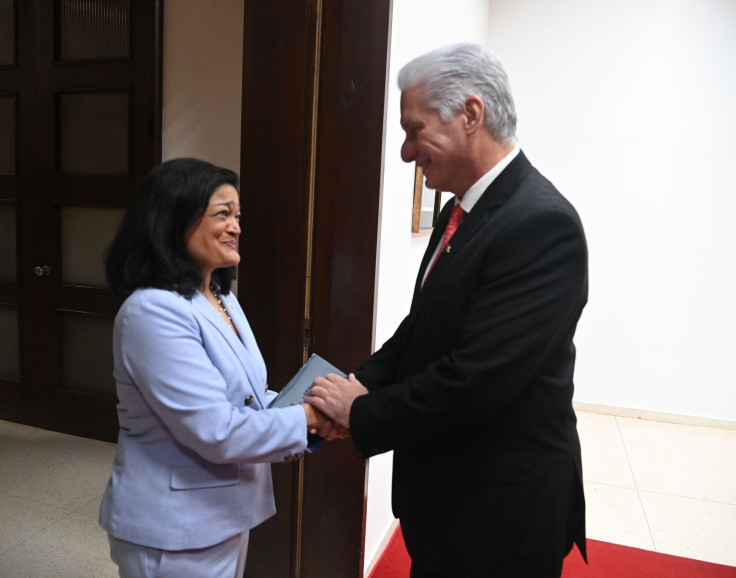
Cuban President Miguel Diaz-Canel posted pictures of a meeting with two Democratic lawmakers, saying he denounced before them the "criminal damage" caused by the U.S. blockade of the country.
In a social media publication, Diaz-Canel said he put emphasis on the "consequences of the energetic blockade determined by the current U.S. government and its threats or even more aggressive actions."

"I reiterated our government's willingness to uphold bilateral, serious and responsible dialogue, and to find solutions to existing differences," the publication concludes.
The Trump administration has rejected imposing a blockade, with Secretary of State Marco Rubio saying the government has not taken any "punitive actions" against the country and only prevented the country from receiving subsidized Venezuelan oil after the capture of former authoritarian President Nicolas Maduro.
The lawmakers who met with Diaz-Canel, Pramila Jayapal and Jonathan Jackson, released a statement of their own regarding their trip to Cuba, saying there is a blockade and it "must stop immediately."
I spent the last few days on a Congressional delegation to Cuba to see firsthand the devastation and suffering caused by the U.S. blockade of fuel.
— Rep. Pramila Jayapal (@RepJayapal) April 5, 2026
Read my full statement. pic.twitter.com/V0OwZb4AkL
"We heard from a wide variety of voices—families, religious leaders, entrepreneurs, civil society organizations, the Cuban government, Latin American and African ambassadors, humanitarian aid organizations, and Cubans across the political spectrum, including dissidents. Across all sectors, there is agreement that this illegal blockade must end immediately. We do not believe that the majority of Americans would want this kind of cruelty and inhumanity to continue in our name," reads a passage of the statement.
The lawmakers went on to claim that the regime has "sent many signals that this is a new moment for the country," including the release of 2,000 prisoners and steps to "liberalize its economy with significant reforms, including allowing Cuban Americans entrepreneurs to invest in private businesses in Cuba."
"The remaining obstacles to progress in Cuba now rest with the United States changing outdated, Cold War-era policy of coercive economic measures and military pressures against Cuba," Jayapal and Jackson said,
"True reform will only come from charting a new course. The United States and Cuba must immediately enter into real negotiations that provide for the dignity and freedom of the Cuban people and the tremendous benefits to the American people that will accrue from a real collaboration between our two countries," the document concludes.
They are not the only Democrats who have taken this stance. Last week, dozens of lawmakers sent a letter to President Donald Trump along the same lines, saying the blockade is "exacerbating a humanitarian crisis" and called for a "new approach."
Led by Rep. Gregory Meeks and Senator Tim Kaine, the letter was signed by 50 representatives and senators. It claimed that "for 64 years, the United States has relied on the flawed premise that maximum pressure would yield political change on the island," but that approach has not worked.


© 2025 Latin Times. All rights reserved. Do not reproduce without permission.


