
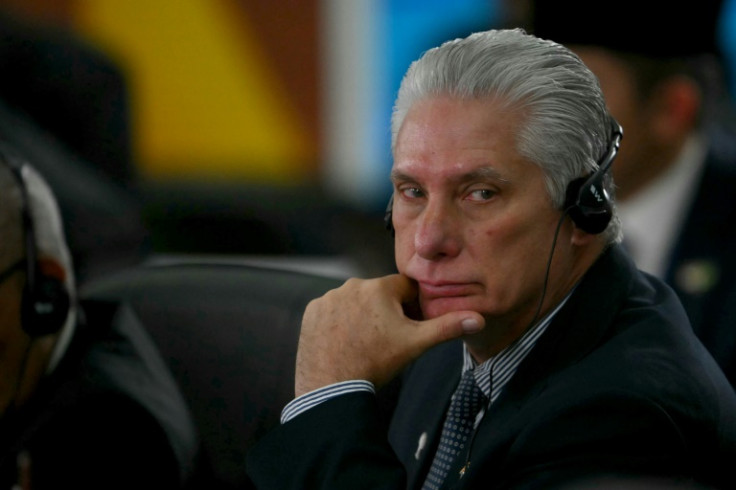
Cuban president Miguel Díaz-Canel said over the weekend that he has "no fear" of Donald Trump and is prepared to die defending his country, prompting a warning from a Republican Rep. Carlos Giménez who invoked the fate of Venezuela's NIcolas Maduro earlier this year.
"Maduro said the same thing. How did that turn out?" Giménez wrote on X, referencing the earlier U.S. intervention that led to the capture of Nicolás Maduro. Giménez also rejected Díaz-Canel's legitimacy, calling him "an unelected puppet dictator."
Maduro said the same thing. How did that turn out?
— Rep. Carlos A. Gimenez (@RepCarlos) April 12, 2026
And for the record, he’s not a president.
Diaz-Canel is an unelected puppet dictator universally despised by the Cuban people! https://t.co/SX6AMXlZut
Díaz-Canel's comments came during an interview on NBC's "Meet the Press," where he framed Cuba as ready to resist any U.S. action. "I have no fear. I am willing to give my life for the revolution," he said, adding that there would be "no justification" for a U.S. military strike, a "surgical operation," or "the kidnapping of a president."
The Cuban leader also warned that any such scenario would lead to "combat" and that Cubans would defend themselves, even if it meant death.
-
'Cuba After Castro': A Bold Documentary that Shows Díaz Canel's Positions Before the Current U.S. Crisis and Why Things Could Be Different - INTERVIEW

-
Human Rights Watchdog Confirms Political Prisoners Excluded From Cuba's 2,000-Inmate Pardon

-
Florida Rep. Díaz-Balart Says Cuban Regime 'Will Not Survive' Trump, Calls Its Removal 'Essential'


The interview marked his first appearance on U.S. television and came amid heightened tensions with Washington. In recent weeks, Trump has escalated rhetoric toward Cuba, saying he expected to have the "honor" of "taking Cuba in some form" and that he could do "anything I want" regarding the island. Díaz-Canel used the interview to reject suggestions he should step down, saying resignation is "not part of our vocabulary."
Despite the defiant tone, Díaz-Canel also called for dialogue, urging the United States to engage without preconditions and arguing that Washington lacks the "moral" authority to demand political change in Cuba. His remarks also highlighted the country's worsening energy crisis, which Cuban officials attribute in part to U.S. pressure on oil shipments following disruptions in supplies from Venezuela.
Giménez, a Cuban-born Republican who has been vocal on both Cuba and Venezuela, has consistently aligned himself with Trump's hardline approach. In March, he said he would support the president "taking" Cuba, calling it "a great honor" if it led to the island's "liberation."
© 2025 Latin Times. All rights reserved. Do not reproduce without permission.


