
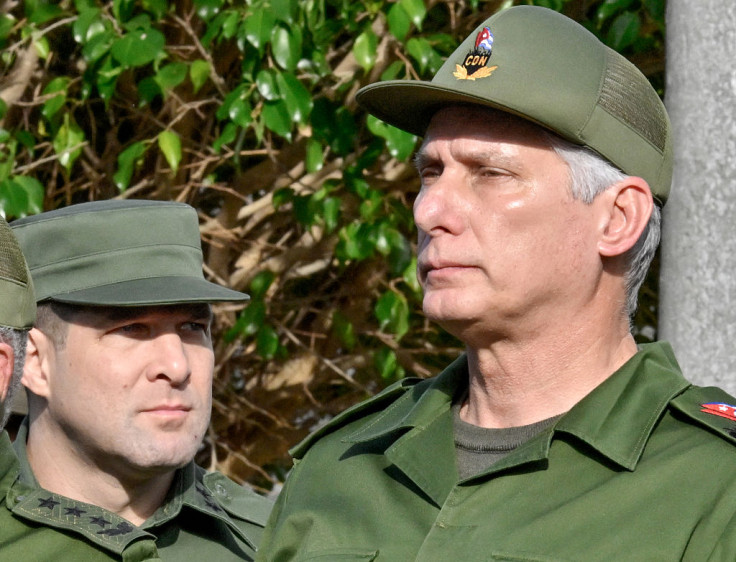
Cuban President Miguel Díaz-Canel warned Monday that threats of military action against Cuba by the United States could trigger "a bloodbath with incalculable consequences," as tensions between Havana and Washington escalated following reports that U.S. intelligence agencies believe Cuba has acquired hundreds of military drones from Russia and Iran.
"The threats of military aggression against Cuba from the world's greatest power are well-known," Díaz-Canel wrote on X. "The threat itself already constitutes an international crime."
Las amenazas de agresión militar contra #Cuba de la mayor potencia del planeta son conocidas.
— Miguel Díaz-Canel Bermúdez (@DiazCanelB) May 18, 2026
Ya la amenaza constituye un crimen internacional. De materializarse, provocará un baño de sangre de consecuencias incalculables, más el impacto destructivo para la paz y la estabilidad…
The statement comes after Axios reported that U.S. intelligence agencies believe Cuba has obtained more than 300 military drones since 2023 and that Cuban officials had discussed possible strikes against targets including the U.S. naval base at Guantánamo Bay, American military vessels and potentially Key West, Florida.
U.S. officials cited by the report said there was no indication of an imminent attack, but described the development as a growing concern given Cuba's ties with Russia and Iran.
Cuban Foreign Minister Bruno Rodríguez Parrilla rejected the allegations on Monday, accusing Washington of constructing a "fraudulent case" to justify additional sanctions or military action. "Cuba neither threatens nor desires war," Rodríguez wrote on social media, adding that the country was exercising its "right to legitimate self-defense recognized by the UN Charter."


Díaz-Canel also took the opportunity to deny that Cuba poses a threat to the United States. "Cuba poses no threat, nor does it have aggressive plans or intentions against any country," he wrote. "It has none against the U.S., nor has it ever had any."
The latest tensions come as Cuba faces one of its worst economic crises in decades, marked by severe fuel shortages and prolonged blackouts. Last week, Díaz-Canel said Havana would accept a $100 million humanitarian aid offer from the United States if it complied with "universally recognized practices for humanitarian assistance."
"Our priorities are more than evident: fuels, food, and medicines," Díaz-Canel wrote at the time, while arguing that the humanitarian crisis could be alleviated "in a much easier and more expeditious way by lifting or easing the blockade."
© 2025 Latin Times. All rights reserved. Do not reproduce without permission.


