
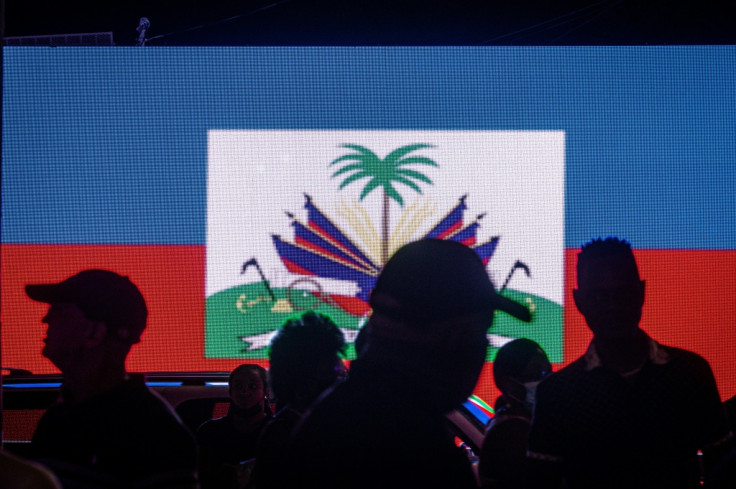
In a rare break with President Donald Trump on immigration, three Miami Republicans joined Democrats this week to help advance and pass legislation protecting Haitians from losing Temporary Protected Status, a move with immediate significance in South Florida, where one of the nation's largest Haitian communities has spent months warning of economic and humanitarian fallout if the program disappears.
The House voted 224-204 on Thursday to extend TPS protections for about 350,000 Haitians for three years, rebuking the administration as it continues trying to end the program through the courts.
The Miami-area Republicans at the center of the vote were Reps. María Elvira Salazar, Mario Díaz-Balart, and Carlos Giménez. Both lawmakers were among the 11 Republicans who crossed party lines to advance the Haiti measure, the Miami Herald reported.
Rep. Maria Salazar (R-FL)
Rep. Don Bacon (R-NE)
Rep. Brian Fitzpatrick (R-PA)
Rep. Carlos Gimenez (R-FL)
Rep. Nicole Malliotakis (R-NY)
Rep. Mario Diaz Balart (R-FL)
Rep. Mike Lawler (R-NY)
Rep. Mike Turner (R-OH)
Rep. Rich McCormick (R-GA)
Rep. Mike Carey (R-OH)
Rep. Kevin Kiley (I-CA)
Salazar had already telegraphed her position in late March, writing on X, "From Haiti to Venezuela, we have to get this right. TPS exists for a reason, to protect people who cannot safely return home." She added, "I represent thousands in my district who would face persecution or jail if we send them back too soon. We cannot strip protections before conditions truly change."
From Haiti to Venezuela, we have to get this right.
— Rep. María Elvira Salazar (@RepMariaSalazar) March 30, 2026
TPS exists for a reason, to protect people who cannot safely return home.
I represent thousands in my district who would face persecution or jail if we send them back too soon. We cannot strip protections before conditions…
The local impact is hard to overstate. WLRN reported in January that South Florida is home to an estimated 130,000 Haitian-born residents and nearly 300,000 people with Haitian roots, with Miami-Dade County at the heart of that diaspora. The same outlet reported that more than 100,000 Haitians with TPS live in South Florida, making the region one of the places most exposed to any rollback of protections.
That is why the vote resonated so strongly in Miami neighborhoods like Little Haiti and North Miami, where community leaders and elected officials have been publicly urging Washington to stop treating Haiti's crisis as if it were over.
-
Cuban Americans Split With Trump on Cuba Negotiations, Overwhelmingly Support Intervention, Poll Finds

-
Lawsuit Alleges Trump Administration Disproportionately Fired Black Officials From Federal Agencies

-
New DHS Chief Doubles Down on Mass Deportations, Says 'We Only Want the Right Kind of Immigrants'




Miami-Dade Mayor Daniella Levine Cava, who joined Haitian leaders after a federal court ruling paused the program's termination in February, said, "Miami-Dade is home to the largest population of Haitians in the country. From hospitals and schools to neighborhoods and small businesses, Haitian TPS holders are essential to the economy and culture of Miami-Dade County." She added, "My heart goes out to all those who have been living with fear and uncertainty and waiting anxiously for this moment."
Miami Mayor Eileen Higgins has been even more pointed.
In a February statement defending Haitian families, she said, "Miami is a city of immigrants, built by immigrants, and our Haitian community is part of the backbone of our city." She warned that "continuing to push legal uncertainty instead of providing stability is wrong, and it puts families, workers, and critical systems like healthcare at risk." In another city statement, Higgins said a renewed legal push against TPS was "cruel" and created "unnecessary fear and instability for hundreds of thousands of people who are living and working legally, raising families, and contributing to our communities."
Religious and civic leaders in Miami have made a similar case. Archbishop Thomas Wenski, one of the most prominent advocates for Haitian migrants in South Florida, warned in January, "We should not force Haitians back into a crisis, back in Haiti, nor should we create another crisis here, because we are forcing them out of their jobs." A month later, he sharpened the point further, saying mass removals would amount to "sending people into a burning building."
The fear has been palpable in Miami's Haitian community for months. During a February vigil in Little Haiti, community member Langlichmie Normile told the Miami Herald, "What is going on in Haiti is real. Haitians are really fearing for their life." At FANM, a longtime advocacy organization in Little Haiti, lead organizer Paul Christian Namphy told WLRN that the dominant emotion in the community was fear as families braced for the possibility of deportation and separation.
The broader economic case has also shaped the debate. ABIC reported in January that more than 113,000 Haitians with TPS are in the workforce in Florida, contributing $1.3 billion in state and local taxes, while many work in health care, child care, construction, and elder services. Those numbers help explain why the issue has drawn support even from some Republicans in South Florida, where the Haitian community is not a distant political talking point but a visible part of the labor force, electorate, and civic fabric.
The bill's future remains uncertain in the Senate, and the Supreme Court is still preparing to weigh the administration's broader effort to end protections. But in Miami, the House vote was seen as something more immediate: proof that local pressure from Haitian families, mayors, clergy and advocates could still force a crack in party orthodoxy. For now, that crack is offering something the community has been demanding for months, a little more time, and a little less fear.
© 2025 Latin Times. All rights reserved. Do not reproduce without permission.


