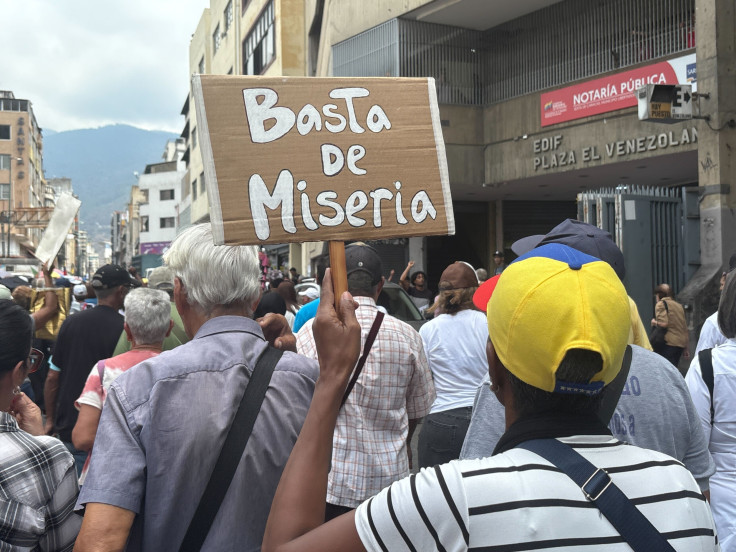
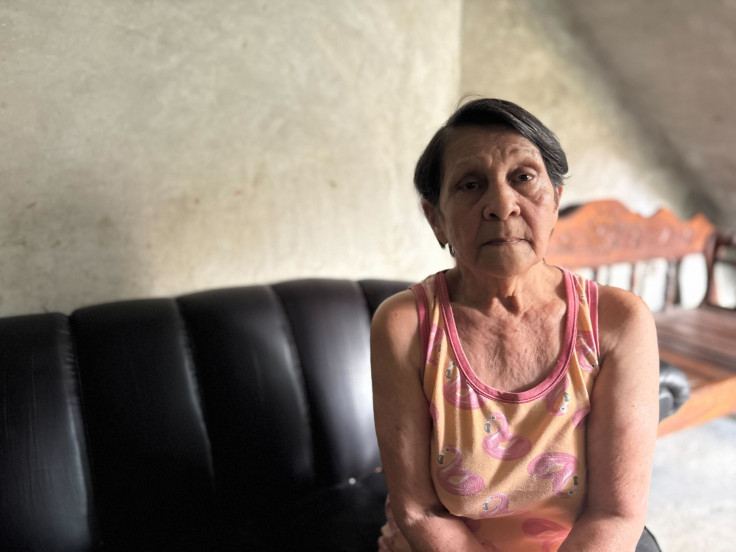
CARACAS—In southwest Caracas, 68-year-old pensioner Carmen Brito sits in her living room furnished with little more than an old sofa, a battered fridge, and plastic containers to store the water that's delivered to her neighborhood just once a week. Like many pensioners in Venezuela, she says she's struggling to get by.
The state pension is currently just 130 bolívares, around $0.30 a month, which is not even enough to buy herself a loaf of bread. The government is set to increase wages and pensions on May 1 but has not yet disclosed the amount. Many are skeptical it will be a meaningful change.
Across the country, many older people are forced to sell personal belongings, rely on family, skip meals, stretch food and medication, or simply go without.
"Sometimes I'm only left with a little pasta or rice, but I try to stretch it so that it lasts me three more days," Brito told Latin Times in March. "I used it to buy toilet paper. Now I can't afford it anymore."
To supplement low pensions, the government also provides 'bonuses,' such as the 'economic war bonus,' which was recently increased to around US$58 a month for most pensioners. Yet this still falls far short of basic living costs.
According to the Venezuelan NGO Convite AC, older adults require between $450 and $500 a month to cover food alone.
"Even with the recent increase in bonuses, it doesn't cover the minimum needed to live above the poverty line," said Luis Francisco Cabezas, director at Convite AC, which supports older people in Venezuela.
The crisis is rooted in Venezuela's broader economic collapse, which hasn't stopped even after three months of U.S. direct influence after the capture of Nicolás Maduro and the ascent of Chavista Delcy Rodríguez as Interim President, with Donald Trump's support. Years of falling oil production, mismanagement, corruption, and sanctions have sharply reduced state revenues, weakening the government's ability to fund pensions and social programs.
-
Machado's Comeback to Venezuela 'Not Dependent on Washington,' Opposition Says Amid Transition Push

-
A Hugo Chávez Loyalist Co-Producer on Melania Trump's Documentary: Who is Max Sánchez Arbeláiz

-
Venezuelan Protesters Clash With Police as Repression Persists Under US-Backed Leadership: 'They Showed Their True Face'



Hyperinflation has eased compared to the peak of the economic crisis, but annualized inflation remains high—at around 600%—continuing to erode incomes and savings. The IMF has warned the situation remains "quite fragile."
While there are hopes that new cooperation between Venezuela and the US in sectors like oil and mining could help revive the economy, any benefits are likely to take time to reach ordinary households.
The gap between income and basic needs is forcing difficult choices, particularly around health. Convite estimates that 82% of older adults require daily medication, yet 62% report serious difficulties obtaining it due to cost.
"They often have to choose between food and medicine," Cabezas said. "And faced with that choice, medicine is often sacrificed."
Some abandon treatment for chronic conditions such as hypertension or diabetes, turning to uncertified remedies.
José Lobo, 78, knows that dilemma well. After bladder surgery, he now requires medication costing around $40 a month, an expense he cannot afford without continuing to work. He works in Mérida as a tour guide, but the work is unstable.
"I used to have a good car and go on holiday yearly to the beach with my wife and children. We stayed in a rented house. It used to be wonderful," he told Latin Times. "Now, life is just hard."
Like Lobo, a growing number of older Venezuelans have returned to work, often in the informal economy.
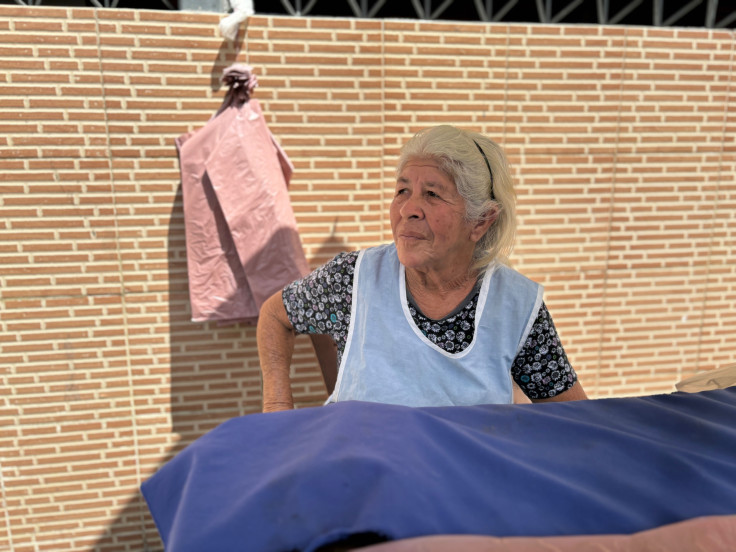
One of them is Catalina Pacheco, who sells herbs outside a market in Caracas. At 73, she says she would prefer not to work, but Venezuela's economic crisis has taken that choice away. "Aside from needing more food, I also need money to fix my house. The roof has a leak in it and the house gets wet when it rains," she said.
Many older Venezuelans rely on government food packages (CLAP), but supplies are often inconsistent, poor quality, and insufficient.
Those in later years often have to support themselves and look after grandchildren or other young family members. Brito cared for her grandson while his father, her son, was working in Colombia. Although he is now back, she continues to look after him while he works long days.
She gets by mainly through help from her daughter in the US. "She sends me money sometimes $100, but other times she can't. She has to pay rent, for food,everything she and my granddaughter need."
Many older people rely on remittances from abroad, with remittance flows from the US making up 7.5% of Venezuela's GDP (US$6 billion) in 2025. But Brito says she is lucky. She knows others have no one to call on or send money.


"They are left without emotional support, with declining income, in a country that does not offer adequate conditions for older people," Cabezas said. This isolation has taken a toll on mental health.
Many older Venezuelans are frustrated after decades of work, with little to show in retirement. Leida Brito, 68, a former cardiopulmonary electromedicine technician said: "Who's going to give me a job at my age? I'm not asking for anything for free. I'm asking for what I worked towards for thirty-four years to receive a pension, with dignity."
© 2025 Latin Times. All rights reserved. Do not reproduce without permission.


