
Some of Latin America's most Trump-friendly governments are still being treated by investors as risky bets, according to J.P. Morgan country-risk data, a reminder that access to Washington does not automatically translate into confidence on Wall Street.
The April 2026 ranking, reported by Bloomberg Línea from J.P. Morgan's EMBI data, placed Venezuela as the region's highest-risk market with 5,557 basis points, followed by Argentina at 556, Ecuador at 411, Bolivia at 408, and El Salvador at 318. The lowest-risk countries were Uruguay at 62, Chile at 83, Paraguay at 108, Panama at 113, and Guatemala at 118. The spread measures how much extra yield investors demand to hold a country's bonds over U.S. Treasuries, meaning higher numbers signal greater perceived risk.
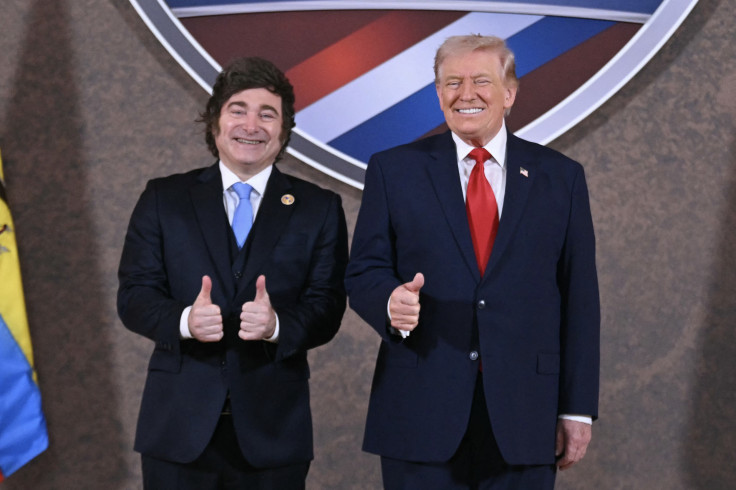
The political irony is hard to miss. Argentina's Javier Milei, Ecuador's Daniel Noboa, and El Salvador's Nayib Bukele have all moved closer to President Donald Trump or his regional agenda, especially on trade, migration, security, and anti-crime policy. But investors are pricing something colder than ideology: debt, inflation, violence, fiscal credibility, and institutional stability.
Argentina is the clearest case. Milei has become one of Trump's closest ideological allies in the hemisphere, and Washington has rewarded that alignment. The U.S. and Argentina signed a reciprocal trade and investment agreement in February, with Reuters reporting that U.S. exports would receive preferential tariff treatment in Argentina and that Buenos Aires would accept U.S. regulatory and safety standards in several areas.
-
Venezuela Admits Man Died in Custody in 2025 Despite Telling his Mother He Was Alive for Almost a Year

-
Cuban Political Prisoners Say Officials Threatened to 'Eliminate' Them if U.S. Attacks: Report

-
María Corina Machado Was Never Considered to Lead Venezuela After Maduro's Capture: She Looks at The U.S. for Her Return Home



But Argentina's 556-basis-point risk score shows that markets are still not fully convinced. The country has a long history of defaults, currency crises, and inflation shocks. The IMF projects that Argentina's consumer prices will rise by 30.4% in 2026, even as GDP grows by 3.5%. Reuters also reported that analysts raised their 2026 inflation forecast to 30.5% and cut projected growth to 2.8%, showing that Milei's reforms have not erased doubts about purchasing power, borrowing costs, or political sustainability.
Fitch recently upgraded Argentina to B- and cited progress under Milei, but even that improvement came with warnings. The agency noted that foreign-currency debt service remains sizable and will rise further in 2027, an election year. In practical terms, Argentina may be friendlier to Trump and more open to markets, but investors still see a country that must prove it can stabilize prices, rebuild reserves, and refinance debt without another crisis.
Ecuador is another example of the gap between U.S. alignment and market risk. Noboa has embraced a hard-line security strategy and deepened cooperation with Washington. In March that U.S. and Ecuadorian forces launched joint operations against drug trafficking, while another Reuters report said Noboa planned to attend the Trump administration's "Shield of the Americas" summit, focused on regional security and organized crime.
That relationship may help Ecuador with security assistance, intelligence and diplomatic support. It does not solve the underlying risk. Ecuador ranks third in the region at 411 basis points because investors are watching cartel violence, fiscal pressure, energy instability and political fragility. The IMF said Ecuador regained access to international capital markets in early 2026 and remains under a $5 billion Extended Fund Facility, a positive sign, but also evidence that the country still depends heavily on external support. Allianz Trade said Ecuador's economy is rebounding after a sharp contraction in 2024 caused by severe power outages, lower oil output and insecurity, but growth is expected to hover just above 2% in 2026 and 2027.
El Salvador also shows why political closeness is not the same as low risk. Bukele has become a key Trump partner on migration and security. Bukele visited the White House in 2025 amid scrutiny over deportations from the U.S. to El Salvador and that he said he had no plans to return a man mistakenly deported from the United States.
For bond investors, the concern is not only Bukele's relationship with Trump. It is El Salvador's debt burden, governance risks, and past bitcoin strategy. The IMF pushed El Salvador to improve public finances, boost bank reserve buffers, strengthen governance and transparency, and mitigate risks tied to bitcoin. El Salvador later changed its bitcoin law to make acceptance of the cryptocurrency voluntary as part of compliance with an IMF deal, Reuters reported. That helps explain why El Salvador still ranks fifth in regional risk at 318 basis points, even with stronger ties to Washington.

Venezuela remains in a category of its own. Its 5,557-basis-point score is far above the rest of Latin America. Even after a huge drop in risk this year, Bloomberg Línea reported that it remained the region's highest-risk country. Reuters has described Venezuela's debt crisis as one of the world's largest unresolved sovereign defaults, while noting that sanctions, creditor disputes and political uncertainty continue to complicate any restructuring.
© 2025 Latin Times. All rights reserved. Do not reproduce without permission.


