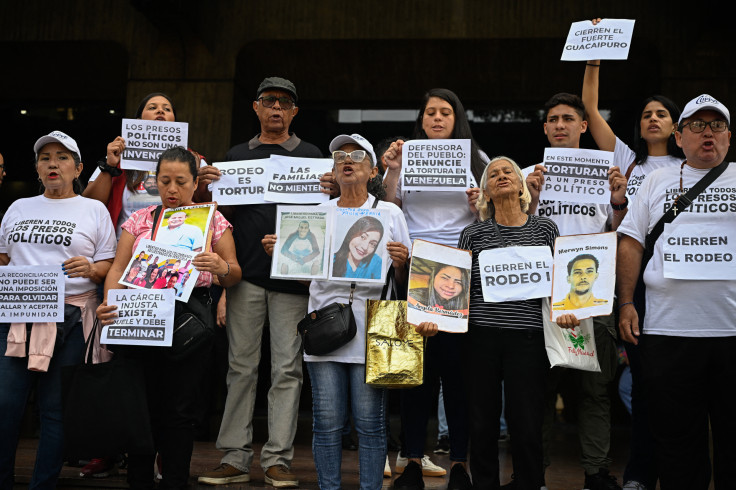
Caracas, Venezuela -- One of the biggest concerns for Venezuela's opposition following the capture of Nicolás Maduro by US special forces in January was the fate of thousands of political prisoners who had been detained since Maduro and his predecessor, Hugo Chávez, took power.
In February, interim President Delcy Rodríguez announced a so-called amnesty law designed to free political prisoners who were detained as far back as 1999.
Despite cautious optimism from family members of the imprisoned, mass releases did not materialize and on April 24, Rodríguez announced the amnesty law would be shuttered, causing what one prisoners' rights group calls "revictimization" of the prisoners and their families.
"This amnesty law is coming to an end. For those cases that were not covered, or rather, were expressly excluded, there are other avenues through which they can be addressed," Rodríguez said during an event last week at the presidential palace.
According to the government, those not covered by the amnesty law can still seek release via the Program for Democratic Coexistence and Peace and the newly established National Commission for Criminal Justice Reform.
Gonzalo Himiob, a lawyer and Vice President of Foro Penal, an NGO that monitors political prisoners in Venezuela, told the Latin Times that Rodríguez's decision to end the law was arbitrary.
-
Trump Floats Venezuela As 51st State, Delcy Rodríguez Fires Back

-
Trump's Friendship Isn't Enough For Investors: His Closest Allies Run Some Of Latin America's Riskiest Countries

-
María Corina Machado Was Never Considered to Lead Venezuela After Maduro's Capture: She Looks at The U.S. for Her Return Home



"The executive branch -- much less an interim presidency -- has no authority to repeal laws, to render laws invalid. Article 218 of the Constitution is quite clear: laws can only be repealed by other laws or by a repeal referendum. There is no other way to repeal laws," he said.
Rodríguez's first 90-day term as interim president expired on April 7 and opposition members argue her current validity as president is questionable.
While the government claims that over 8,000 people have benefited from the amnesty law in its short timeframe -- including over 314 prisoners and 8,037 under government restrictions such as house arrest -- Himiob says the actual number of people who have received full amnesty is far less. Foro Penal has recorded 186 people who have received full amnesty under the law, with the overwhelming majority still facing some sort of legal process in the country. As of April 27, 454 political prisoners remained detained in Venezuela, according to Foro Penal data.
Over the years, the United Nations and rights groups have denounced the poor conditions for prisoners inside Venezuela, citing forced detentions, holding prisoners incomunicado from lawyers and family members, and even torture.
Himiob noted that Rodríguez's "de facto" halt of the amnesty law won't just impact prisoners, but also victims of political persecution, people facing ongoing investigations, and Venezuelans living in exile.
"Unfortunately a great many people from a population that is also very difficult to pinpoint will be left out of consideration for amnesty," he said.
Distress Among the Families of Political Prisoners
Himiob said the whole ordeal surrounding the amnesty law has revictimized prisoners and their families.
"The situation for the families of political prisoners is one of great distress," he said. He argued that the law wasn't broad enough and, in the end, served as a "mechanism for revictimization, causing people to literally suffer immense worry and distress as they tried to determine whether or not someone was a potential beneficiary of the law."
-
Cuban Political Prisoners Say Officials Threatened to 'Eliminate' Them if U.S. Attacks: Report

-
Chavista Hardliners Accuse Rodríguez of 'Treason' as Venezuela Reopens to U.S. Oil Interests: 'Imperialism Is the Enemy'

-
Rick Scott Calls for Sanctions Against Delcy Rodríguez After Amnesty Ruling For Prisoners is Annuled in Venezuela


He also lamented that despite everything, the government's "repressive system remains intact" and real changes to Venezuela's brutal policy toward political prisoners haven't come about.
Venezuelans should reject the unconstitutionality of Rodríguez's order to stop the amnesty law, argues the Foro Penal representative.
He reminds families of the imprisoned that there are other legal pathways that could lead to their relatives' freedom.
"There are many other legal avenues that can be pursued to free people from the prisons where they are unjustly detained. There are many other possibilities that can be explored if—and only if—there is a genuine political will for this to happen," he said.
"As long as that political will does not exist, neither imprisonment nor persecution for political reasons can be eliminated," he concluded.
Julio Blanca, Latin America Reports
Julio Blanca is a contributing reporter to Latin America Reports. Based in Venezuela, Julio has 10 years of experience in journalism and is also a reporter for El Nacional, one of the country's largest newspapers. His work has been featured in Al Jazeera and others.
© 2025 Latin Times. All rights reserved. Do not reproduce without permission.


